


Introduction
Building on our earlier audit of the Pfizer trial,1 we went back through the records of Moderna’s pivotal phase 3 trial, known as P301. These are the records the FDA relied on to authorize and then license the vaccine. A court order obtained by Public Health and Medical Professionals for Transparency (PHMPT) made them public. We downloaded the released datasets and documents and rebuilt the trial from the ground up.
Our question was simple. Can each published result be traced back to what actually happened to the participants? In most places it can. In some places it cannot. And in a few places the records show decisions that need explaining.
This summary is written for readers who will not go through the full report. The next two sections explain how the trial worked and define the terms we use. The findings come after, ordered by what they could affect: first the safety records, then decisions and records that cannot yet be verified, then the checks on efficacy and infection. We reproduced the primary symptomatic COVID-19 case counts in both submissions. At emergency authorization there were 11 vaccine and 185 placebo cases. At the end of blinded follow-up there were 55 and 744, respectively. For safety, all 56 arm-specific participant counts in the two original licensing tables we checked for unsolicited adverse events matched the clinical study report (¶¶77, 90). Several individual safety records and decisions about illness testing still require explanation.
In Short
a) Serious adverse events. For one placebo recipient (US3172069), the emergency-authorization form records a prostate-cancer biopsy result in September 2020. The licensing records place the cancer onset a year earlier, yet the disposition listing still gives “SAE #1” as the reason dosing stopped. For another placebo recipient (US3172205), the emergency record describes a hospital admission for recurrent diverticulitis in October 2020. We found no licensing adverse-event entry for that admission. These were among 23 serious-event records without a direct match under our matching rules. Some differences can be traced to duplicate reporting or to surgery being recorded under its underlying diagnosis. Three participants had no adverse-event row in either licensing table. Adding back a qualifying serious event for each of those three would increase the participant count by at most one in the vaccine arm and two in placebo (¶¶83–85). Separately, an earlier medication record documents intravenous heparin during surgery in a placebo recipient whose bleeding remained recorded as serious. The later medication tables omit that entry (¶119).
b) Deaths. We reproduced the 16 deaths in each arm during blinded follow-up. One site learned in April 2021 that a vaccine recipient had died the previous December. Staff entered a precise date after documenting that the exact day was unknown. For another vaccine recipient, a data-management query led staff to change the outcome of a serious event from “Fatal” to “Not recovered/Not resolved.” They restored “Fatal” ten days later. Death remained recorded as the reason the event qualified as serious throughout (¶¶97–98).
c) An exclusion from the safety analysis. One trial ID had two recorded vaccine doses. Moderna and its research contractor agreed to exclude it from all analysis sets after an incomplete safety diary and a missed or out-of-window visit. Every other record for either deviation code was marked for inclusion. We found no record linking this ID to a second enrollment. The question is why these deviations warranted exclusion here.
d) Analysis timing. The first look at efficacy was planned at 53 cases and happened at 95. The records that would show when the cases were ready to count have not been released. This bears on the first look and its announcement, not on the final efficacy result.
e) Participant numbering. 145 numbers in the sites’ sequences cannot be found in either roster, including an unbroken block of 34 at one site. The released randomization schedule shows no matching gap: every randomized participant’s recorded assignment matches the released schedule. In the complete numbered BLA roster, no occupied randomization block has an unaccounted-for earlier slot. What the missing screening numbers were used for, if anything, is still unexplained.
f) Antibody tests. After PCR-confirmed illness, a smaller proportion of vaccine recipients developed detectable antibodies to the virus’s nucleocapsid (anti-N). This makes infections harder to count equally in the two groups. A symptomatic efficacy case required a positive PCR. In the final blinded analysis, a positive anti-N result at a scheduled visit could also end the time a participant was counted as at risk. We have not quantified the effect of that rule on the efficacy estimate (¶65).
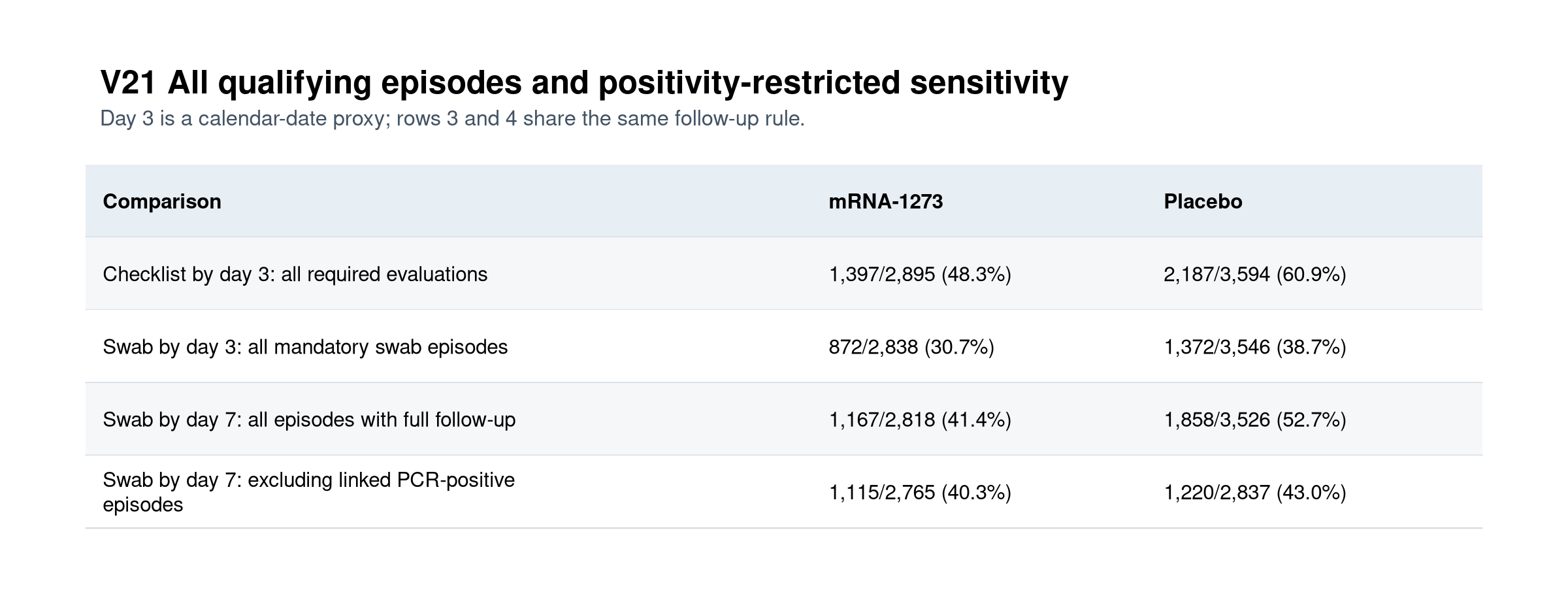
g) Testing of sick participants. Among recorded illnesses that called for a swab and had seven days of follow-up, a swab was documented for 41.4% in the vaccine arm and 52.7% in placebo. After excluding episodes with a linked positive PCR, coverage was 40.3% and 43.0%, respectively. This exclusion removed 53 vaccine episodes and 689 placebo episodes because of their test results. The records cannot tell us how often comparable illnesses would have been tested in each arm. Site records do document individual missed illness visits in both arms. Their frequency and their effect on case detection remain unknown (¶¶46–49).
h) Late safety reports. A late safety notification was recorded for 28 vaccine recipients and 219 placebo recipients. Among participants with a confirmed symptomatic COVID event, 19 of 92 vaccine recipients (20.7%) and 191 of 954 placebo recipients (20.0%) had a late-notification deviation within 28 days of illness onset. The records do not identify which event triggered each notice (¶¶19–22).
What we are asking for is specific: the underlying records, logs and change histories that would let anyone check these points independently.
How the trial worked
Who took part. Between 27 July and 23 October 2020, 30,415 adults were randomized at 99 sites in 31 US states. A computer randomly assigned each person to the vaccine (15,209 people) or a saltwater placebo (15,206). Each person was to receive two injections, 28 days apart.
Blinding. Neither participants nor the staff assessing them were supposed to know who received what. This matters because knowing can change behaviour. A participant who believes they are protected may not report a cough. A nurse who believes the same may not order a test. From mid-December 2020, participants were gradually told their assignment, and placebo recipients were offered the vaccine. The period before that is called blinded follow-up. Only this period gives a clean vaccine-versus-placebo comparison.
How a COVID case was found. Participants were asked to contact their site if they developed any of the listed symptoms: fever, chills, cough, breathlessness, fatigue, aches, headache, loss of taste or smell, sore throat, congestion, nausea or diarrhoea. For a qualifying report, the site was to document the illness and arrange a visit within 72 hours or as soon as possible. A nasopharyngeal swab could be collected at the clinic or during a home visit. If neither visit was feasible, the protocol allowed a home-collected sample, including saliva (¶26). Under the initial protocol, any listed symptom warranted investigation; fever meant at least 38°C. From the 31 July amendment, fever at that threshold, chills, cough and breathlessness qualified regardless of duration; other listed symptoms generally had to persist for 48 hours. During the first post-dose week, staff could use judgment about swabbing for symptoms compatible with an expected systemic reaction, but respiratory symptoms still called for evaluation.
What counted as a case. The primary efficacy analysis counted the first qualifying illness from 14 days after dose 2 in an eligible, baseline-negative participant who received both doses on schedule. The illness had to meet the protocol’s symptom criteria and have a positive PCR from a qualifying specimen. A nasal or nasopharyngeal swab, saliva, or another respiratory specimen in a hospitalized participant could qualify. The adjudication committee reviewed potential cases.
Two places to record a complaint. A symptom could be written on the COVID checklist, or recorded as an adverse event: the general record of any medical problem, whatever its cause. The same headache could end up in either place, or both. The protocol required an investigation for qualifying symptoms however they were recorded, and the checklist is where that investigation was documented. An AE entry alone does not tell us whether staff investigated the complaint; we therefore checked the PCR records separately.
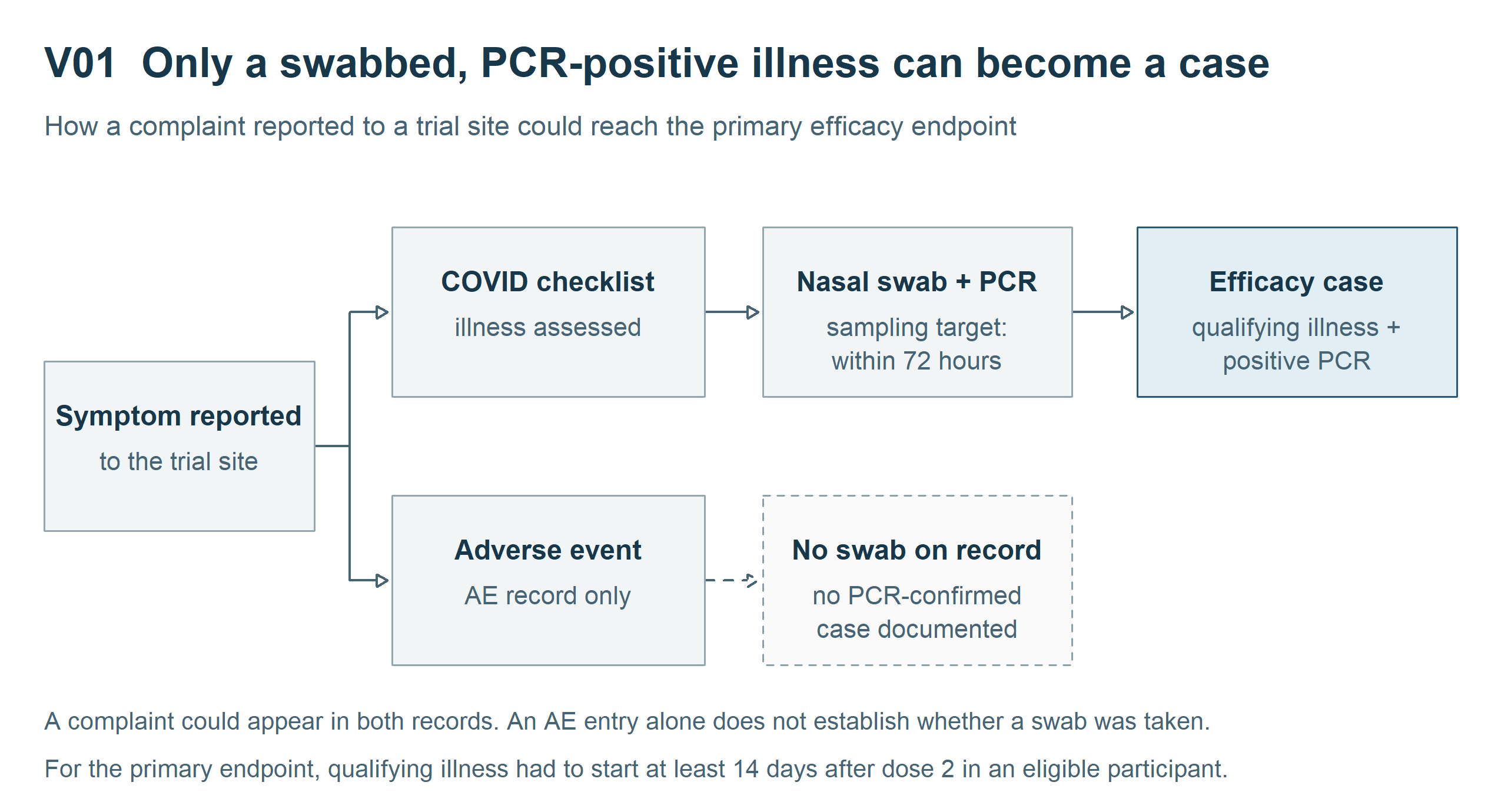
A complaint could be recorded on a COVID checklist, as an adverse event, or in both places. We checked the specimen and PCR records to see whether the illness was tested. A qualifying positive result was required for the illness to count as a primary case. During blinded follow-up, a diagnostic PCR was linked within seven days for 0.5% of vaccine recipients and 1.1% of placebo recipients whose qualifying symptoms appeared only in adverse-event records, compared with 96.2% and 96.9%, respectively, among those with symptoms on a COVID checklist (¶¶35–39).
Safety reporting. Serious adverse events, including deaths, had to be reported to Moderna within 24 hours of the site learning about them. Until a protocol change in March 2021, every confirmed COVID illness also had to be reported within 24 hours.
Antibody checks. Blood was drawn on days 1, 29 and 57, among other visits. It was tested for antibodies to the virus’s nucleocapsid (”anti-N”). The vaccine does not produce these antibodies, so their presence points to infection, including infections PCR never caught.
Two data submissions. Moderna first submitted data for an emergency use authorization (EUA). It covered efficacy through 21 November 2020 and safety through 25 November, and authorization came on 18 December 2020. The later biologics license application (BLA) extended blinded follow-up to 26 March 2021, and the vaccine was licensed on 31 January 2022. For adverse events, we compared the emergency-authorization records with the original licensing table, known as S3, and traced the records into the December 2021 licensing amendment, known as S27.
Participant numbers. Each person who came in for screening received a site number plus a sequence number. At 98 of the 99 sites, the sequence starts at 2001 and runs upward: US3952070 is person 2070 at site US395. People screened but not enrolled keep their number, so the sequence should have no unexplained holes. We checked apparent gaps against the released rosters.
Key terms
These are the only technical terms the summary relies on. The full report defines the rest.
Arm - One of the two randomized groups: vaccine (mRNA-1273) or placebo. The blinded efficacy analysis groups participants by their randomized assignment. The blinded safety analysis groups them by the treatment they received (V04).
Blinded follow-up - The period before a participant was told their assignment. The fair comparison between arms is made here.
COVID checklist (COVID form) - The trial’s dedicated form for recording COVID-type symptoms during an illness assessment.
Symptom-group-week - One participant counts once for each symptom group recorded in a Monday-to-Sunday week. Repeated entries for cough count once; cough and fever count as two. Loss of smell and loss of taste belong to one group.
Adverse event (AE) - Any medical problem recorded during the trial, whatever its cause, from a headache to a hospital stay.
Serious adverse event (SAE) - An adverse event that causes death, is life-threatening, leads to hospitalization or disability, or meets similar criteria. “Serious” is about consequences, not how bad the symptoms felt.
PCR - A laboratory test used here to detect the virus’s genetic material in a specimen, such as a nasal swab or saliva. A positive PCR was required for an illness to count as a case.
Anti-N antibodies - Antibodies to the virus’s nucleocapsid. Infection produces them; the vaccine does not. A positive result therefore suggests infection.
Efficacy case - Qualifying symptoms plus a positive PCR, starting at least 14 days after dose 2, in a participant who followed the protocol and had no sign of earlier infection.
Interim analysis - A planned early look at efficacy, set to happen once a given number of cases had accumulated.
EUA and BLA - The emergency use authorization submission (data through November 2020) and the later biologics license application (blinded data through 26 March 2021).
Analysis population - The list of participants included in a given analysis, such as “safety” or “per-protocol”. Each participant carries yes/no flags for each one.
Protocol deviation - A recorded departure from the trial’s rules, such as a missed visit, a missing sample or a late report.
Per opportunity - A proportion calculated among people eligible for the procedure being assessed. For example, we counted how many participants missed a follow-up visit among those with a qualifying positive PCR and observation through day 28 (¶¶17–18).
Summary of findings
The findings fall into three groups: safety records requiring reconciliation; decisions and records that the released data do not yet explain; and checks on infection ascertainment and efficacy. Several apparent discrepancies have identifiable explanations. The S3 adverse-event analysis reproduces the two overall CSR safety summaries checked, and every randomized participant matches the released randomization schedule. Other questions remain at the event level. The testing comparisons must also be read at their actual scope: near-equality in a selected or matched subset does not establish equal ascertainment throughout the trial.
A. Safety records
A1. The licensing tables do not directly match 23 serious-event records. The case forms explain some, but not all, of the differences.
We traced the adverse-event records through three releases: the emergency-authorization submission, the original licensing submission (S3), and its amendment (S27).
The 23 EUA records belonged to 21 people: 11 records in nine vaccine recipients and 12 in 12 placebo recipients. All 23 original forms marked the event serious. Nineteen had a possible counterpart in the original licensing table, and those candidates carried forward into the December amendment. One case is now particularly clear: two EUA forms describe serious pericarditis over the same dates, a monitor flagged the overlap, and the licensing tables retain the diagnosis as serious.
Four records had no candidate under the matching rules. For one, the EUA queries instructed the site to record the thyroidectomy as a procedure and its underlying condition as the adverse event; the licensing records describe the operation and classify the thyroid cancer as serious. For the other three, neither licensing AE table contains an event, although all three participants remain in the licensing demographics. Their records point to different explanations: elective prostate surgery remains in the procedure table; prostate cancer remains in medical history but with an earlier onset; and a history of diverticulitis does not account for a separately documented hospital admission for a recurrence (¶84). Even if all three were added back, the number of people with a serious event would rise by at most one in the vaccine group and two in the placebo group.
Among candidate EUA-to-S3 event links, 16 pairs differ from serious to non-serious and 15 in the reverse direction. All 31 licensing-side rows are present in S3 ADAE and selected for the Part A unsolicited-event analysis under their licensing classifications: the 15 serious rows also qualify for the serious-event summary, while the 16 non-serious rows do not qualify as serious events. S27 retains those S3 classifications. Twelve of the original cross-release pairings still require source confirmation, so tracing the licensing rows into the summary does not establish that every pairing or reclassification was correct.
Some numbered medication entries did not carry forward between submissions. One was intravenous heparin given during heart-valve surgery to a placebo recipient whose bleeding remained a serious event in every table (¶115–120).
The automated comparison found no positive-to-negative change among the PCR pairs it accepted. Unresolved local-test entries and specimen linkages remain outside that conclusion and are examined separately in ¶87.
A2. Deaths: the totals match, but several records were mishandled.
The full licensing dataset contains 44 deaths. During blinded follow-up there were 16 in each arm, exactly as published. None of the problems below changes those counts. What is in question is how individual deaths were recorded along the way, and what was known when. The case report forms show both.
A date the site said it did not know (US3872496, vaccine). After failing to reach this participant, the site contacted his emergency contact on 9 April 2021. It learned that he had died in early December 2020, about four months earlier. That same day, the death date was entered as an unknown day in December, then 10 December, then 17 December. Between the last two entries, the site wrote that the exact date was unknown. The final dataset uses 17 December. Why does it matter? A precise date feeds into follow-up calculations, and the records do not show whether it was evidenced or simply assumed.
A fatal outcome temporarily recoded (US3912024, vaccine). This participant died on 22 November 2020. Staff recorded the multisystem-organ-failure event as “Fatal” on 25 November. After a data-management query on 21 December, they changed the outcome to “Not recovered/Not resolved” and cleared the end date. A safety reviewer queried the change on 28 December. Staff restored “Fatal” and the end date on 31 December. The separate seriousness field continued to record death throughout. The query history raises two questions. What medical information supported each instruction, and which data extracts were produced during those ten days?
A corrected date that never reached every form (US3812060, placebo). A death certificate received in March 2021 gave 24 November 2020 as the date of death. The licensing dataset uses that date, but the end-of-study form in the June 2021 export still says 30 November.
A death entered with the wrong year (US3832237, placebo). The site learned of this death on 30 November 2020 and recorded it as an adverse event the next day. The end-of-study form was not completed until 3 February 2021, and its death date read 19 November 2019. The year was corrected six days later.
What the FDA knew at authorization. The FDA’s authorization review counted 13 deaths reported as of 3 December 2020. By the 18 December authorization, at least 14 deaths were documented at site or database level. The submission logs would show which later information reached the FDA in time.
A3. Why one dosed trial ID was excluded.
One trial ID with two recorded vaccine doses was removed from every analysis set, including safety. The licensing records document the decision. Moderna and PPD marked two deviations for exclusion from all analysis sets: an incomplete post-vaccination diary and a missed or out-of-window visit. Across the trial, 246 other diary records and 1,803 other visit records with these same codes were marked for inclusion. Twenty other IDs had both types of deviation; all twenty retained their randomized flag. We found no documented second enrolment for this ID. The deviation-review file should explain what distinguished this case and whether its doses and safety observations were counted under another ID.
B. Decisions and records that cannot yet be verified
B1. When were the cases ready to count?
The plan set efficacy analyses at 53, 106 and 151 cases. In practice, the first interim analysis used 95 cases (5 vaccine, 90 placebo), announced on 16 November 2020 as 94.5% efficacy. The second interim analysis was dropped, and the primary analysis used 196 cases.
Counted by symptom onset, the 53rd case occurred on 26 October 2020. But an onset date is not the date a case was ready: swabs must be tested, records completed and cases reviewed. The European regulator, the EMA, found the sponsor’s explanations for changing the plan insufficient. It said it could not exclude opportunistic decisions based on accruing data, but judged the impact on the benefit assessment to be low. The accrual, review and data-freeze logs would settle the question. What is at stake is the first look and its announcement; the final efficacy result does not depend on it.
The licensing analysis kept all 196 original cases and added 35 more with onset dates before the original cutoff (3 vaccine, 32 placebo). Their processing histories should explain why they arrived later.
B2. Participant numbers that cannot be accounted for.
Assuming each site allocated numbers consecutively from 2001, 183 positions are absent from our reconstructed screening index. We traced 36 to EUA records explicitly marked nonrandomized and two more to BLA demographics with no recorded arm or treatment dates. The other 145 positions were not found in either comparison roster, including 34 consecutive positions at US370 (US3702055 to US3702088). In our Pfizer audit, we found 301 such gaps.
The gaps are small: 145 out of about 32,000 numbers. Reserved or unused numbers could explain them. A missing number is not, by itself, a missing person, and the randomization schedule points the same way. Every participant flagged as randomized had a randomization number whose scheduled treatment matched the recorded assignment, and no block leaves a place empty before a later one is filled. At US370, the participants on either side of the 34 missing numbers took consecutive places in the same block. What remains is what became of the screening numbers themselves; the sites’ screening logs and dated randomization-system transactions would show it.
B3. Which manufacturing process the trial actually tested.
FDA identifies Scale A as the source of the material used in the pivotal phase 3 trial. It accepted the commercial Scale B material for emergency use on the basis of analytical comparisons. EMA also reports that initial Scale B active substance was used in clinical studies. That statement does not identify which participants received it or establish which finished-product lots they received during blinded follow-up. For the European finished product, EMA initially required further evidence of comparability and subsequently recorded the relevant manufacturing obligations as fulfilled. We could not trace every blinded injection from participant to finished-product lot and manufacturing process. Access to that mapping and the underlying comparisons would allow readers to check which material was used (¶¶102–107).
B4. The unblinding form sometimes named an assigned product as a dose that was not given.
Among participants with only one recorded blinded injection in the non-random sample of readable case report forms, “Actual Dose 2” nevertheless named mRNA-1273 for 2/70 vaccine recipients (2.9%) and saline placebo for 48/101 placebo recipients (47.5%). In all 50, the named product matched the original assignment. At one site, staff documented why: they entered placebo for three participants who had not received a second injection so that additional decision-visit pages would open. Crossover visits were common even when the form was completed correctly. All 50 participants were already outside the licensing per-protocol population and remained in the safety population (¶13).
C. Checks on efficacy and infection
C1. Anti-N antibodies were detected less often in vaccine recipients after PCR-confirmed illness.
This matters for any comparison of all infections, including those without symptoms. A positive anti-N test could identify an infection that PCR surveillance had missed. A symptomatic efficacy case required qualifying symptoms and a positive PCR. Antibody results had a separate role in the final blinded efficacy analysis. A positive anti-N result at a scheduled visit could end the participant’s time at risk for a subsequent case. We have not estimated how much differences in antibody detection between arms affected the efficacy estimate (¶65).
In a published sub-study, people with PCR-confirmed COVID developed anti-N antibodies in 40% of vaccine recipients and 93% of placebo recipients. At the day-57 blood draw, 24 vaccine and 47 placebo recipients had anti-N antibodies but no positive PCR. Counting earlier positive antibody results raises this to 28 and 55. Because the test is less sensitive after vaccination, these counts are not equally complete in both arms. How many infections both tests missed cannot be known from these records.
C2. Documented swab coverage differed by arm and by which illnesses were included.
Where complaints were recorded. We counted each person’s symptoms by week. During blinded follow-up, 50.0% of vaccine-arm symptom weeks involved an adverse-event record, against 29.1% in the placebo arm. The number of weeks involving an adverse event was similar in both arms (10,383 versus 9,513). The difference came from weeks recorded only on COVID checklists: 10,363 versus 23,160. Placebo recipients had substantially more PCR-confirmed COVID. Vaccine side effects, meanwhile, were naturally recorded as adverse events. This describes where complaints were written down, not whether anyone was tested.
Whether they were tested. Across participants with qualifying symptoms on either reporting source, diagnostic PCR coverage was 47.0% in the vaccine arm and 61.6% in placebo. This comparison includes different mixtures of infection, other illness and post-vaccination reactions. The following sensitivities describe selected populations. In particular, removing participants with a linked positive PCR removes people who were necessarily tested and detected, disproportionately from the arm with more detected disease. It cannot independently test whether ascertainment was equal.
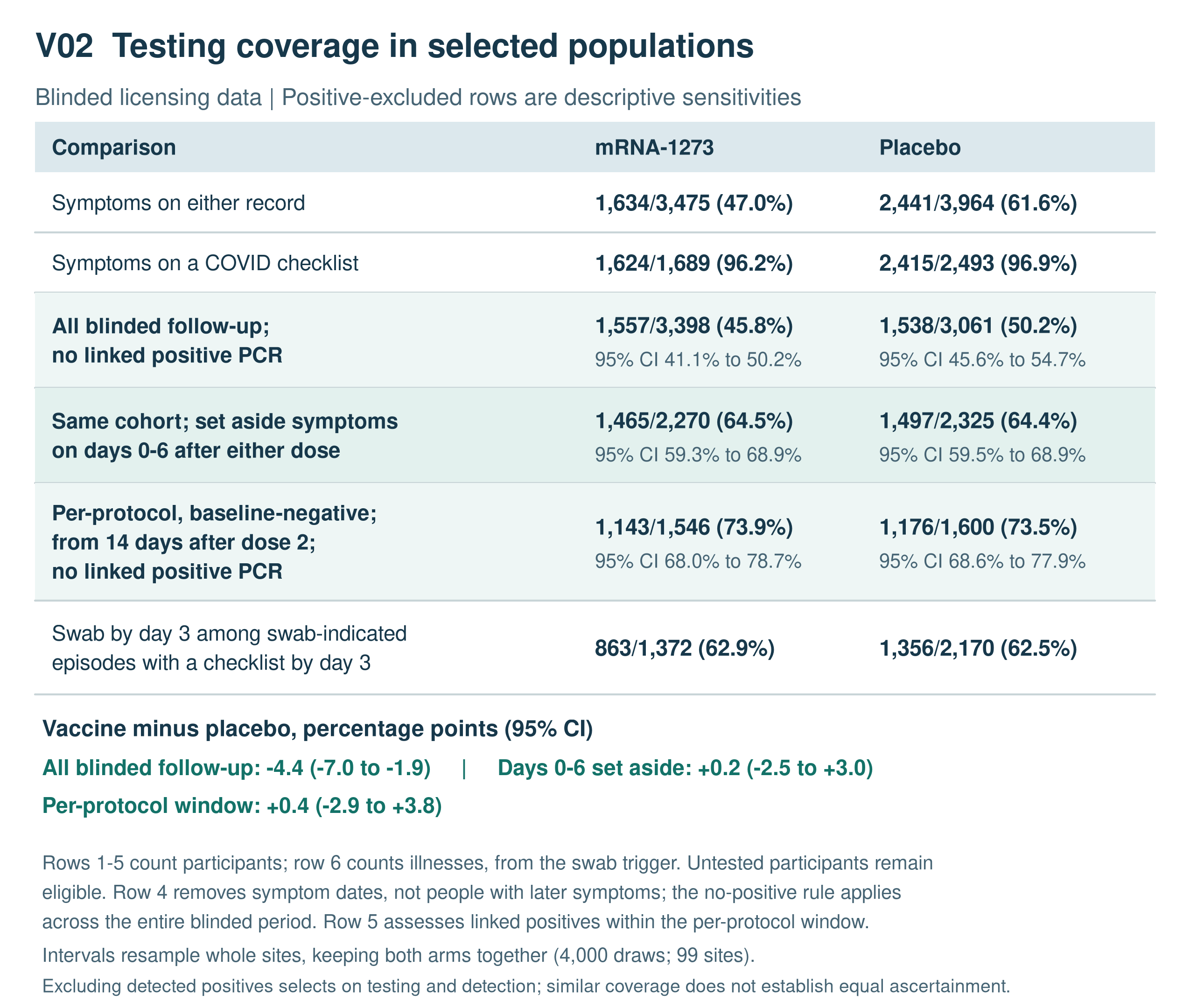
Among participants without a linked positive PCR, the vaccine-minus-placebo difference was −4.4 percentage points (95% CI −7.0 to −1.9) over blinded follow-up, +0.2 points (−2.5 to +3.0) after setting aside first-week symptom dates, and +0.4 points (−2.9 to +3.8) in the per-protocol window. These are descriptions of the participants remaining after selection, not independent demonstrations of equal testing or detection. The first-week result identifies where the difference lies within the no-positive population; it does not establish that every early complaint was appropriately left uninvestigated.
Across swab-indicated episodes with seven days of follow-up, a swab was documented for 1,167/2,818 vaccine episodes (41.4%) and 1,858/3,526 placebo episodes (52.7%). The vaccine-minus-placebo difference was −11.3 percentage points (95% CI −13.8 to −9.0). After excluding episodes with a linked positive PCR, the corresponding figures were 1,115/2,765 (40.3%) and 1,220/2,837 (43.0%), a difference of −2.7 points (95% CI −5.2 to −0.1). That exclusion selects episodes according to a result that depends on testing. These comparisons describe the recorded illnesses in each group. They leave open the size and direction of any difference in testing for clinically comparable illnesses. Restricting the analysis to eligible episodes in the baseline-negative, per-protocol population from 14 days after dose 2, with detected positives included, gave 800/1,128 (70.9%) versus 1,397/1,855 (75.3%) (¶49). A checklist was documented by day 3 for 1,397/2,895 vaccine-arm episodes (48.3%) and 2,187/3,594 placebo episodes (60.9%) warranting evaluation. Among episodes warranting a swab, collection by day 3 was documented for 872/2,838 (30.7%) and 1,372/3,546 (38.7%). The matched checklist comparison gave a difference of −0.85 points (95% CI −2.75 to +1.03), but covered only 504 vaccine and 539 placebo episodes—17.4% and 15.0% of the eligible episodes. The remainder still requires explanation. The following source records and review population warrant further investigation:
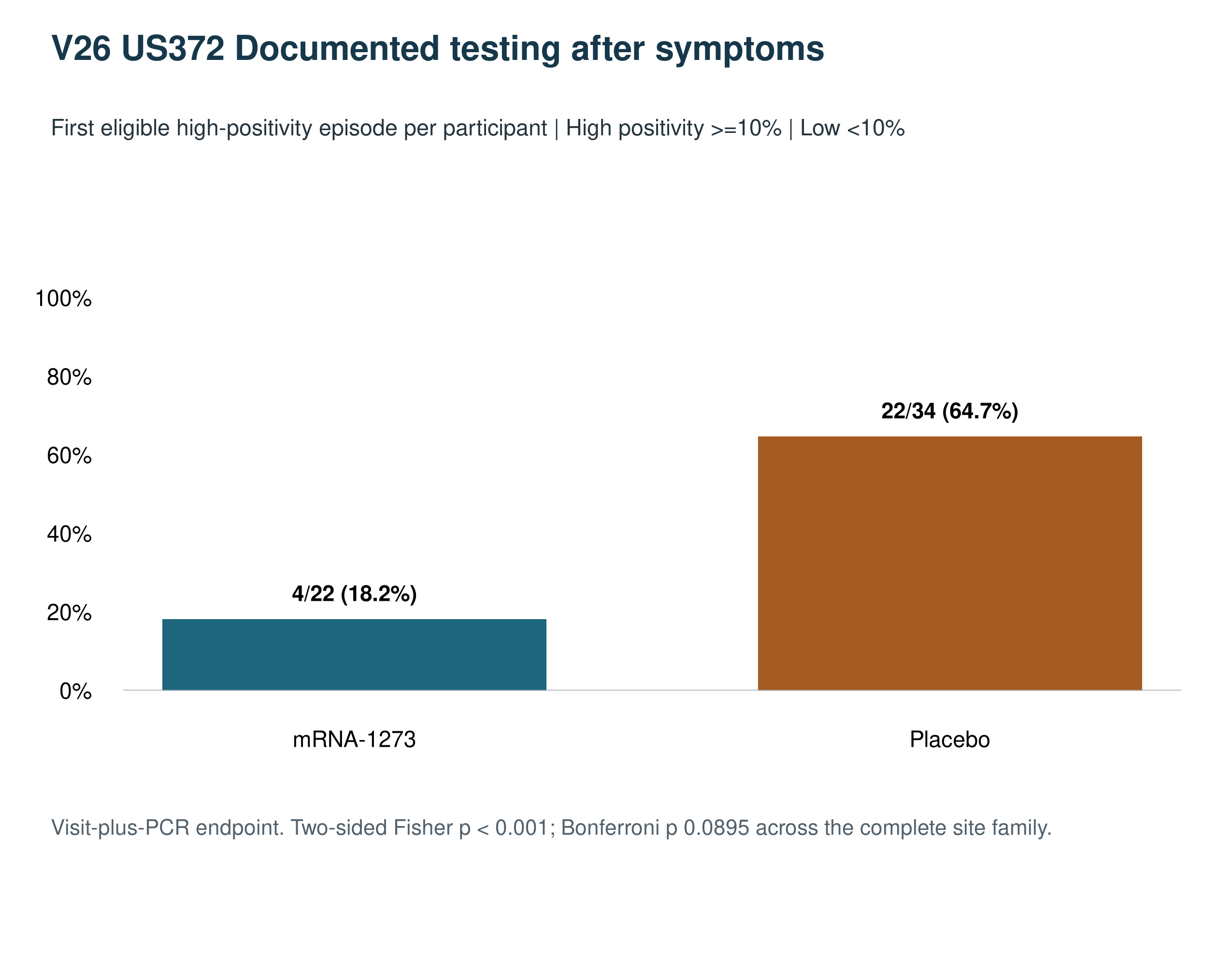
US372. During weeks of high local positivity, no episode starting on post-dose days 0–6 met the seven-day visit-plus-PCR endpoint (0/21 vaccine; 0/9 placebo). Outside those days, 5/5 vaccine and 26/29 placebo episodes met it. Early episodes accounted for 21/26 vaccine episodes but only 9/38 placebo episodes, explaining the lower pooled coverage in the vaccine arm. The source records are needed to determine which early complaints warranted investigation.
US325. During high local transmission, 4 of 19 vaccine-arm illnesses first recorded on a COVID checklist lacked a timely visit and PCR; all 26 placebo illnesses had one. These four records need individual review.
570 respiratory illnesses. The review packet combines 570 respiratory-trigger episodes without a diagnostic specimen in the following seven days and 570 tested controls. Independent clinical review has not yet occurred. The supplied workflow records two masked assessments, source availability and the reasons for each decision, and requires a signed consensus before revealing the treatment and testing labels. Coded excerpts alone do not complete the proposed source review. FDA separately reviewed 60 participants with suspected COVID-19 who lacked a qualifying PCR result at database lock. Paragraph 49 explains how that participant count relates to our seven-day episode review.
C3. More placebo recipients had a late notice. Among participants with confirmed COVID, similar proportions had a notice near illness onset.
During blinded follow-up, 28 vaccine recipients and 219 placebo recipients had a deviation for a safety notification made more than 24 hours after site awareness. Looking first at those with a late notice, we found a confirmed or explicitly COVID-coded event within 28 days of a deviation in 19 of 28 vaccine recipients and 193 of 219 placebo recipients. Hospitalization was recorded on the nearby COVID event for none of the 19 vaccine recipients and four of the 193 placebo recipients.
We then started with participants whose adverse-event record identified confirmed symptomatic COVID. A late-notification deviation fell within 28 days of illness onset in 19/92 vaccine recipients (20.7%) and 191/954 placebo recipients (20.0%). The records do not link each notice to the event that triggered it. Among participants eligible for the relevant follow-up, 7/65 vaccine and 76/772 placebo recipients missed a visit (10.8% and 9.8%), and 3/75 and 35/849 missed monitoring (4.0% and 4.1%) (¶¶17–22).
Method and reading conventions
The analyses use clinical datasets and documents released through Public Health and Medical Professionals for Transparency (PHMPT), supplemented by the cited regulatory assessments and publications. The R scripts and supporting assets are available in the project repository. To reproduce the work, download the archives, extract and categorize their contents, convert the SAS transport files where needed, and run the relevant analysis scripts with the documented input selections. The scripts retain discovery and provenance outputs so that each result can be tied to its source files.2 3 4 5
We also searched the electronic case report forms (CRFs), which preserve entries, corrections and queries between sites and reviewers. We reviewed 1,576 case report form PDFs covering 1,180 participants. The original licensing submission (S3) also contained 669 two-page placeholder files. For every one of those participant IDs, the later S10 submission contained a case report form with clinical entries, which we included in the review. A participant could appear in more than one release. We checked selected findings against their original pages and the corresponding clinical tables. We distinguish a monitor’s question from the site’s answer and from the value that reached the submission. The released forms are a subset of the trial, not a random sample.
The evidence index identifies the original submission, PDF page and FDA document number for the reviewed cases. Readers can replay the reported counts from the published CSVs or rerun the extraction against the original PHMPT participant files. The source check reads the marked dose field, compares numbered adverse-event forms with the corresponding submission, and compares dated diagnostic results with laboratory records. The illness-visit search identifies candidate pages. The site’s answer and the clinical interpretation are shown separately in the reviewed_cases.csv ledger.
“EUA” denotes the emergency-authorization submission; “BLA” denotes the biologics-license application. A release label alone does not identify a data snapshot: the report distinguishes the original EUA tables, the production tables associated with the BLA analysis, and later amendments. Truncating a later production table at an earlier calendar date does not recreate the database available on that date. The principal historical cutoffs are 21 November 2020 for EUA efficacy, 25 November 2020 for EUA safety, and 26 March 2021 for the BLA blinded-phase analysis. Death reporting also requires separate boundaries: the FDA EUA memorandum includes reports through 3 December 2020, and the BLA review continued death surveillance through the 4 May 2021 database lock. Participant-specific follow-up limits are applied where stated.
In the interval-based charts, symptom-table evidence is assigned to its positive assessment date. A matched AE contributes to every week overlapped by its recorded onset-to-end interval, restricted to the allowed follow-up; if its end date is missing or incomplete, only its onset week is counted. A participant can therefore contribute several groups in one week and the same group in successive weeks. These units are neither unique participants nor reconstructed illnesses, and “both sources” does not establish that the entries describe the same clinical episode. Unless otherwise specified, arm comparisons are presented as mRNA-1273 followed by placebo, using the original randomized assignment.
We classified each symptom-group-week by where it was recorded: on a COVID checklist only, in an adverse-event record only, or in both. For each arm and week, the AE share was the number recorded as AEs, including those also on a checklist, divided by the total number of symptom-group-weeks. A unit recorded in both sources counted once.
For the three participant-level PCR coverage comparisons in ¶42, we calculated 95% confidence intervals for each arm and for the vaccine-minus-placebo difference by resampling the 99 trial sites 4,000 times, keeping both arms together within each sampled site and taking the 2.5th and 97.5th percentiles of the resulting estimates.
The report separates observed counts, statistical screening results and sensitivity scenarios. Multiplicity adjustments are identified where they change the selection of site findings. The objective is to locate consequential decisions and unresolved records for audit; an unexplained discrepancy is a request for reconciliation, not a substitute for it.
Trial populations, recruitment and public milestones
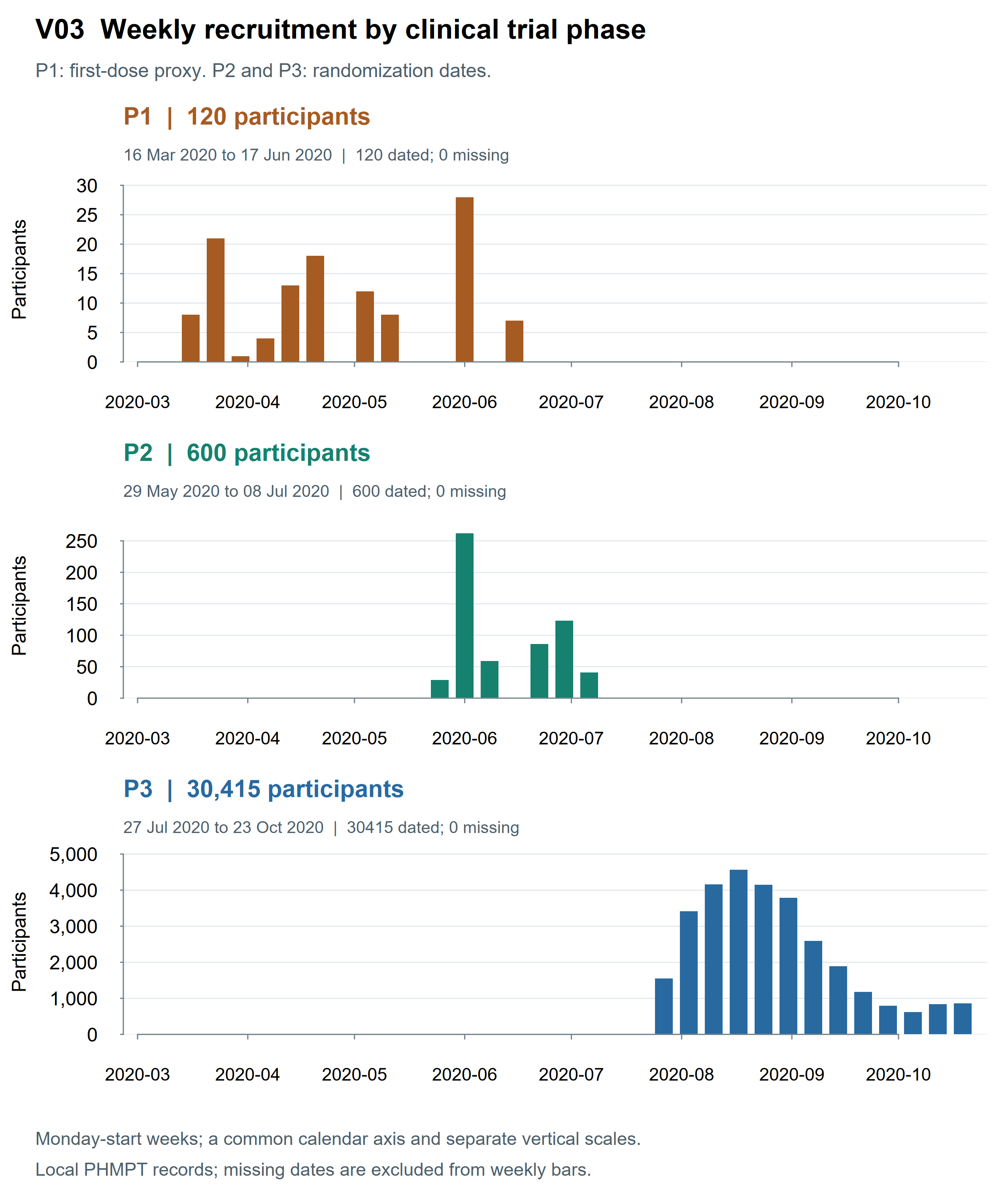
The phase 1 data cover 120 participants at three sites, with first-dose dates from 16 March to 17 June 2020. The study evaluated safety and reactogenicity of a two-dose schedule, 28 days apart, across five dosage levels in healthy adults. First dose is used as the available recruitment proxy in the chart.6 7
The phase 2 dataset contains 600 participants at eight sites, randomized from 29 May to 8 July 2020. Its objectives included safety, reactogenicity and immunogenicity assessed through spike-binding antibodies, with neutralizing-antibody responses as a secondary outcome.8
The phase 3 P301 trial randomized 30,415 participants at 99 sites, comprising 15,209 assigned to mRNA-1273 and 15,206 to placebo. The BLA ADSL table contains 30,423 unique identifiers; this is a dataset roster, not a count of screened or randomized participants. The first original study injections occurred from 27 July to 23 October 2020.
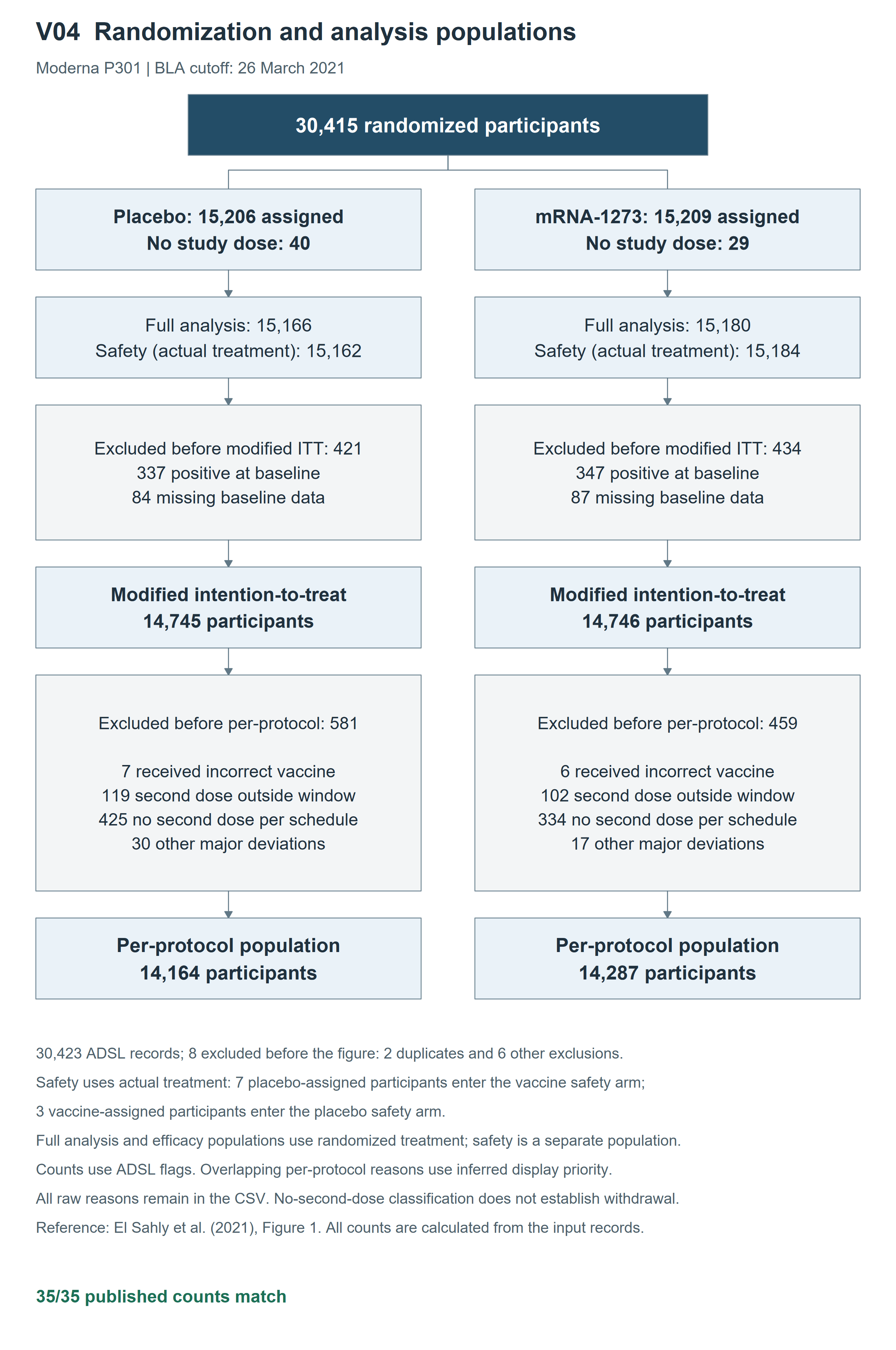
The reconstruction of the published randomization diagram distinguishes randomized assignment from actual-treatment safety membership and subsequent efficacy populations. The full-analysis population contains 15,180 vaccine and 15,166 placebo participants; the safety population contains 15,184 and 15,162, respectively. The modified intention-to-treat population contains 14,746 and 14,745, and the per-protocol population 14,287 and 14,164. These last two figures are per-protocol denominators and must not be used as the randomized denominators in the deviation analysis.
The trial’s two central objectives were to characterize safety—including the frequency, severity and nature of adverse reactions and adverse events—and to assess efficacy against symptomatic, RT-PCR-confirmed COVID-19. The primary efficacy analysis concerned the first qualifying illness beginning at least 14 days after dose 2 among per-protocol participants without evidence of SARS-CoV-2 infection at baseline. The safety results contributed to the overall benefit-risk assessment.9 10
The recruitment map uses an asset file established for the project,11 which records site identifiers, names and geographic coordinates. It provides the geographic framework for the site-level analyses of symptom recording, testing and background epidemic activity.
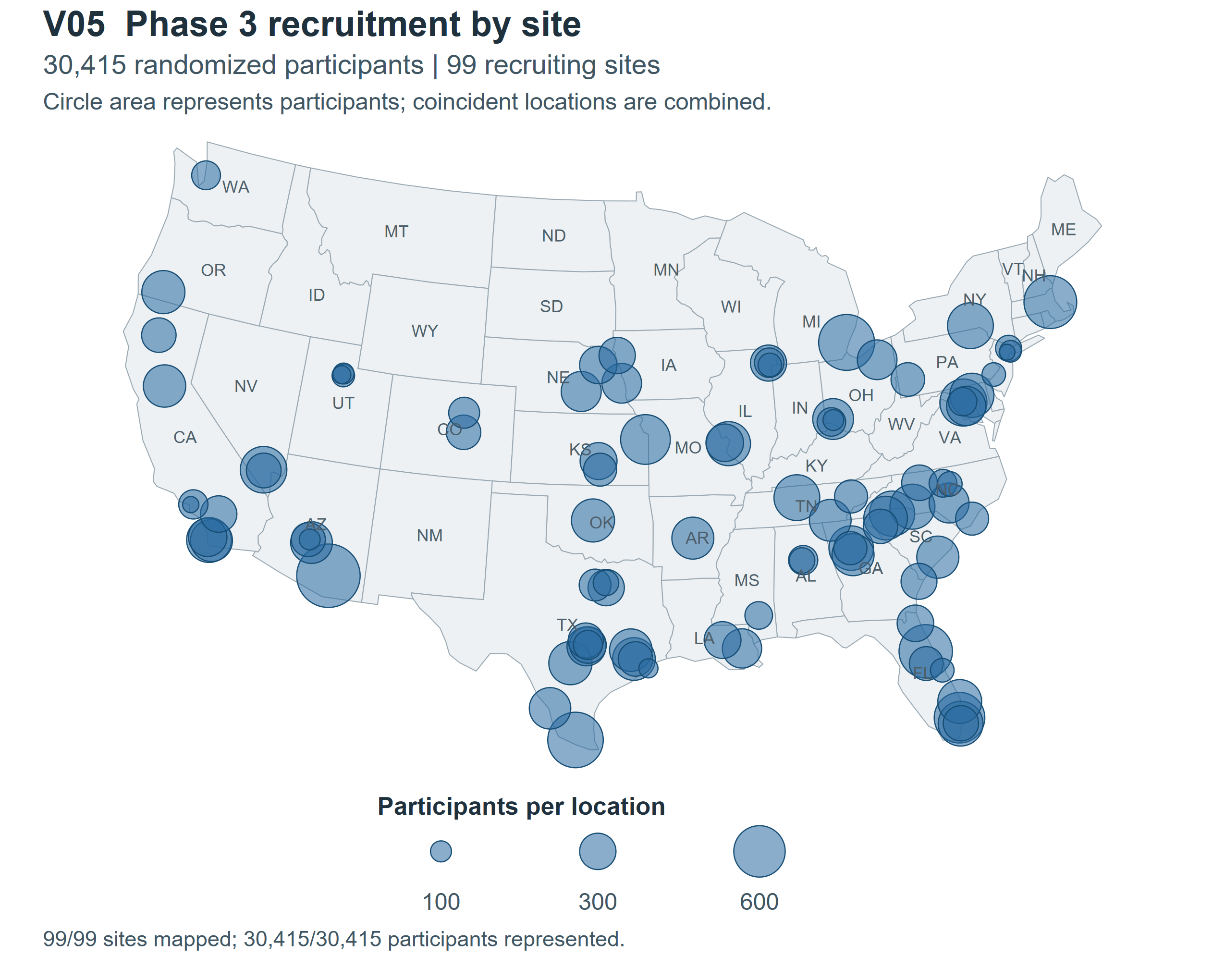
Moderna announced the first phase 3 efficacy results on 16 November 2020: 94.5% efficacy against symptomatic COVID-19, based on 5 vaccine cases versus 90 placebo cases; all 11 severe cases were in placebo recipients. On 30 November, the company announced the primary analysis, reporting 94.1% efficacy from 11 versus 185 cases and 100% observed efficacy against severe COVID-19, with all 30 severe cases in the placebo arm. It also reported no new serious safety concerns and submitted its EUA request.12 13
FDA issued the EUA on 18 December 2020, following the advisory-committee meeting on 17 December. Baden et al. published the initial phase 3 results online on 30 December. The EUA efficacy cutoff was 21 November, while safety follow-up used 25 November (these dates should not be conflated with publication or authorization dates).14
El Sahly et al. published the completion-of-blinded-phase results online on 22 September 2021, using the 26 March 2021 cutoff associated with the BLA analysis. FDA approved the vaccine, marketed as Spikevax, for adults aged 18 years and older on 31 January 2022.15
How the records became available
PHMPT requested Moderna’s biological-product-file records under FOIA on 23 February 2022, through request 2022-1614. FDA denied expedited processing on 7 March; PHMPT appealed on 1 June. On 11 October 2022, PHMPT, Patrick de Garay and Stephanie de Garay sued FDA in the Northern District of Texas. The litigation concerned Moderna’s adult vaccine and Pfizer’s vaccine for ages 12-15.16 17
On 9 May 2023, Judge Mark T. Pittman held that expedited processing had been wrongly denied and rejected a proposed timetable described as taking at least 23.5 years. The subsequent production order of 12 June 2023, ECF 38, required completion of Moderna production by 30 June 2025, at a minimum rate of 75,000 pages in January 2024 and 180,000 pages per month thereafter.18 19
An amended order dated 9 June 2025, ECF 52, addressed the EUA records. It required Moderna EUA production at 180,000 pages per month from 1 October 2025, with completion no later than 1 October 2026. Completion was subsequently announced, and PHMPT provides the released archives for download. The availability of those archives enables this audit; completeness of individual clinical histories still has to be assessed against the records themselves.20 21 22
Original study injections
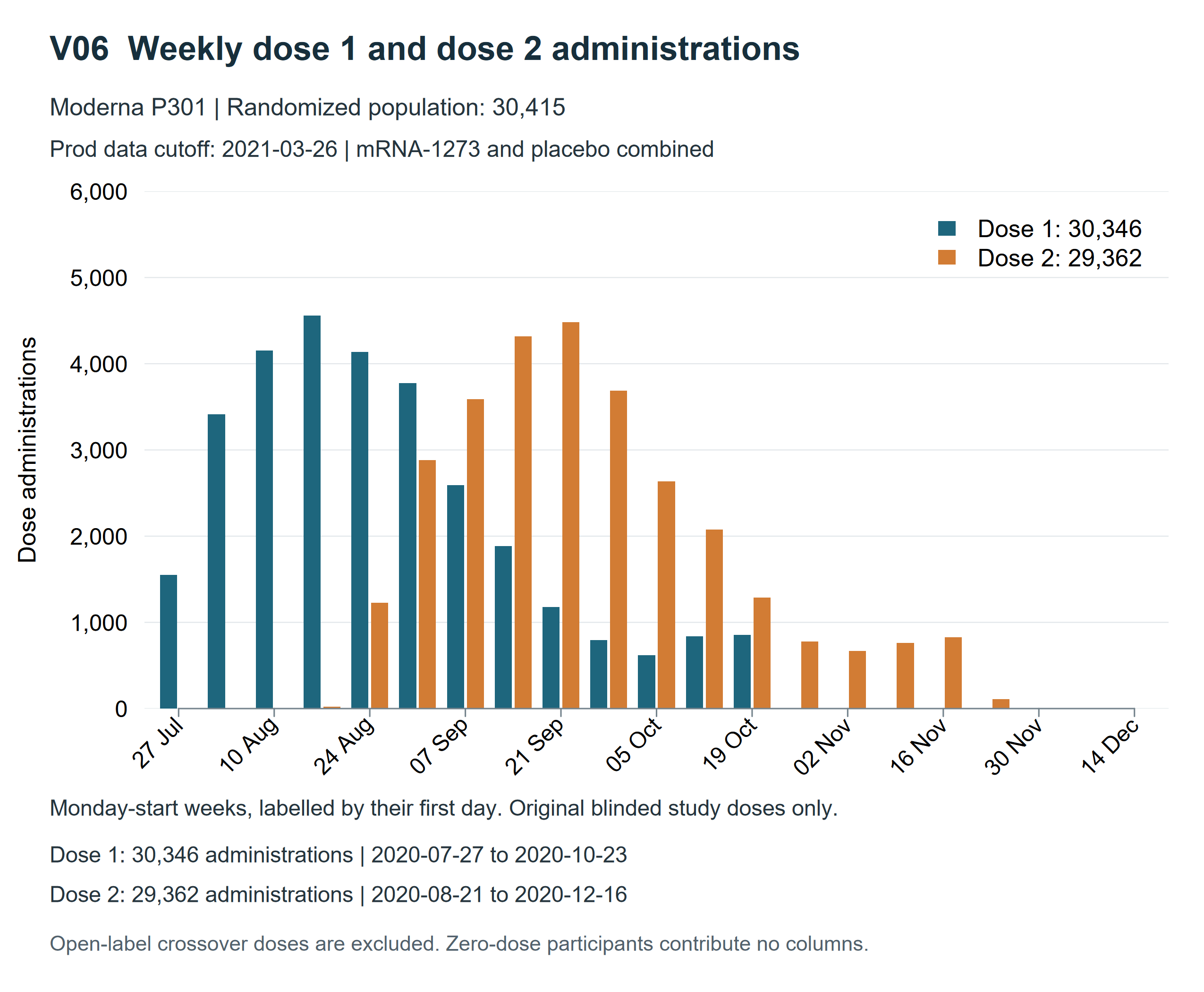
Among the 30,415 participants in the sponsor-defined randomized population, 30,346 received a first study injection between 27 July and 23 October 2020, and 29,362 received a second between 21 August and 16 December 2020. The weekly reconstruction combines the randomized arms and counts each participant once in the corresponding dose series, using Monday-to-Sunday weeks. It covers the original blinded injections and excludes subsequent open-label crossover doses.23
A first-dose example shows why the distinction matters. For US3172360, the vaccination visit and exposure table record mRNA-1273 on 27 August 2020. The unblinding form says the dose was not administered. On 4 May 2021, a monitor cited the trial’s treatment-assignment system and asked for a correction; the released form still shows no dose. The discrepancy is between records of administration, not in the participant’s randomized assignment. In the non-random subset of released participant forms, the original assignment was readable for 996 people and agreed with the randomized arm in all 996. “Actual Dose 2” was readable for 995. Of these, 171 had only one blinded injection in the exposure table and no second dose in the subject-level table. The unblinding form nevertheless named the assigned product for 2/70 mRNA-1273 recipients (2.9%) and 48/101 placebo recipients (47.5%) across 32 sites. For 44 of the 50, the Day 29 vaccination form explicitly said that treatment was not given; the remaining six had no extractable yes/no answer. Later open-label injections were counted separately.
All 171 unblinding forms were filed under the participant decision visit. A clinic visit on the recorded unblinding date was documented for 40/48 placebo recipients with the discrepancy and 48/53 whose field correctly said “Not Administered.” A first open-label mRNA injection on that date was recorded for 37/48 and 37/53, respectively. Both vaccine recipients with the discrepancy had a clinic visit that day; neither received a recorded open-label dose. Thus, the crossover visit was a common setting for the placebo entries, but attendance alone did not distinguish the discrepant forms.
At site US331, three placebo recipients received open-label mRNA on 12 January 2021. On 13 or 15 January, staff entered “Placebo” in the blinded dose-2 field and explicitly noted that no second placebo dose had been given: the entry opened additional decision-visit pages. The final product value was first entered between 6 January and 8 April for the 48 placebo recipients (median one day after unblinding), and on 21 January and 19 March for the two vaccine recipients. The first entries of the final dose-2 value and the correct randomized assignment shared a timestamp for 45/50 discrepant forms, but also for 81/121 forms correctly recording “Not Administered.” A common save time does not establish that the assignment was copied from the randomization system. Conversely, in a comparison participant (US3192730), a monitor cited the system’s record of no second injection and the field was corrected to “Not Administered.”
All 50 had a negative licensing per-protocol flag. Missing the scheduled second dose was a recorded reason for every exclusion; 11 also failed the modified intention-to-treat criterion. All 50 remained in the full-analysis and safety populations. The later form entry therefore did not put any of them into the per-protocol efficacy denominator and does not establish a second blinded exposure. Dose-specific safety analyses should use documented administrations and keep later open-label injections separate.
Protocol deviations and consistency of follow-up
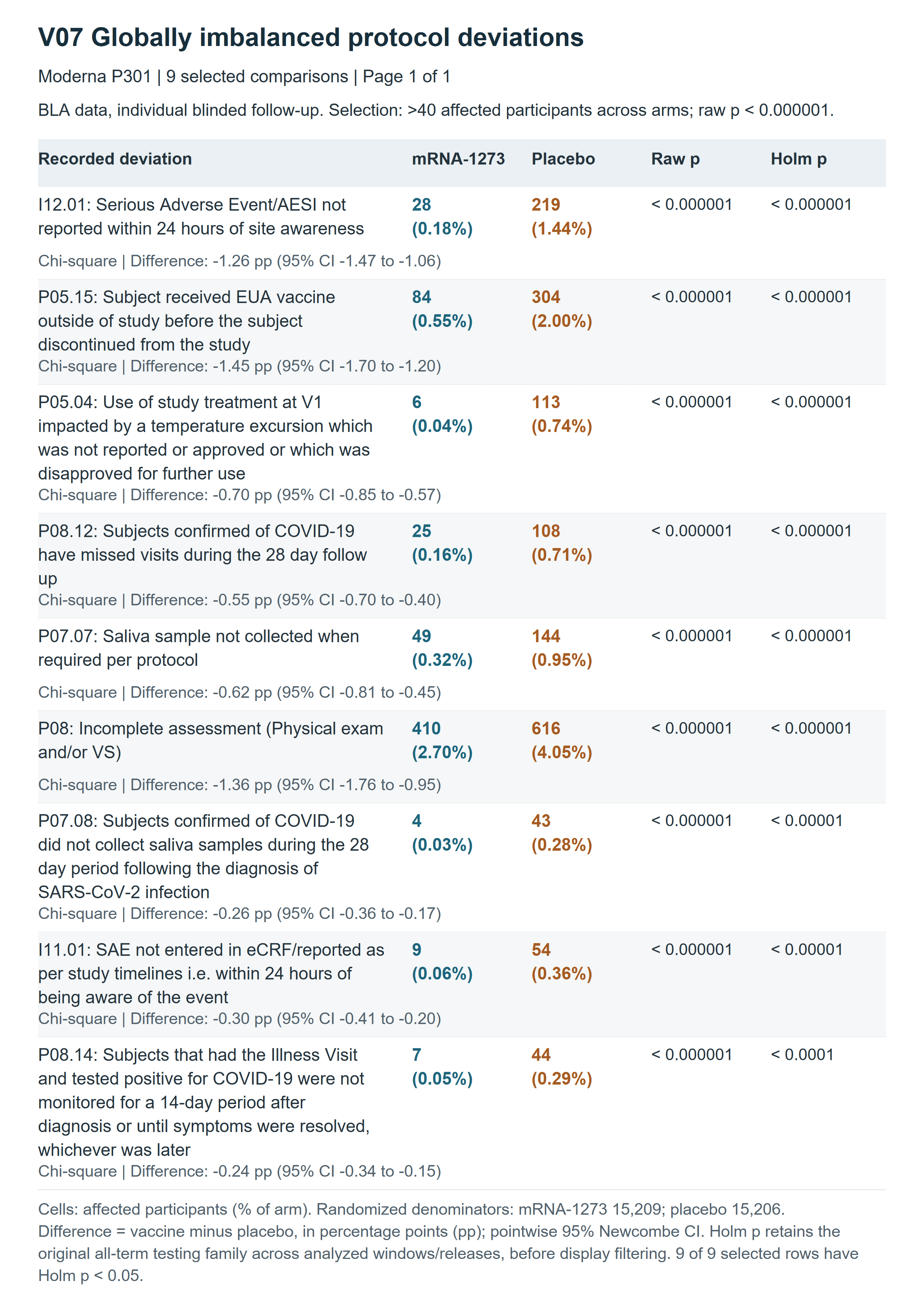
Protocol deviations can arise from participant circumstances, missed procedures or errors in trial conduct. Their classification can also affect membership in analysis populations. Reviewing the deviations therefore serves two purposes: assessing the consistency of follow-up and understanding how departures from the protocol were translated into exclusions.24
The global comparison uses the randomized denominators of 15,209 vaccine and 15,206 placebo participants. The displayed selection contains nine deviation codes affecting more than 40 participants across the trial and showing statistically significant arm differences. Each code is counted once per affected participant for this comparison. The reported tests for these rows are chi-square tests, with the accompanying Holm-adjusted results retained. The analysis ends at the earliest of 26 March 2021, the recorded end of Part A, the day before Part B began, the day before recorded unblinding, end of study or death. An individual unblinding date was missing for 646/15,209 vaccine recipients (4.2%) and 896/15,206 placebo recipients (5.9%). Another Part A or Part B date was available for 491 and 731 of them, respectively. The remaining 155 and 165 had none of these three dates and no earlier death or study-end date; their follow-up therefore ran to 26 March. For these 320 participants the cutoff is an administrative assumption, not confirmation that they remained blinded.
V07 counts participants with a recorded deviation out of everyone randomized. One difference concerns notification of a serious adverse event (SAE) or adverse event of special interest (AESI) more than 24 hours after site awareness: 28/15,209 (0.18%) versus 219/15,206 (1.44%). The incomplete-examination or vital-signs code affected 410 versus 616 participants; the general missed-saliva code (P07.07) affected 49 versus 144. Receiving an authorized vaccine outside the study before discontinuation (P05.15; 84 versus 304) records a participant’s action. All nine comparisons shown in V07 survive the original Holm adjustment; those tests use randomized participants as the denominator, not the number of times each task was required.
Three deviations could occur only after confirmed COVID-19. We started follow-up at the first positive diagnostic PCR labelled as collected at an initial illness visit, or at a local-coded positive diagnostic PCR collected on the same day as, or within three days after, a separately documented initial illness visit. Participants had to remain under observation through day 28 for follow-up visits and saliva collection, or day 14 for illness monitoring. We counted each participant once per code if a deviation was dated from the index date through the end of that interval. V08 compares these results with the counts among all randomized participants in V07.
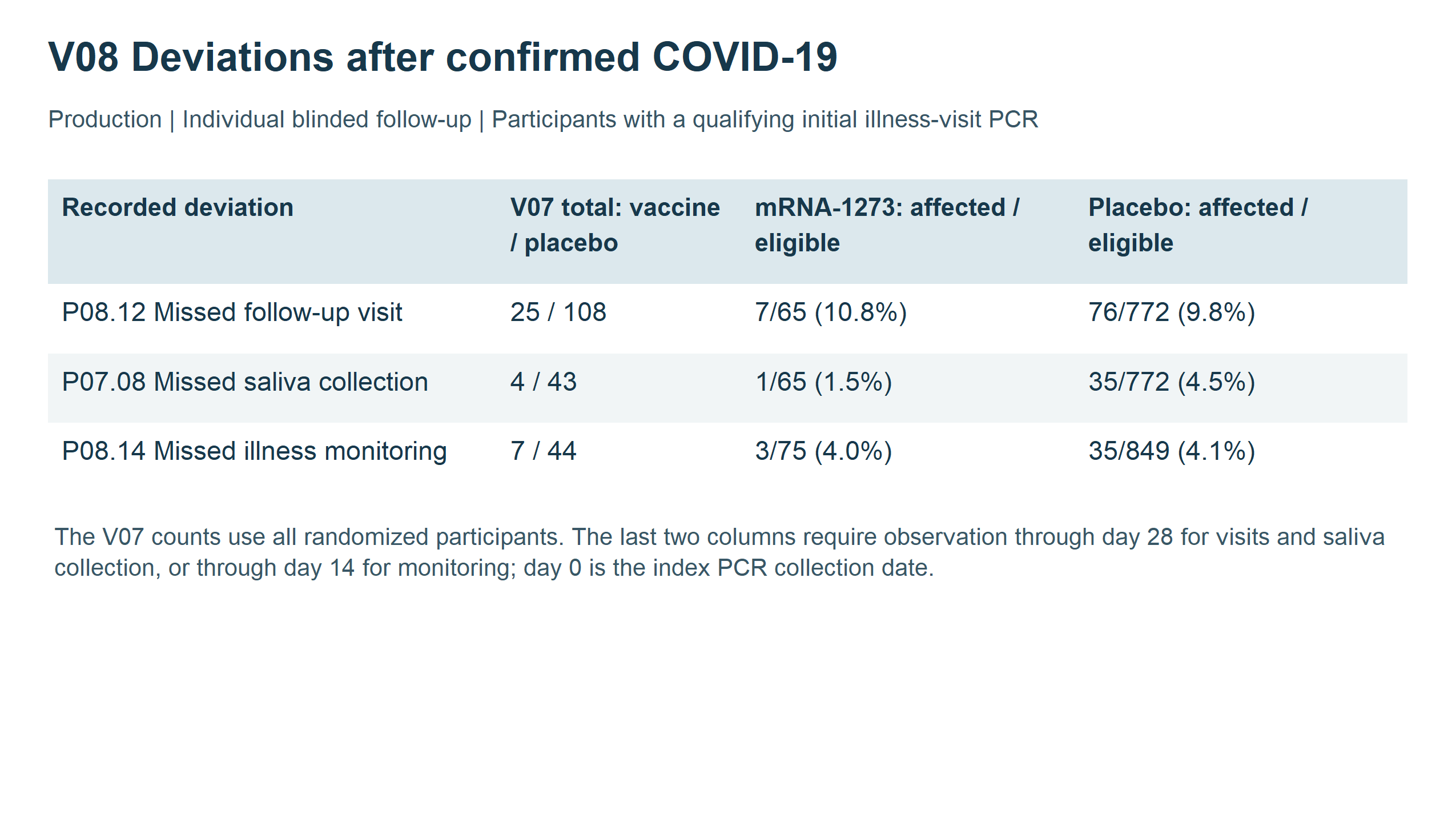
Missed follow-up visits affected 7/65 vaccine recipients (10.8%) and 76/772 placebo recipients (9.8%). Missed saliva collection was less frequent in the vaccine arm (1.5% versus 4.5%); missed monitoring was nearly identical (4.0% versus 4.1%). The three codes therefore showed no consistent placebo excess once participants with an opportunity were compared. When shorter follow-up was allowed, the counts were 8/78 versus 87/877 for visits, 3/78 versus 36/877 for saliva, and 3/78 versus 36/877 for monitoring. These are participant counts, not counts of individual procedures due. The 14-day screen cannot assess monitoring required beyond day 14 for unresolved symptoms.
The 28 vaccine and 219 placebo participants in V07 accounted for 30 and 224 late-notification records, respectively (I12.01). Earlier protocols required all confirmed COVID-19 illnesses to be reported within 24 hours of site awareness, whether or not the participant was hospitalized. Amendment 8, dated 23 March 2021, narrowed that COVID-19 requirement to serious cases. Of 254 deviation records, 253 were dated before the amendment. V09 classifies each participant once according to the highest-priority AE found within 28 days on either side of a deviation and within that participant’s analysis window.
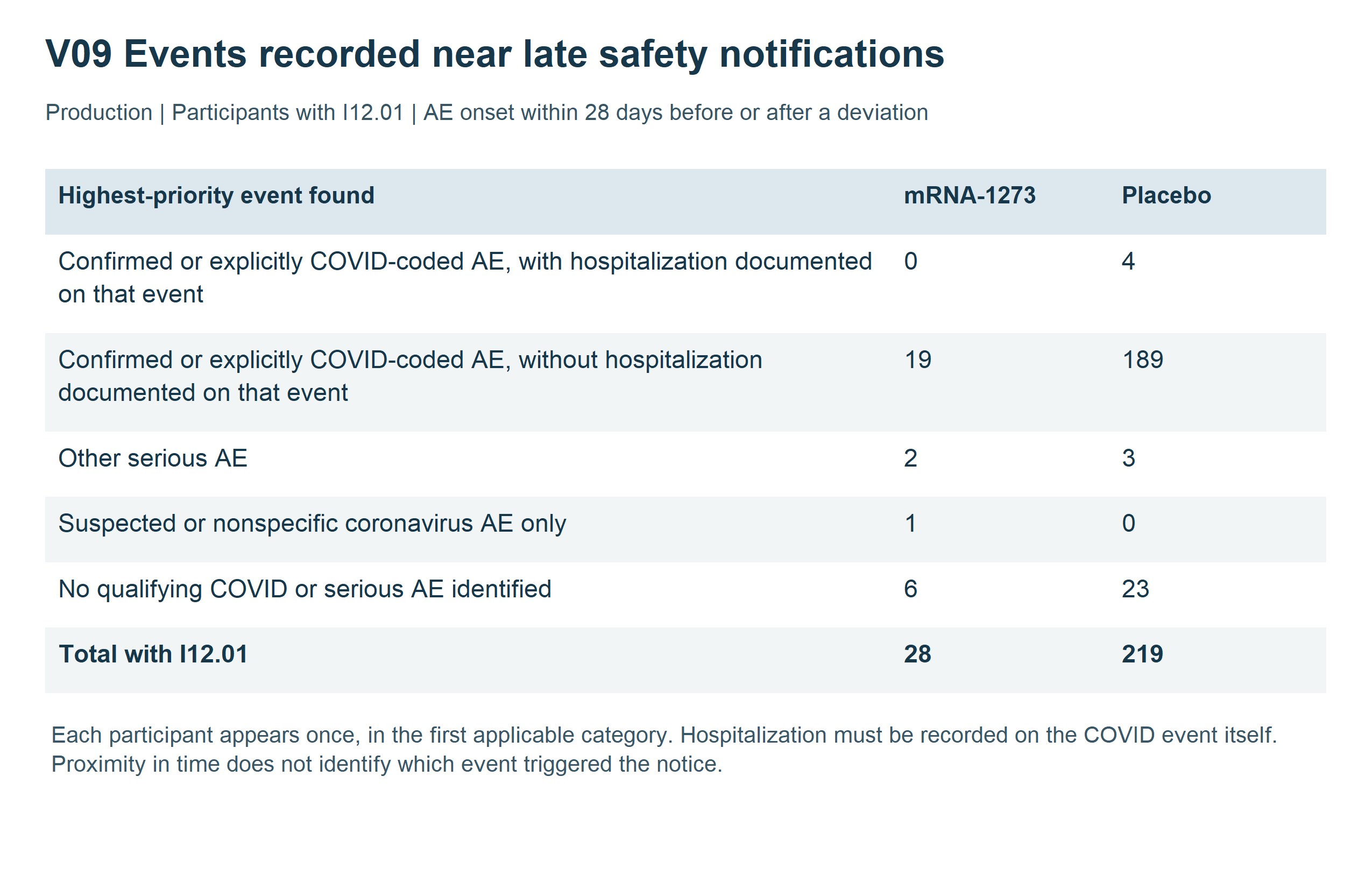
A confirmed or explicitly COVID-coded AE was recorded near a late notification for 19/28 vaccine recipients and 193/219 placebo recipients. Hospitalization was documented on that same COVID event for none of the 19 vaccine recipients and four of the 193 placebo recipients. The separate hospitalization table showed a nearby admission of any kind for seven placebo recipients. COVID illness provided many more reporting opportunities in the placebo arm; the records do not support attributing most of its late notifications to COVID hospitalizations.
For placebo participant US3602074, the COVID event record dates hospital admission to 10 December 2020, the deviation is dated 11 December, and the safety form records submission on 14 December at 06:58 GMT. All four inpatient candidates had a dated COVID safety submission. None of their searchable forms contained the deviation identifier, and the sequence alone does not establish when the site first learned of the event.
Starting instead from the confirmed symptomatic COVID flag in the AE table, 19/92 vaccine recipients (20.7%) and 191/954 placebo recipients (20.0%) had an I12.01 deviation within 28 days of illness onset; within seven days the counts were 6/92 and 65/954. Excluding participants without an unblinding date left 28 versus 205 participants with the deviation; excluding only those without any of the three period dates left 28 versus 214. The release provides neither a verified event-to-notice link nor paired site-awareness and notification timestamps. The absolute difference warrants tracing the notices, but does not establish that staff gave placebo events lower priority.
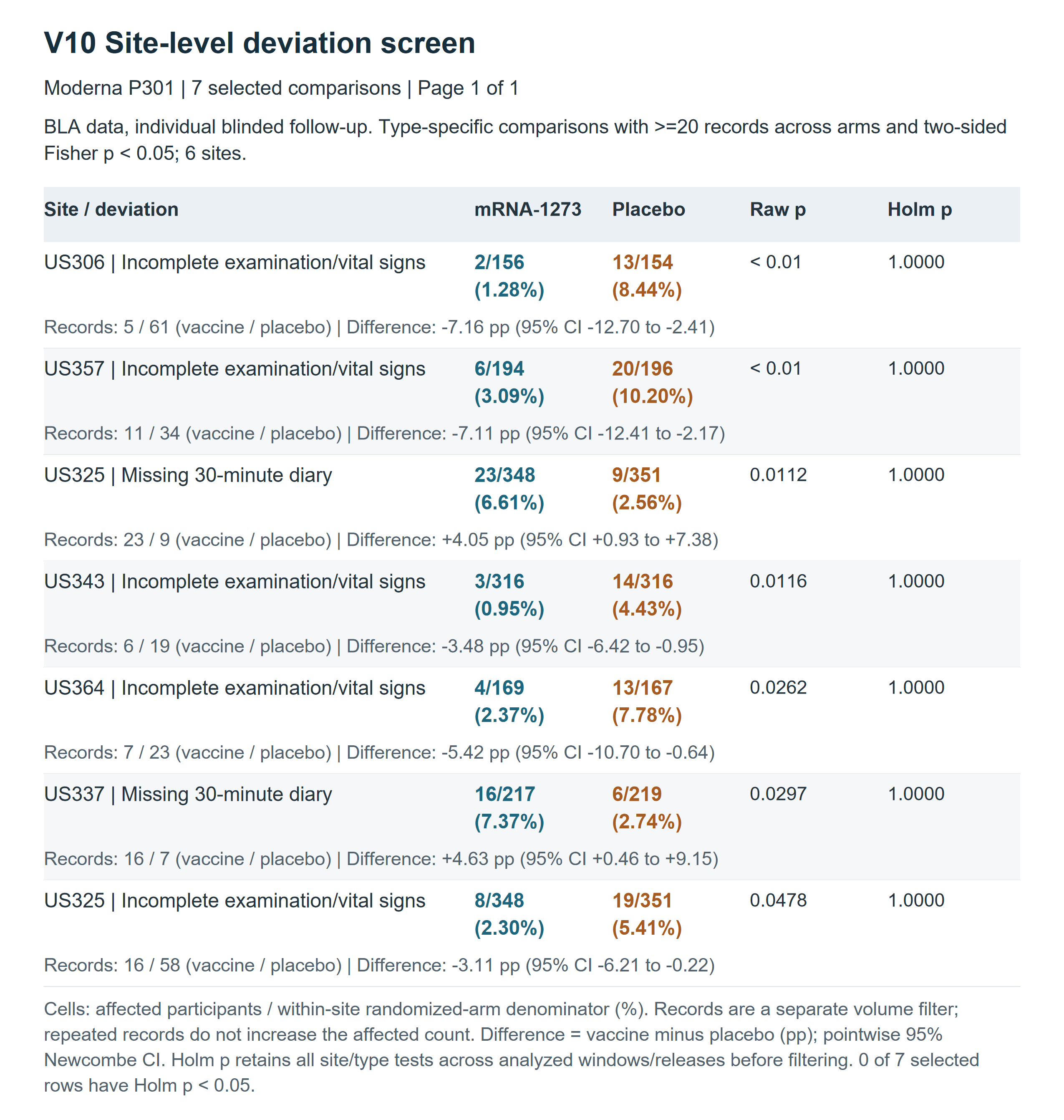
A separate site screen selects site-deviation combinations with at least 20 recorded deviations and a nominal two-sided Fisher p value below 0.05. It identifies seven comparisons across six sites, because US325 appears twice. This screen includes missing 30-minute diaries as well as incomplete examinations or vital signs; it is not restricted to the nine codes in the preceding global table. None of the seven comparisons survives the reported Holm correction: all adjusted p values are 1.0000. They are leads for targeted review, rather than statistically confirmed site effects.
The incomplete-assessment comparisons are US306, 2/156 versus 13/154; US357, 6/194 versus 20/196; US343, 3/316 versus 14/316; US364, 4/169 versus 13/167; and US325, 8/348 versus 19/351. Missing 30-minute diaries show the opposite direction at US325, 23/348 versus 9/351, and US337, 16/217 versus 6/219. The 20-record selection threshold concerns records, while these fractions concern affected participants.
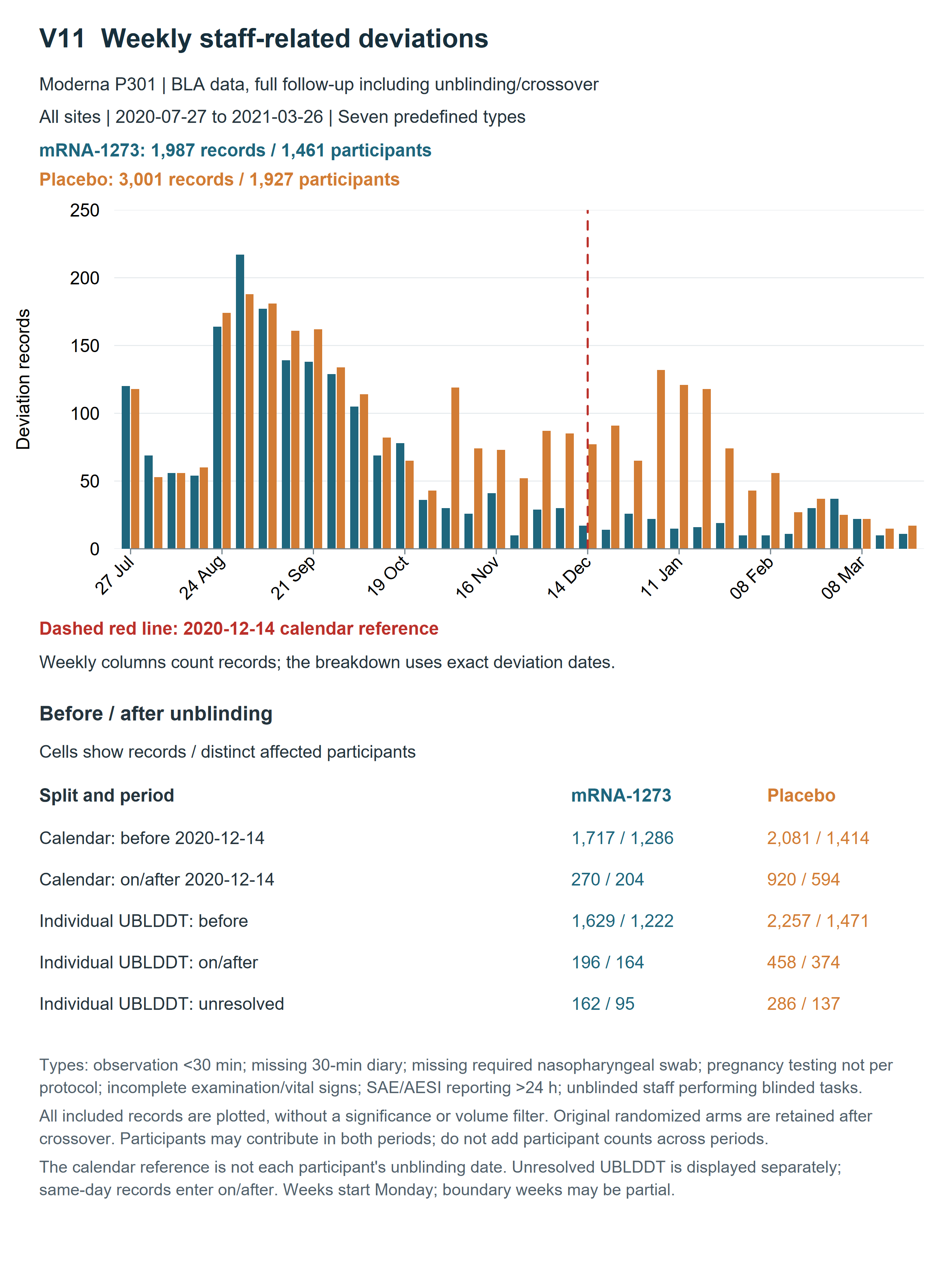
The weekly chart uses a third selection: seven “staff-related deviation” categories pooled across sites. Here, “staff-related deviations” means departures involving assessments, specimen collection, documentation, reporting or staff blinding that are directly influenced by site personnel and whose procedural requirements do not inherently justify an imbalance between randomized arms, given comparable opportunities to perform the required task. This category should be distinguished from product-specific handling deviations: preparing or storing the investigational vaccine and saline placebo need not involve identical requirements or opportunities for error. The chart includes 1,987 vaccine-arm and 3,001 placebo-arm records, affecting 1,461 and 1,927 participants, from 27 July 2020 through 26 March 2021. Repeated deviations contribute repeatedly, using their recorded start dates. The dashed line at 14 December 2020 is the chart’s unblinding reference date; it does not establish each participant’s individual blinding status. The chart shows that the selected deviations occurred during both the earlier trial period and later follow-up, with original randomized arms retained throughout. The weekly staff-related series excludes external vaccination (P05.15) and the three post-COVID codes examined above. A reporting task may be staff-controlled even when the two arms had different numbers of events to report. The weekly counts do not adjust for those opportunities.
From reported symptoms to a COVID investigation
Protocol triggers and the recorded symptom fields
For suspected COVID-19, the protocol called for an illness visit and nasopharyngeal sampling within 72 hours of a qualifying report, or as soon as possible. The trial used a dedicated COVID symptom checklist to document the assessment. The site’s first receipt of that report and the date entered on a symptom checklist are distinct events. Collection could take place at the site or through a qualified home visit; when this was not feasible, the protocol provided for home saliva collection and courier arrangements. The symptom criteria referenced the CDC list available on 10 June 2020.25
The listed symptoms were fever of at least 38°C; chills; cough; shortness of breath or difficulty breathing; fatigue; muscle or body aches; headache; new loss of taste or smell; sore throat; congestion or runny nose; nausea or vomiting; and diarrhea. Under Amendment 1, any listed symptom warranted investigation; fever required a temperature of at least 38°C. From Amendment 2 (31 July 2020), fever at that threshold, chills, cough and breathlessness qualified regardless of duration; other listed symptoms generally had to persist for at least 48 hours. During the first seven days after a dose, staff could use clinical judgment about swabbing for systemic symptoms that overlapped with expected vaccine reactions. Respiratory symptoms still warranted evaluation. An indication to investigate was broader than the definition of a primary efficacy case.
The ADSYMP symptom assessment contains 17 parameters: body aches, chills, cough, diarrhea, difficulty breathing, fatigue, fever, headache, myalgia, nasal congestion, nausea, new loss of smell, new loss of taste, runny nose, shortness of breath, sore throat and vomiting. Sixteen non-fever parameters use graded responses such as none, mild, moderate, severe or not done; fever is represented through temperature assessment. Additional fields concern severe illness, including pneumonia, respiratory failure, oxygen support and intensive care. FAEF and SUPPFAEF supply associated assessments and timing information, including hospitalization details.26 27
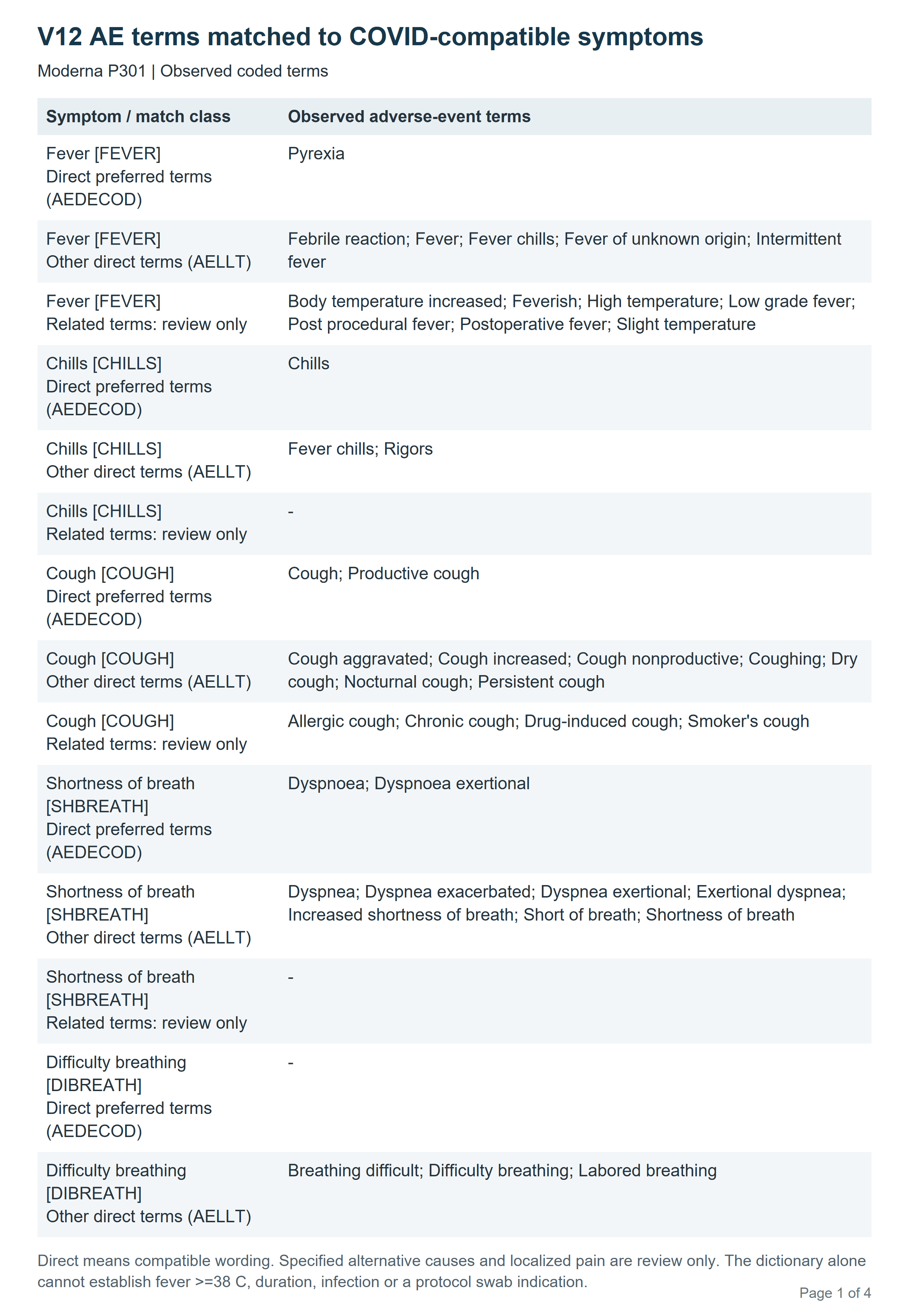
Compatible complaints also appear in the AE tables. We matched adverse-event descriptions to symptom groups without using treatment arm or PCR result. The primary mapping reserves for review terms specifying another diagnosis or a drug, procedure or trauma, as well as chronic complaints, specified headache syndromes and localized muscle pain. An ordinary cough counts; smoker’s cough and drug-induced cough do not enter the primary cough count. Upper-extremity myalgia does not by itself establish generalized muscle aches or an injection-site reaction. A specific qualifier on one AE field prevents a generic label on the same record from restoring that symptom group. An independently recorded COVID-form symptom remains eligible. The weekly figures do not impose a fever or duration threshold. The separate protocol analysis considers measured temperature, symptom duration, time since dose and the applicable protocol amendment. When the available record cannot establish a required temperature or duration, the indication remains indeterminate.28


Weekly recording patterns
V13 and V14 show, by week, the share of symptom observations recorded only on the COVID checklist, only as adverse events, or in both sources. The line shows the combined share involving an adverse-event record. Each observation represents one participant, one symptom group and one week; it does not have to meet the protocol’s fever or duration threshold to appear here. The figures span full follow-up and retain original randomized assignment. The background columns show injections, including open-label vaccination in the original placebo arm.29
During blinded follow-up, adverse-event records contributed to 10,383/20,746 vaccine-arm symptom-group-weeks (50.0%) and 9,513/32,673 placebo-arm symptom-group-weeks (29.1%). The difference was 20.9 percentage points (site-clustered 95% CI, 17.5 to 24.4; p < 0.000001). AE-only observations accounted for 38.6% versus 21.5% of the totals; observations in both sources accounted for 11.4% versus 7.6%.
In the original placebo arm, doses 3 and 4 on V14 denote the first and second open-label mRNA-1273 injections. The AE-recorded share was about 11-12% during the main dose 3 weeks in January. It rose from 16.2% in the week of 25 January to 47.6% in the week of 8 February, when dose 4 administrations peaked, and reached 58.4% in the week of 1 March. Between 25 January and 8 February, AE-involved observations rose from 151 to 282 and checklist-only observations fell from 783 to 310. The later placebo-arm curve thus includes participants who had received active vaccine.
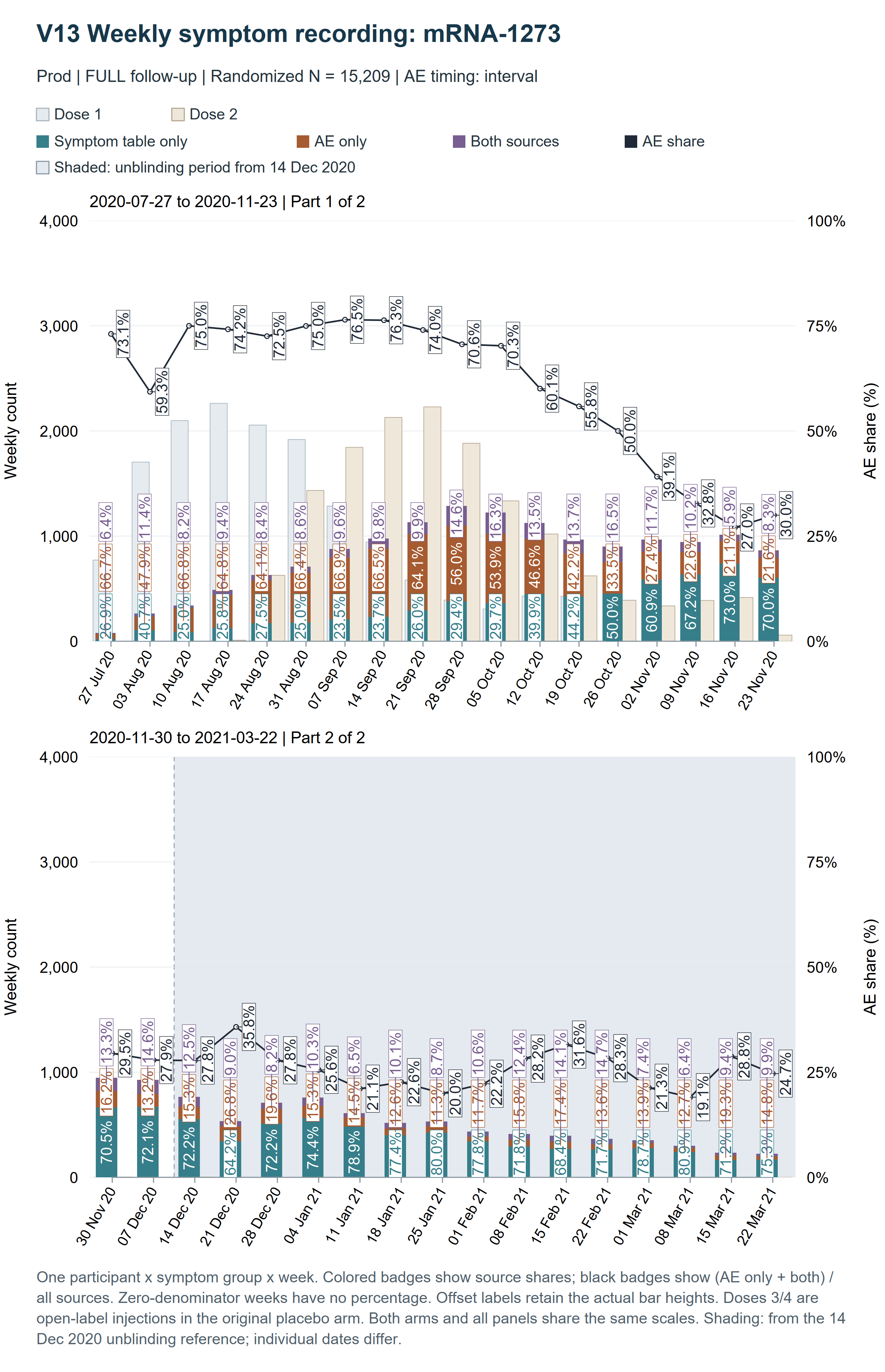
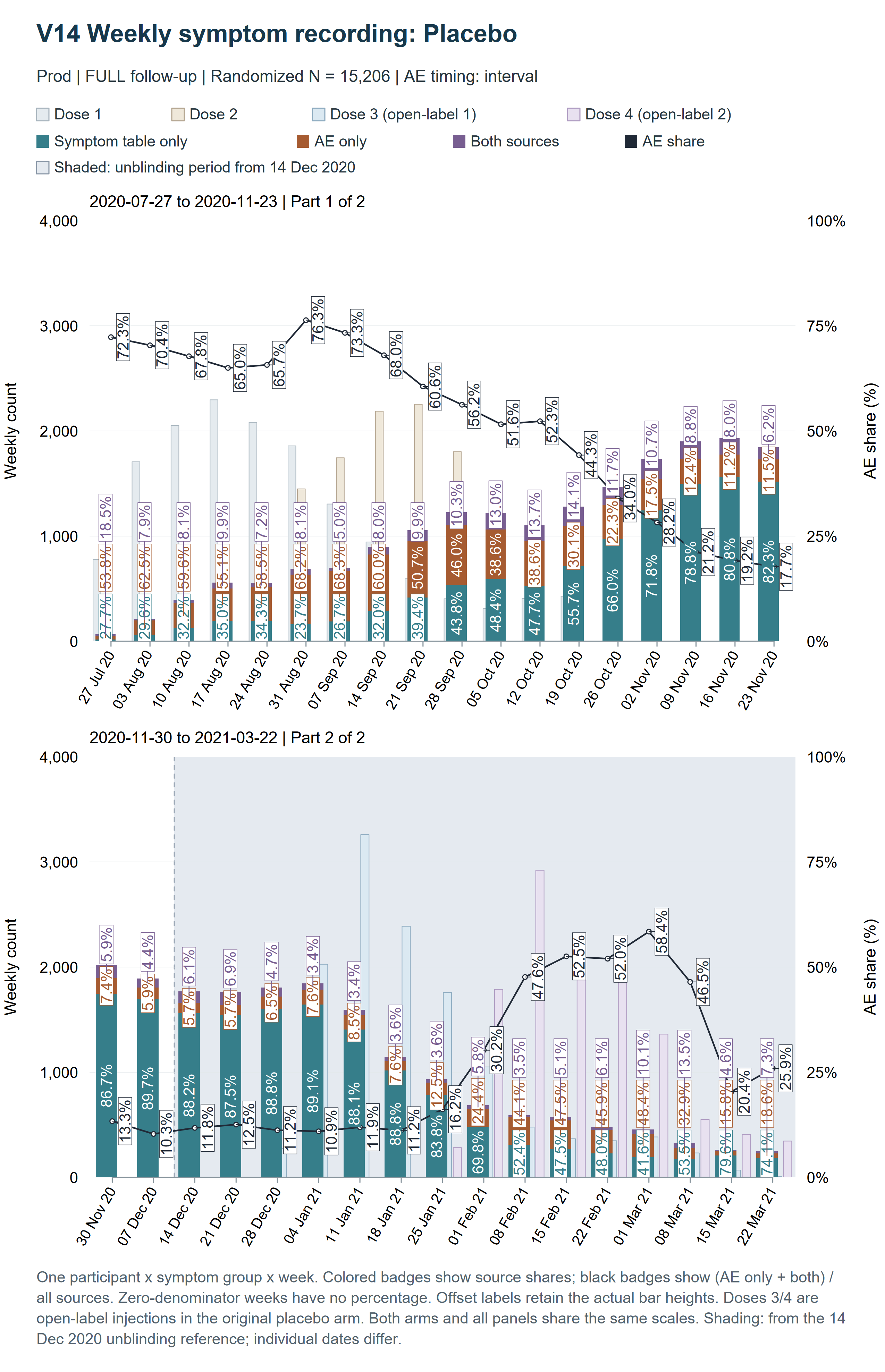
After adjustment for site, calendar week and symptom group, vaccine-arm observations had higher odds of appearing in AE records (OR, 1.85; 95% CI, 1.58 to 2.17; p < 0.000001). When each AE contributed only its onset week, the AE shares were 31.9% and 17.4%. Counting a long-running AE in several weeks therefore does not fully explain the difference.30
Local epidemic activity supplies context for the site comparisons. The 99 trial sites map to 74 counties in 31 states. Weekly case counts use changes in cumulative case totals, while county positivity uses the available CDC seven-day molecular-test indicator. Where county data are unavailable, the specified state-level HHS series uses positive results divided by positive plus negative results, excluding inconclusive results. Weeks run Monday to Sunday. Missing observations remain missing, and the exported source and geography fields distinguish county data from state substitutes.31 32
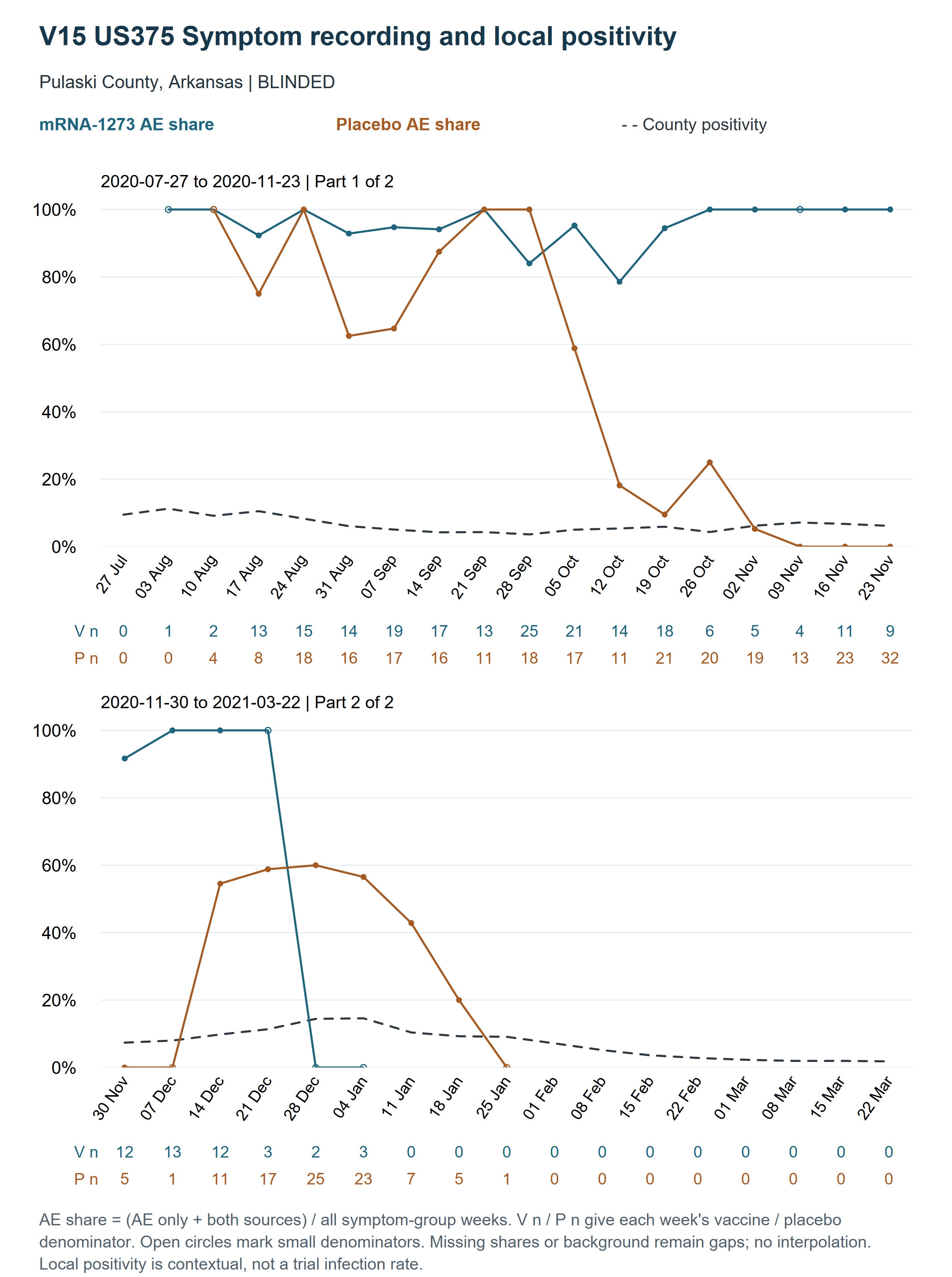
At US375 in Pulaski County, Arkansas, 200 participants were randomized to each arm. During blinded follow-up, 233/252 vaccine-arm symptom-group-weeks (92.5%) involved AE records, versus 160/359 placebo observations (44.6%), a difference of 47.9 percentage points. From the week of 12 October through the week of 30 November, the weekly vaccine-arm share ranged from 79% to 100% and the placebo share from 0% to 25%. V15 shows the weekly denominators and local test positivity alongside those shares.
PCR coverage among participants reporting symptoms
We counted participants in two ways: those with qualifying symptoms on COVID forms, and those with qualifying evidence on COVID forms or in matched AE records. Each participant is counted once per analysis window. Diagnostic PCR coverage requires at least one completed diagnostic-labelled or local-coded PCR linked to symptom evidence on the same date or within seven days, within the allowed follow-up. COVID-form evidence uses assessment dates and AE evidence uses onset dates. The primary analysis includes post-dose days 0-6 and permits follow-up to end at the applicable boundary; requiring a complete seven-day opportunity is examined separately.33
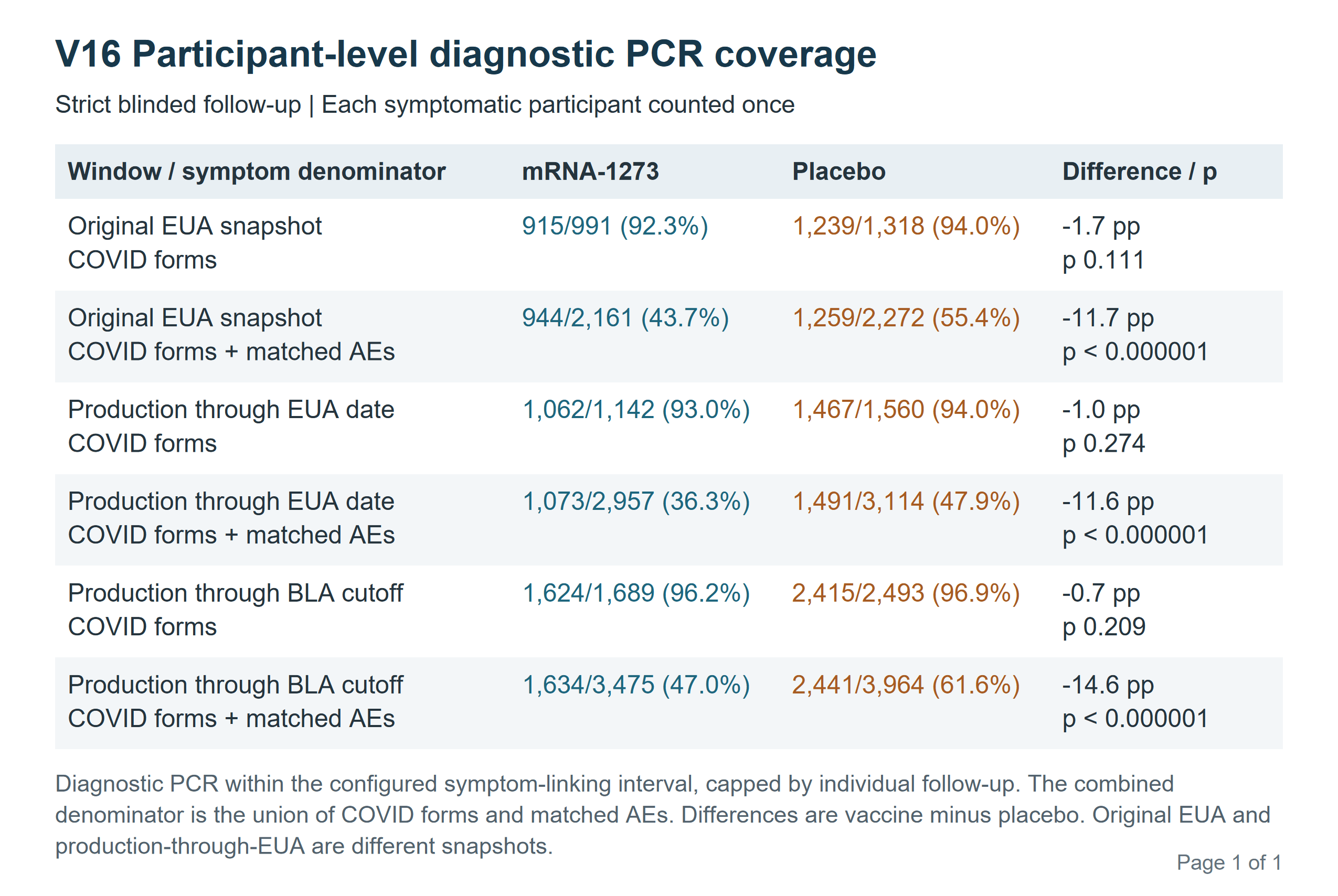
In the original EUA snapshot, 915/991 vaccine recipients (92.3%) and 1,239/1,318 placebo recipients (94.0%) with symptoms on COVID forms had a linked diagnostic PCR (p = 0.111). Including participants whose symptoms appeared only in AE records gave coverage of 944/2,161 (43.7%) versus 1,259/2,272 (55.4%; p < 0.000001). When the production records were truncated at the EUA date, COVID-form coverage was 1,062/1,142 (93.0%) versus 1,467/1,560 (94.0%; p = 0.274); combined coverage was 1,073/2,957 (36.3%) versus 1,491/3,114 (47.9%; p < 0.000001).
Across blinded BLA follow-up, COVID-form coverage was 1,624/1,689 (96.2%) versus 2,415/2,493 (96.9%; p = 0.209). Across both sources, it was 1,634/3,475 (47.0%) versus 2,441/3,964 (61.6%), a vaccine-minus-placebo difference of −14.6 percentage points (p < 0.000001). Coverage was similar among participants who reached a COVID form; it differed when the denominator also included those whose symptoms were recorded only as AEs.
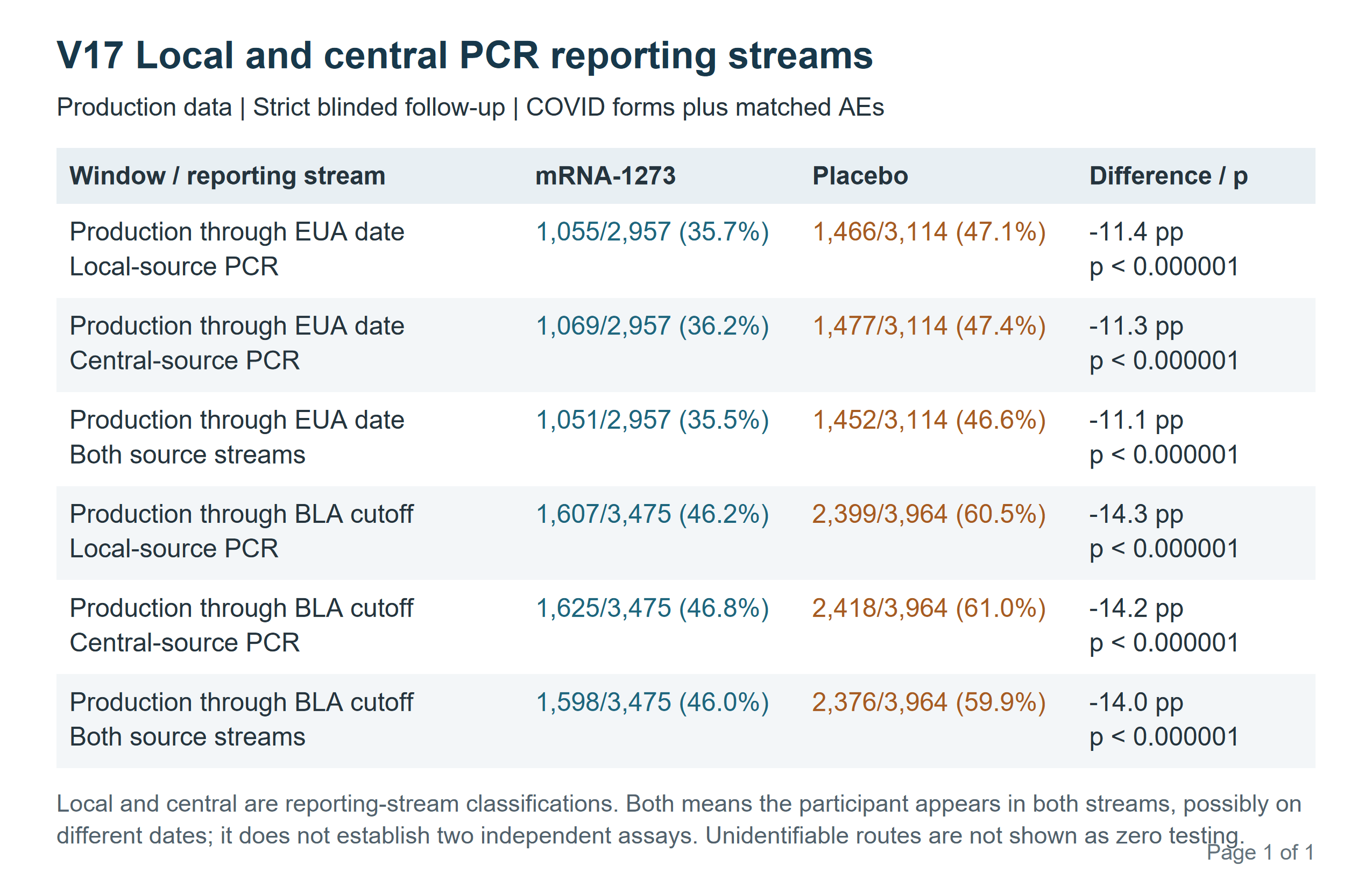
The difference appeared in both laboratory reporting streams. In the combined BLA population, 1,607/3,475 vaccine recipients (46.2%) and 2,399/3,964 placebo recipients (60.5%) had a linked local-source PCR; 1,625/3,475 (46.8%) and 2,418/3,964 (61.0%) had a linked central-source PCR (both p < 0.000001). Among those tested, 97.8% of vaccine recipients and 97.3% of placebo recipients appeared in both streams. A participant can appear in both on different dates; the stream labels do not establish that two distinct laboratories performed two assays.
Symptoms were recorded only in AEs for 1,786/3,475 vaccine recipients (51.4%) and 1,471/3,964 placebo recipients (37.1%) in the combined BLA population. Few in either AE-only group had a linked diagnostic PCR: 9/1,786 (0.50%) versus 16/1,471 (1.09%; Fisher p = 0.069). Allowing any non-baseline PCR, including scheduled tests, gave 321/1,786 (18.0%) versus 199/1,471 (13.5%). A routinely scheduled test need not have been prompted by the complaint. The decision to open a COVID investigation and the subsequent decision to collect a swab therefore warrant separate examination.
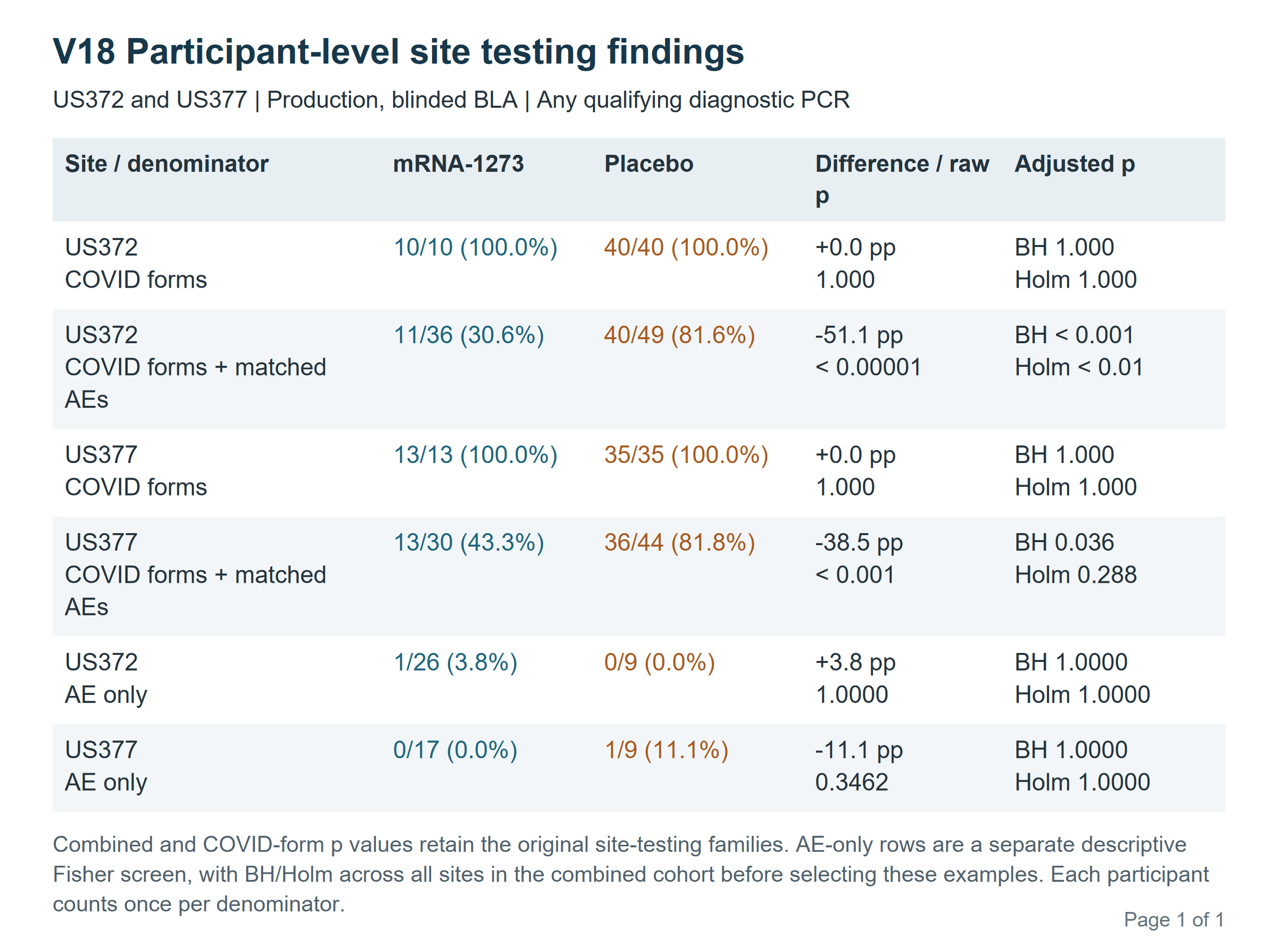
In the family of 99 sites and five testing endpoints, US372 and US377 survived Benjamini-Hochberg adjustment; only US372 also survived Holm adjustment. Combined coverage at US372 was 11/36 (30.6%) versus 40/49 (81.6%; Benjamini-Hochberg p = 0.000252; Holm p = 0.001009). At US377 it was 13/30 (43.3%) versus 36/44 (81.8%; adjusted p = 0.036453 and 0.288090, respectively). Every participant with COVID-form symptoms at these sites had a linked diagnostic PCR: 10/10 versus 40/40 at US372 and 13/13 versus 35/35 at US377. The corresponding AE-only populations were 26 versus 9 and 17 versus 9.
At US372, counting only symptom dates outside post-dose days 0-6, 11/16 vaccine recipients (68.8%) and 40/42 placebo recipients (95.2%) had a linked diagnostic PCR across all blinded weeks. This participant measure differs from the high-positivity episode measure at US372 in ¶60, which also requires a documented illness visit.
Requiring a full seven days of follow-up gave combined diagnostic coverage of 47.0% versus 61.8%. Allowing any non-baseline PCR gave 56.2% versus 66.2%. When we removed symptom dates during post-dose days 0-6 and rebuilt eligibility and test links, coverage was 1,540/2,346 (65.6%) versus 2,397/3,225 (74.3%), a difference of −8.7 percentage points (p < 0.000001). A participant with symptoms on another eligible date could still contribute.
Of the 1,689 vaccine and 2,493 placebo recipients with symptoms on COVID forms, 77 and 903, respectively, had a linked positive PCR. That left 1,612 and 1,590 without a linked positive. When we also included qualifying symptoms recorded as adverse events, testing coverage across blinded follow-up among participants without a linked positive PCR was 1,557/3,398 (45.8%; 95% CI 41.1% to 50.2%) in the vaccine arm and 1,538/3,061 (50.2%; 95% CI 45.6% to 54.7%) in placebo. The vaccine-minus-placebo difference was −4.4 percentage points (95% CI −7.0 to −1.9). We then held the full blinded-period exclusion of participants with a linked positive PCR fixed and set aside symptom dates on days 0-6 after either injection. Participants with symptoms on other dates still counted; a diagnostic PCR counted only if it was linked to a retained symptom date, on that date or within the following seven days and within blinded follow-up. Coverage was 1,465/2,270 (64.5%; 95% CI 59.3% to 68.9%) in the vaccine arm and 1,497/2,325 (64.4%; 95% CI 59.5% to 68.9%) in placebo, a vaccine-minus-placebo difference of +0.2 percentage points (95% CI −2.5 to +3.0). The corresponding comparison in ¶41 includes participants with a linked positive PCR.
Restricting the comparison to baseline-negative, per-protocol participants whose symptoms occurred during blinded follow-up, from 14 days after dose 2 and no later than their individual efficacy cutoff, coverage was 1,143/1,546 (73.9%; 95% CI 68.0% to 78.7%) in the vaccine arm and 1,176/1,600 (73.5%; 95% CI 68.6% to 77.9%) in placebo. The difference was +0.4 percentage points (95% CI −2.9 to +3.8). Each participant counted once per window. Coverage meant at least one completed diagnostic PCR on a qualifying symptom date or within the following seven days, subject to the follow-up cutoff. Participants without such a test stayed in the denominator; absence of a linked positive did not establish absence of infection. These exclusions serve a descriptive purpose. A linked positive PCR requires testing and detection; conditioning on its absence therefore removes tested participants according to an outcome that the testing process itself helped determine. Similar coverage among those who remain cannot independently establish equal ascertainment. We report the complete eligible-episode analysis below alongside this sensitivity: it estimates documented investigation and swabbing among recorded illnesses meeting the protocol rules, whereas the no-positive analysis describes a selected remainder. Neither measures infections or complaints absent from the released records.
Symptomatic episodes, sites and background positivity
Protocol indications for investigation and swabbing
We grouped compatible complaints from COVID forms and matched AE records into illness episodes. For each episode we reconstructed, where possible, the first date on which the symptoms warranted evaluation and the first date on which they warranted a swab. These dates could differ: in the first week after a dose, an upper-airway complaint could warrant evaluation before it met the duration rule for a swab. We used the sponsor’s amendment dates because site-specific activation logs were unavailable. A fever label without a supporting temperature, or dates insufficient to establish duration, left that indication indeterminate; another symptom could still qualify the illness.
Day 0 is the date of the relevant protocol trigger. We required three further calendar days of blinded observation. A checklist already present when the illness qualified counts as documented by day 3. None of the 6,384 swab-indicated episodes had a verified timestamp for the qualifying report to site staff. A day-3 swab could therefore fall on either side of 72 hours; same-day records also do not establish which action occurred first. We could measure a different interval: the time between the stated contact date and its first entry in the electronic field. Of 642 eligible contact-date fields, 64 were first entered at least 30 days later. Those 64 entries concerned 56 participants. The denominator counts fields in each release, so a contact can appear twice. For US3572076, the 1 September 2020 contact date was entered on 9 April 2021, 220 days later. Two negative illness-visit laboratory records carry the September date. Here the documentation was late; the records do not show a 220-day delay in testing.
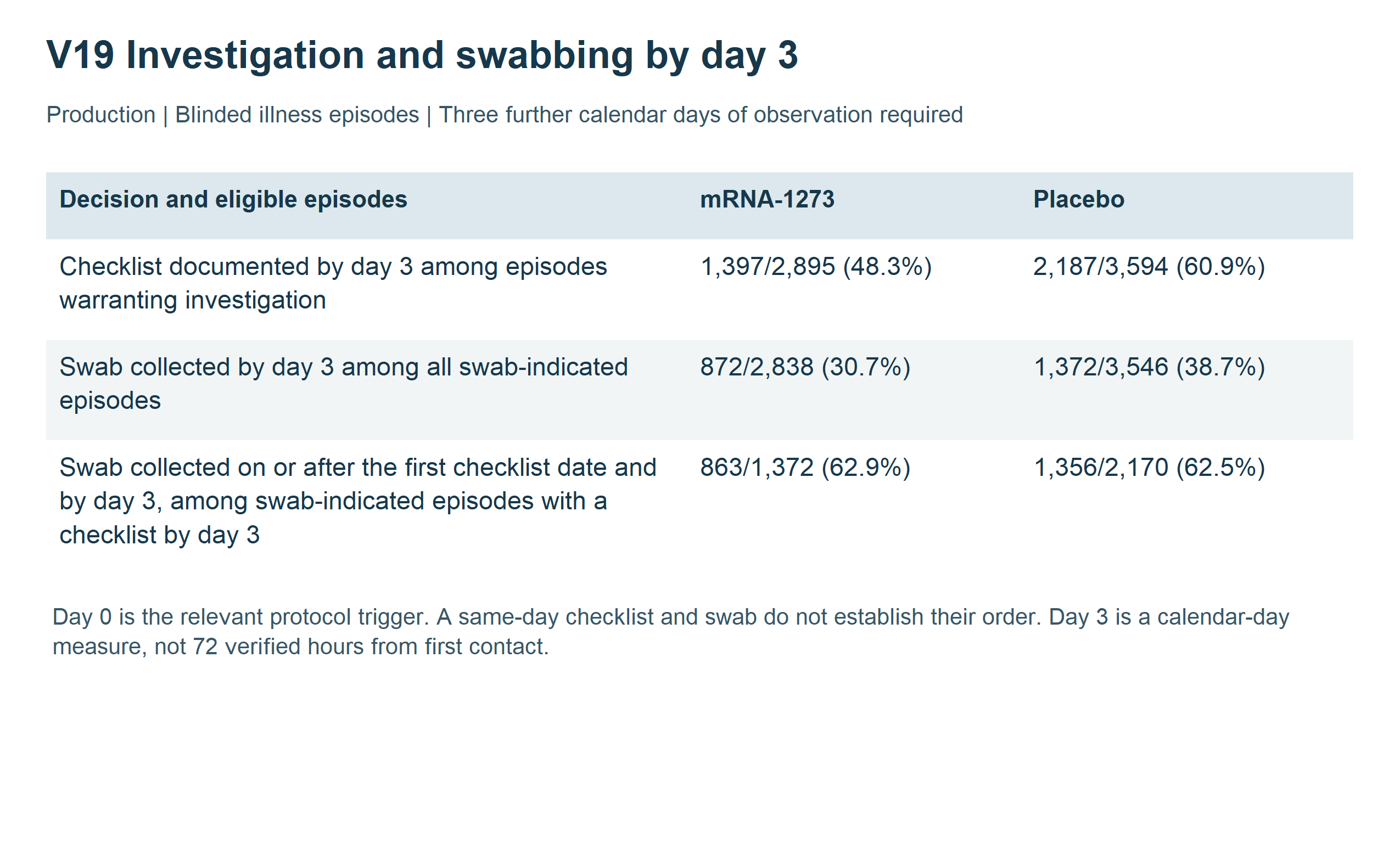
A checklist was documented by day 3 in 48.3% of vaccine-arm episodes warranting investigation and 60.9% of placebo episodes. Among all episodes that warranted a swab, 30.7% and 38.7%, respectively, had one collected by day 3. Among swab-indicated episodes with a checklist by day 3, 62.9% and 62.5% had a swab on or after the first checklist date and by day 3. V19 shows the denominator for each decision.
Where a qualifying symptom was documented as an AE and there was no earlier checklist, a checklist was documented by day 3 in 234/1,700 vaccine-arm episodes (13.8%) and 227/1,603 placebo episodes (14.2%). In this comparison the AE record identifies the complaint even if staff never completed a checklist. At site US393 the forms document missed investigations in both arms. For US3932147 (placebo), a monitor identified cough, shortness of breath, fatigue, muscle aches, headache, congestion and diarrhoea on 20–27 September 2020. The complaints began in the first week after dose 1 and persisted beyond it. The monitor said the participant should have had an illness visit; the site confirmed that none was completed. All seven complaints appear in the EUA and licensing AE tables. No PCR is dated to that illness in the released laboratory records.
At the same site, US3932018 (vaccine) reported joint aches from 28 August to 23 September 2020. The site acknowledged that it had inadvertently missed the illness visit and said it would report a deviation. The swabs on 28 August and 24 September were routine vaccination-visit samples. None of the five submitted deviations for this participant explicitly identifies the missed illness visit. At a second site, the medical monitor asked whether US3632127 (placebo) had been assessed for COVID after an intermittent cough on 3–13 January 2021. The site answered that no illness visit had taken place. No PCR is dated during the cough. The forms establish missed investigations; they cannot establish whether any of these illnesses was COVID.
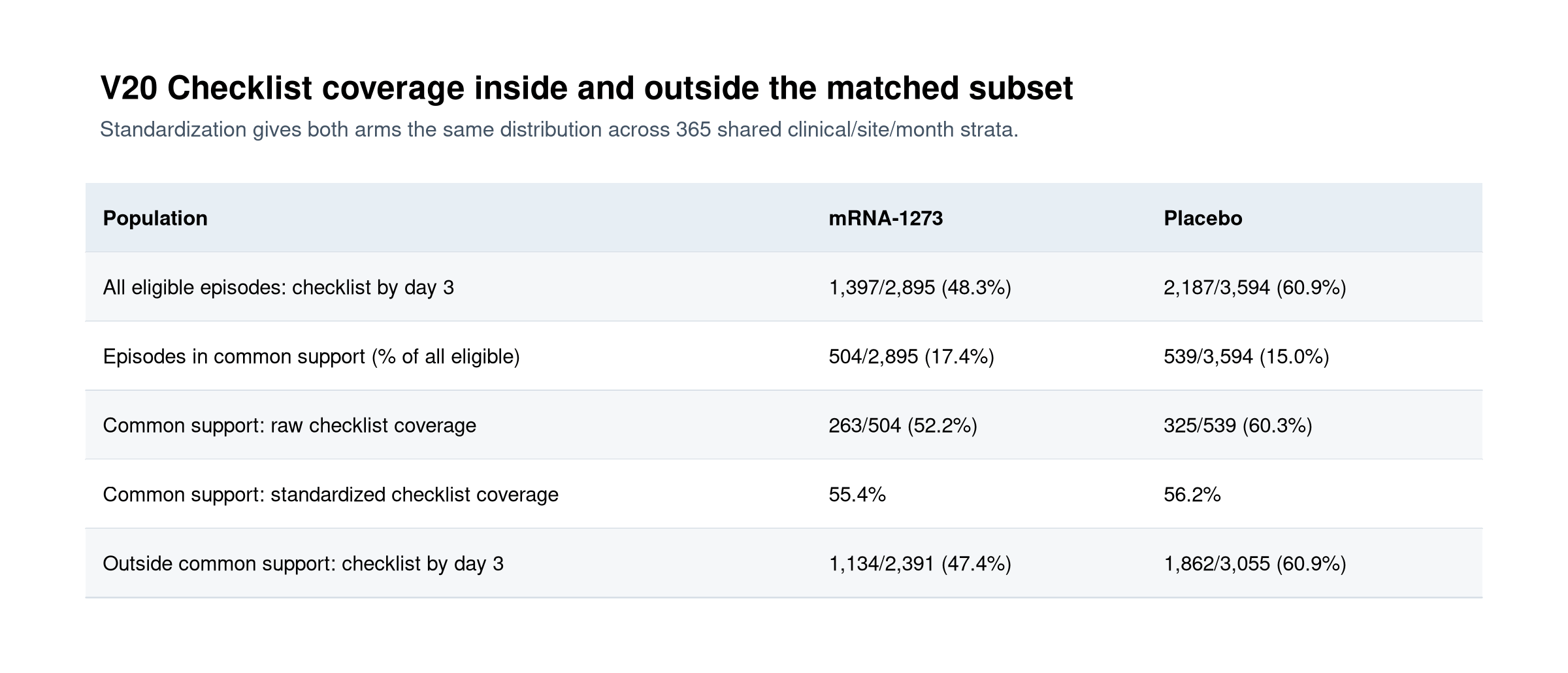
We compared episodes within the same site and calendar month, accounting for trigger symptom, number of symptom groups, recorded severity and duration, time from onset, and dose timing. For checklist documentation, 504 of 2,895 vaccine-arm episodes (17.4%) and 539 of 3,594 placebo episodes (15.0%) had counterparts under these rules, across 365 shared strata and 82 sites. Applying the same stratum weights to both arms gave standardized checklist coverage of 55.4% versus 56.2%, a vaccine-minus-placebo difference of −0.85 percentage points (95% CI from resampling sites, −2.75 to +1.03). For swabbing after checklist documentation, the difference was +0.72 points (95% CI −6.34 to +7.79), based on 256 and 312 episodes. The unmatched remainder comprised 2,391 vaccine and 3,055 placebo episodes across all 99 sites. Checklists were documented by day 3 for 1,134/2,391 (47.4%) and 1,862/3,055 (60.9%); swabs were documented for 711/2,391 (29.7%) and 1,164/3,055 (38.1%). These are unadjusted descriptions of the unmatched population. The accompanying exports show its distribution by site, symptom pattern, severity, source and dose timing. The matched result applies to episodes with comparable recorded characteristics in both arms; it does not resolve the broader recording difference or establish the appropriateness of decisions in episodes without a counterpart.
Among swab-indicated episodes, diagnostic specimens of any type, including saliva, yielded 38 versus 501 positive results, 902 versus 1,004 negative results, and one versus zero indeterminate results by day 3, respectively for mRNA-1273 and placebo. No qualifying diagnostic specimen was documented in that window for 1,897 vaccine versus 2,041 placebo episodes. Each episode was counted once.
Among swab-indicated episodes with complete seven-day follow-up, a documented illness visit and qualifying PCR within seven days of first symptom evidence occurred in 1,179/2,818 vaccine episodes (41.8%) and 1,923/3,526 placebo episodes (54.5%). A swab within seven days of the protocol indication was documented in 1,167/2,818 (41.4%) and 1,858/3,526 (52.7%), a difference of −11.3 percentage points (95% site-bootstrap CI −13.8 to −9.0). The starting date and what counts as testing differ between these measures. Keeping the same complete-follow-up rule but excluding episodes with a linked positive PCR during days 0–7 removes 53 vaccine and 689 placebo episodes. Swab coverage in the remainder is 1,115/2,765 (40.3%) versus 1,220/2,837 (43.0%), a difference of −2.7 points (95% CI −5.2 to −0.1). This sensitivity shows how strongly the composition of the denominator affects the comparison. It cannot establish the testing or infection status of episodes that were not detected as positive. In the baseline-negative, per-protocol window beginning 14 days after dose 2, the complete seven-day episode comparison, including detected positives, is 800/1,128 (70.9%) versus 1,397/1,855 (75.3%). Follow-up boundaries do not explain the full-population seven-day gap in the tested scenarios. An explicit unblinding date is absent for 646 vaccine and 896 placebo recipients; only 153 and 159 lack all the blinded-phase boundary indicators used in the analysis. Missing unblinding dates are not equivalent to undocumented follow-up, since death, withdrawal or another phase boundary can end observation. Restricting to participants with an explicit unblinding date gives coverage of 41.7% versus 52.4%. Capping follow-up on 17 December 2020 only where no phase boundary, death or study-end date is recorded gives 41.4% versus 52.7%. These scenarios test sensitivity to available dates; the common calendar cap is not an imputed personal unblinding date. FDA examined suspected COVID-19 beginning at least 14 days after dose 2 during blinded follow-up. Moderna searched three listings for participants with COVID or suspected-COVID adverse events, illness or convalescent specimens lacking a qualifying result, or illness visits where no sample was collected. At the licensing database lock, 21 vaccine recipients and 39 placebo recipients met the investigation criteria and lacked a qualifying PCR result. Three placebo recipients met clinical criteria for severe illness. Moderna supplied narratives for those three placebo recipients (US3302472, US3572086 and US3642333). FDA judged that including suspected cases from this group would be unlikely to materially change the efficacy result.34
Our review packet contains 570 respiratory episodes with no documented diagnostic specimen from the protocol trigger through day seven, plus 570 tested controls. An episode could qualify for this review even if a specimen was collected later. FDA counted participants from a defined period after dose 2 and assessed the availability of a qualifying result at database lock. A participant-by-participant comparison would establish the overlap. We have not performed that linkage.
Reconstructing the opportunity for testing
The episode analysis combines compatible complaints from COVID forms and AE records when their intervals overlap or are separated by no more than seven unrecorded days. Each reconstructed episode is assigned to its onset week. A recorded assessment date is not automatically a symptom-onset date; an AE with no known end date contributes onset evidence only. The primary analysis includes the first seven post-dose days and applies participant-specific blinded follow-up limits within 27 July 2020 to 26 March 2021.35 36
The endpoint requires a documented illness-visit association and a diagnostic PCR within seven days after the first recorded symptom evidence, with the test on the visit date or within three days of it. Both arms must have a full seven-day observation opportunity. A laboratory visit label can establish the recorded association; it does not by itself prove physical attendance at a trial site. Unlike the preceding participant analysis, this endpoint asks whether each reconstructed illness received the specified visit-and-PCR follow-up.
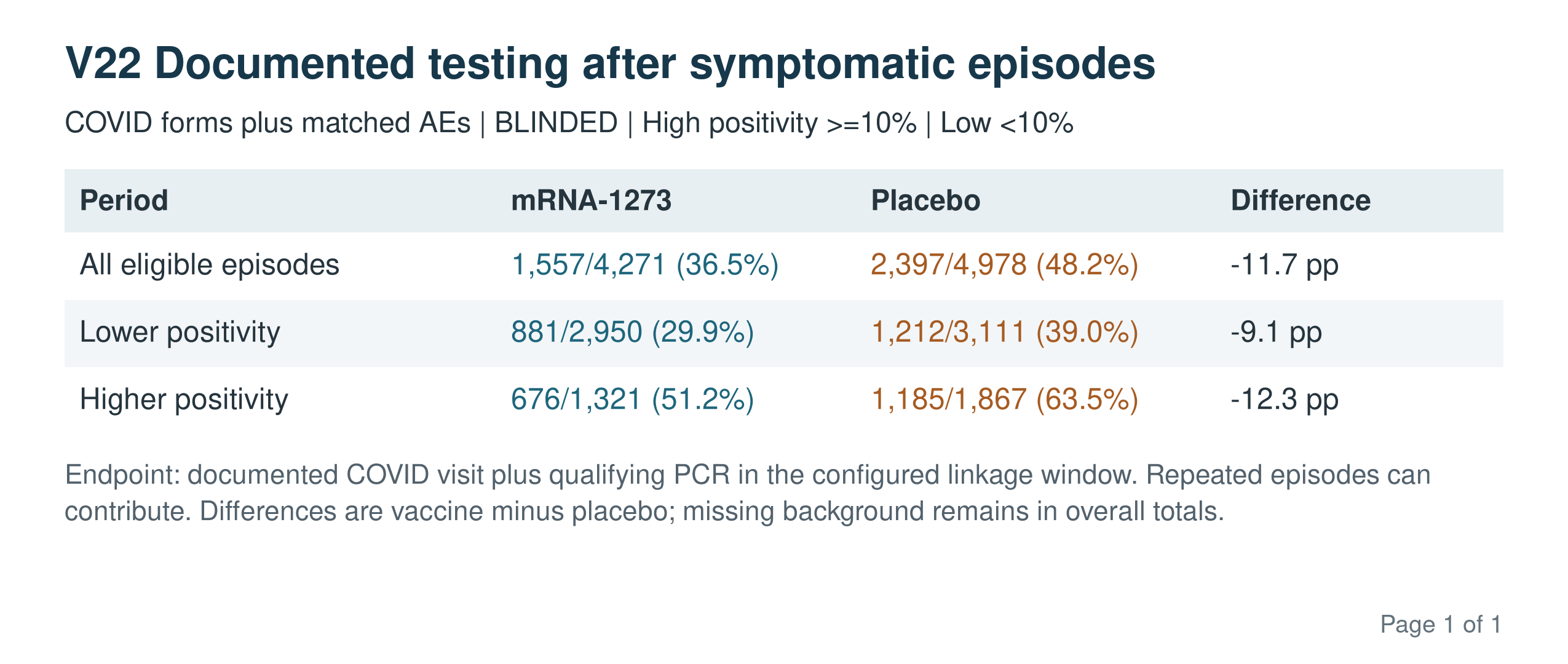
Across all eligible episodes, the seven-day visit-and-PCR endpoint was met in 1,557/4,271 vaccine episodes (36.5%) and 2,397/4,978 placebo episodes (48.2%). In weeks with local positivity below 10%, it was met in 881/2,950 (29.9%) versus 1,212/3,111 (39.0%). In weeks with positivity of at least 10%, it was met in 676/1,321 (51.2%) versus 1,185/1,867 (63.5%). Testing was more frequent in higher-positivity weeks in both arms.
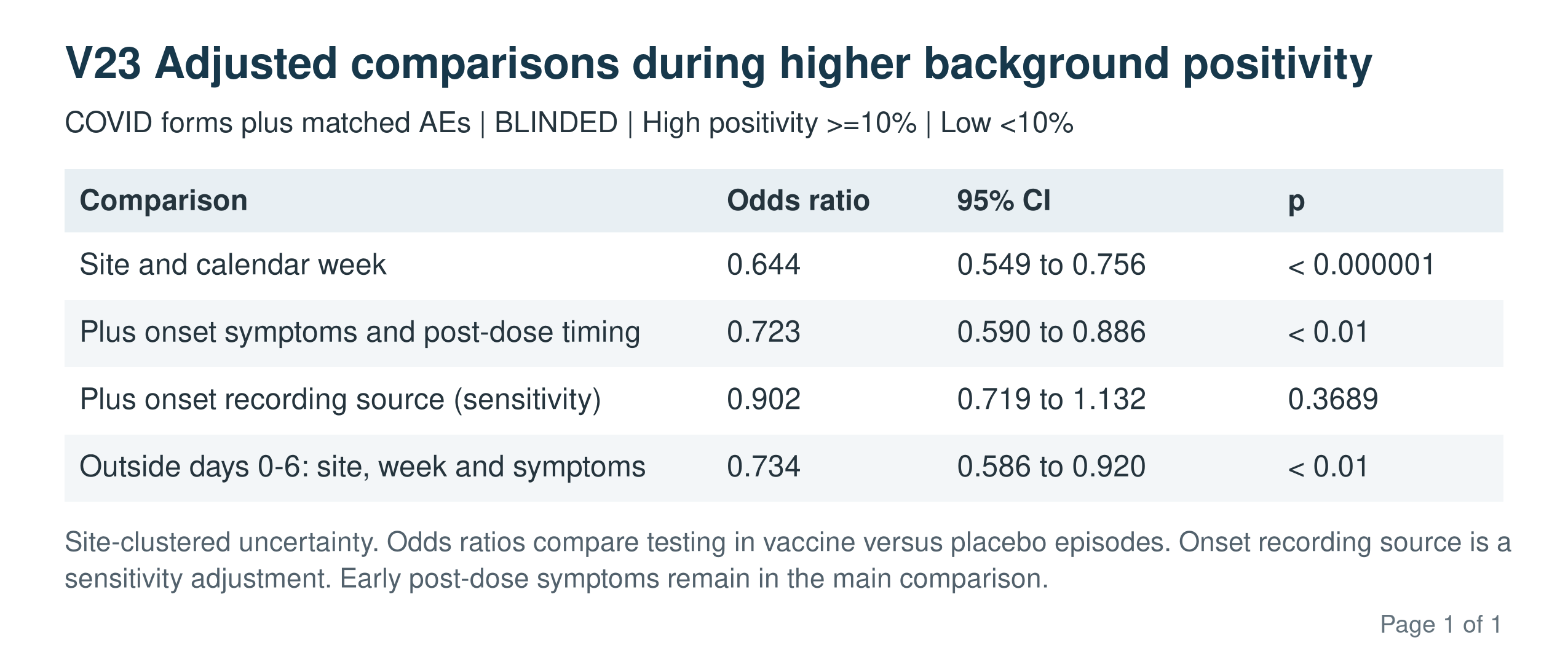
During high-positivity weeks, the vaccine-to-placebo odds ratio for documented testing was 0.644 (95% CI, 0.549 to 0.756; p < 0.000001) after adjustment for site and calendar week. Adding onset symptoms and post-dose timing gave 0.723 (0.590 to 0.886; p < 0.01). Adding recording source gave 0.902 (0.719 to 1.132; p = 0.369). Restricting to episodes outside post-dose days 0-6 and adjusting for site, week and symptoms gave 0.734 (0.586 to 0.920; p < 0.01). The intervals account for clustering within sites.
Recording source, as Symptom or as Adverse Event, deserves particular attention in this model. If the decision to classify a complaint as an AE influenced whether a COVID investigation followed, source lies within the pathway being audited. Adjustment for it describes where the aggregate difference is concentrated; it does not establish that the original clinical decisions were appropriate. Likewise, matching recorded symptom patterns and timing does not fully match clinical severity.
Site-level findings during high positivity
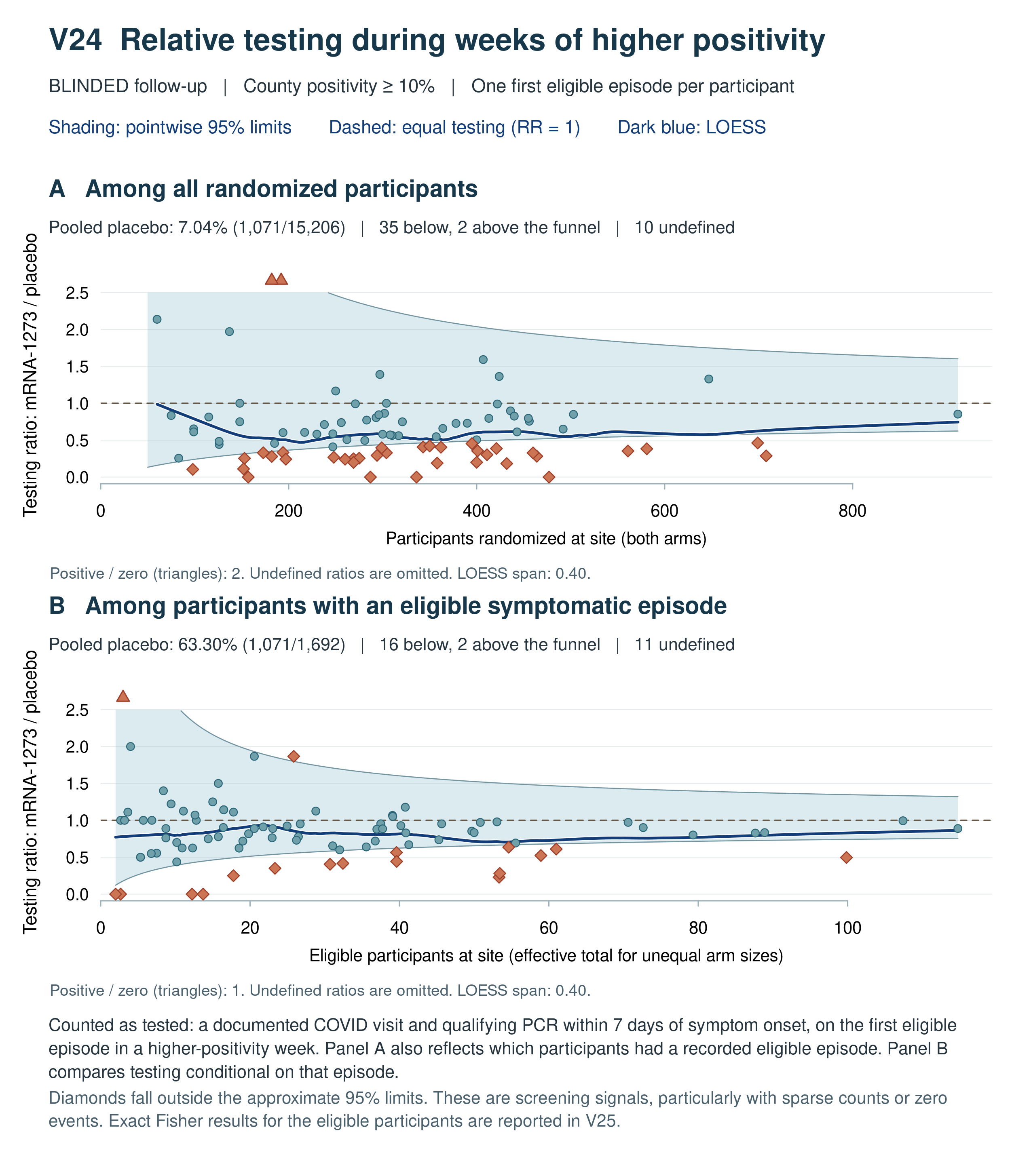
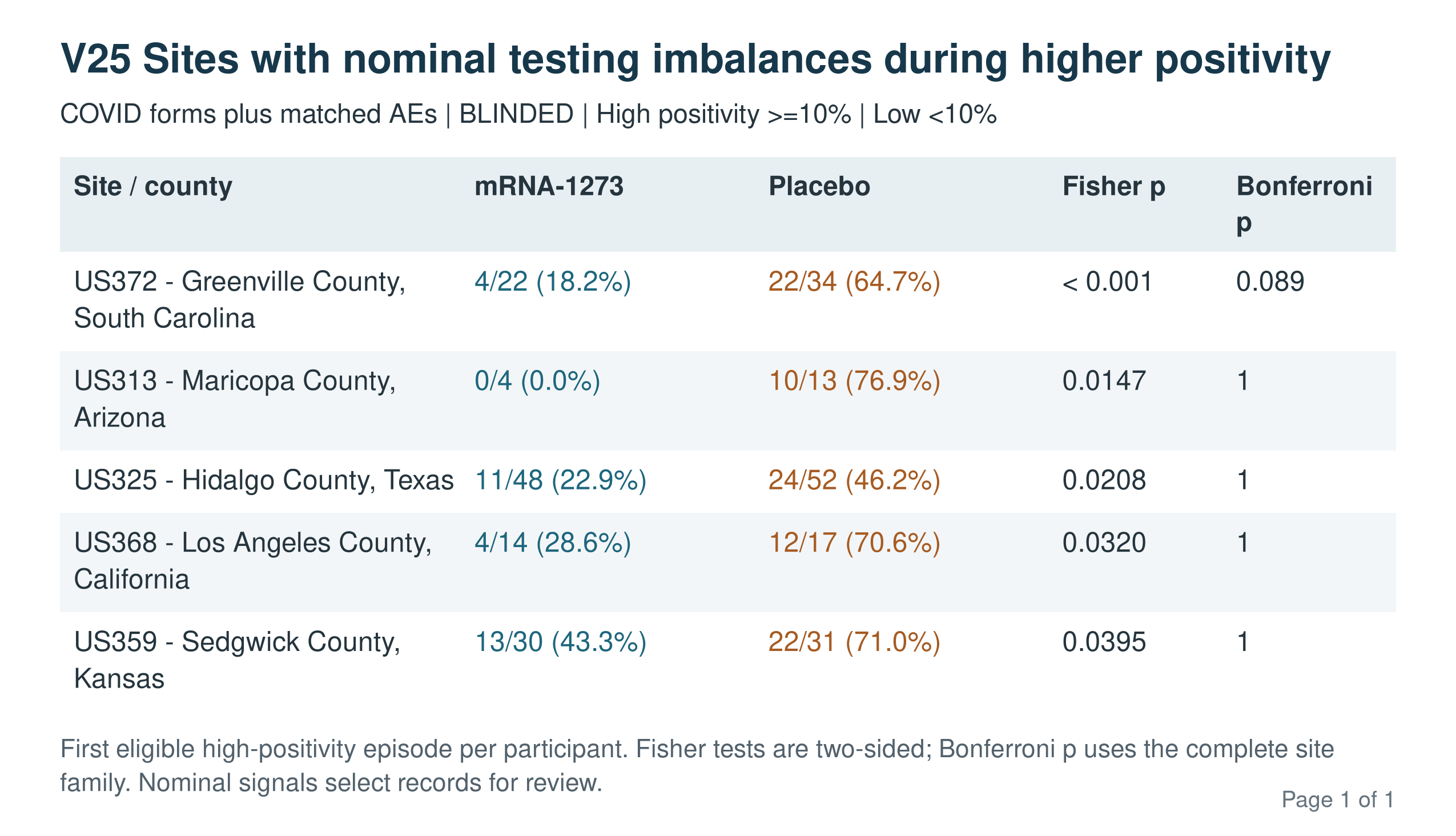
We retained each participant’s first eligible episode during high-positivity weeks. Five of 99 sites had a nominal two-sided Fisher p value below 0.05; none remained significant after Bonferroni adjustment across the 99 sites. The vaccine versus placebo counts were: US372, Greenville County, SC, 4/22 versus 22/34 (p = 0.00090; adjusted p = 0.0895); US313, Maricopa County, AZ, 0/4 versus 10/13 (p = 0.0147); US325, Hidalgo County, TX, 11/48 versus 24/52 (p = 0.0208); US368, Los Angeles County, CA, 4/14 versus 12/17 (p = 0.0320); and US359, Sedgwick County, KS, 13/30 versus 22/31 (p = 0.0395). These fractions describe participants’ first eligible high-positivity episodes, not all participants who ever reported symptoms. V24 counts each participant once, at the first eligible symptomatic episode during blinded follow-up in a week when local test positivity was at least 10%. In both panels, the numerator counts participants with a documented illness visit and qualifying PCR within seven days. Panel A uses all randomized participants as its denominator: 602/15,209 mRNA-1273 recipients (3.96%) and 1,071/15,206 placebo recipients (7.04%) met that endpoint. Panel B uses only participants who had an eligible episode: 602/1,200 (50.2%) and 1,071/1,692 (63.3%), respectively. Panel A therefore reflects both how often an eligible illness was recorded and how often it was tested; panel B compares testing among participants with such an illness.
Each site’s vaccine-to-placebo testing ratio is judged against approximate 95% limits for equal testing rates, using the pooled placebo rate for that panel. In panel A, 35 sites fell below the lower limit and two above the upper limit; in panel B, 16 fell below and two above. These crossings identify sites for review. V25 reports the exact tests for the eligible-participant comparison; none remained significant after Bonferroni adjustment across the 99 sites.
At US325, during weeks with at least 10% local test positivity, we compared all eligible episodes first recorded only on a COVID form. A visit and qualifying PCR were documented within seven days of first symptoms in 15/19 vaccine-arm episodes (78.9%) and 26/26 placebo episodes (100%). Those episodes involved 18 vaccine and 24 placebo participants. All four exceptions began outside post-dose days 0-6. US3252521 and US3252324 had negative PCRs on days 8 and 15, respectively, within the reconstructed illness. US3252097 had a “NOT DONE” record on the day symptoms were first recorded. US3252024 had a negative PCR on day 21, outside the reconstructed illness.
Three of the four had a documented swab indication: chills in US3252024 and cough in US3252097 and US3252324. For US3252521 the available records did not establish whether the duration requirement was met. Applying the same protocol rules to both arms, 12/15 vaccine versus 13/19 placebo episodes with a documented indication had a swab on days 0-3 after the qualifying symptom; by day seven the counts were 12/15 versus 18/19. The four timelines therefore identify individual decisions to review. They do not, by themselves, establish lower vaccine-arm sampling within the shorter protocol window.
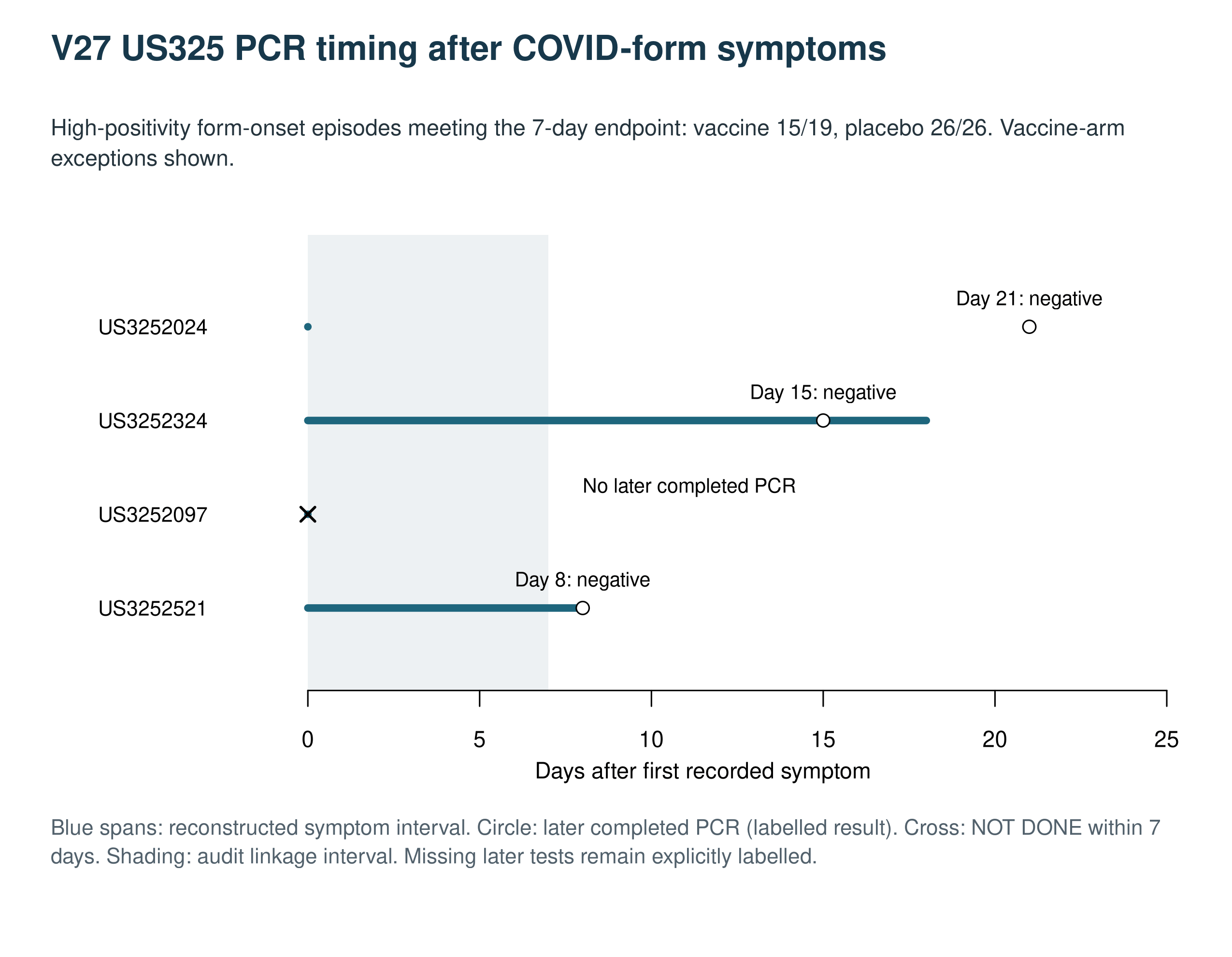
The plot shows every episode in this comparison that missed the seven-day visit-and-PCR endpoint: 4/19 vaccine-arm episodes and 0/26 placebo episodes. All began on COVID forms in weeks of at least 10% local test positivity. A missed endpoint does not establish infection.
At US352, 32 of the 33 vaccine-arm episodes during high-positivity weeks began in AE records only. One began in both sources and none began only on a COVID form. Of 24 placebo episodes, 16 began in AE records only, seven only on COVID forms and one in both sources. Testing occurred in 1/32 versus 0/16 AE-only episodes, in 6/7 placebo COVID-form-only episodes, and in the single both-source episode in each arm. There was no vaccine-arm COVID-form-only episode from which to estimate a testing rate. The site records would help explain why complaints entered different reporting routes.
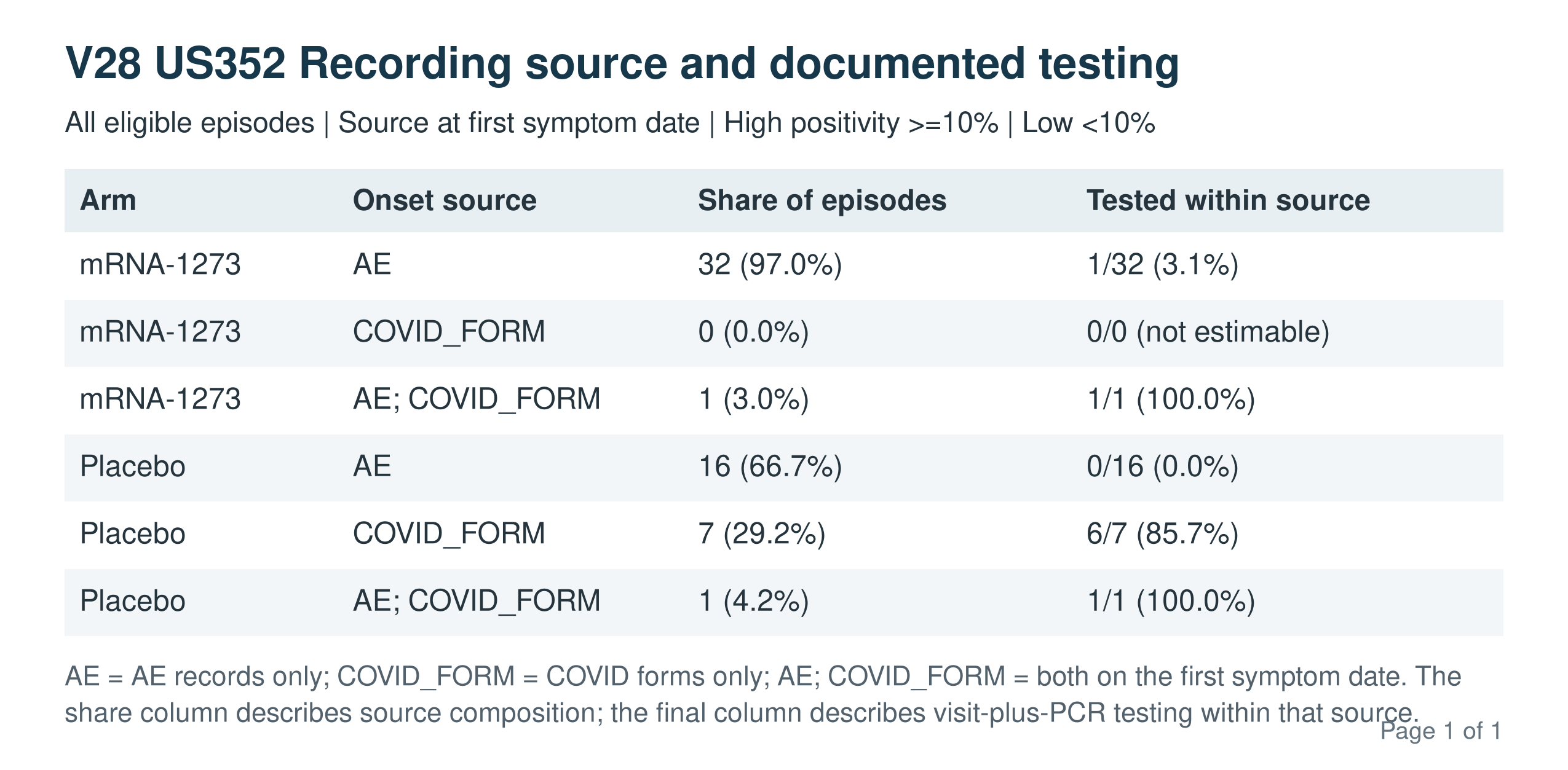
At US372, during high-positivity weeks, 5/26 vaccine episodes (19.2%) and 26/38 placebo episodes (68.4%) met the seven-day visit-and-PCR endpoint. No episode beginning on days 0-6 after a dose met it in either arm (0/21 versus 0/9). These early episodes accounted for 21/26 of the vaccine total but only 9/38 of the placebo total. Outside that window, testing was documented for 5/5 vaccine and 26/29 placebo episodes. No early episode met the endpoint in either arm. The vaccine arm’s lower pooled percentage reflects its larger share of early episodes. The original symptom and contact records are needed to determine which of those complaints warranted investigation.
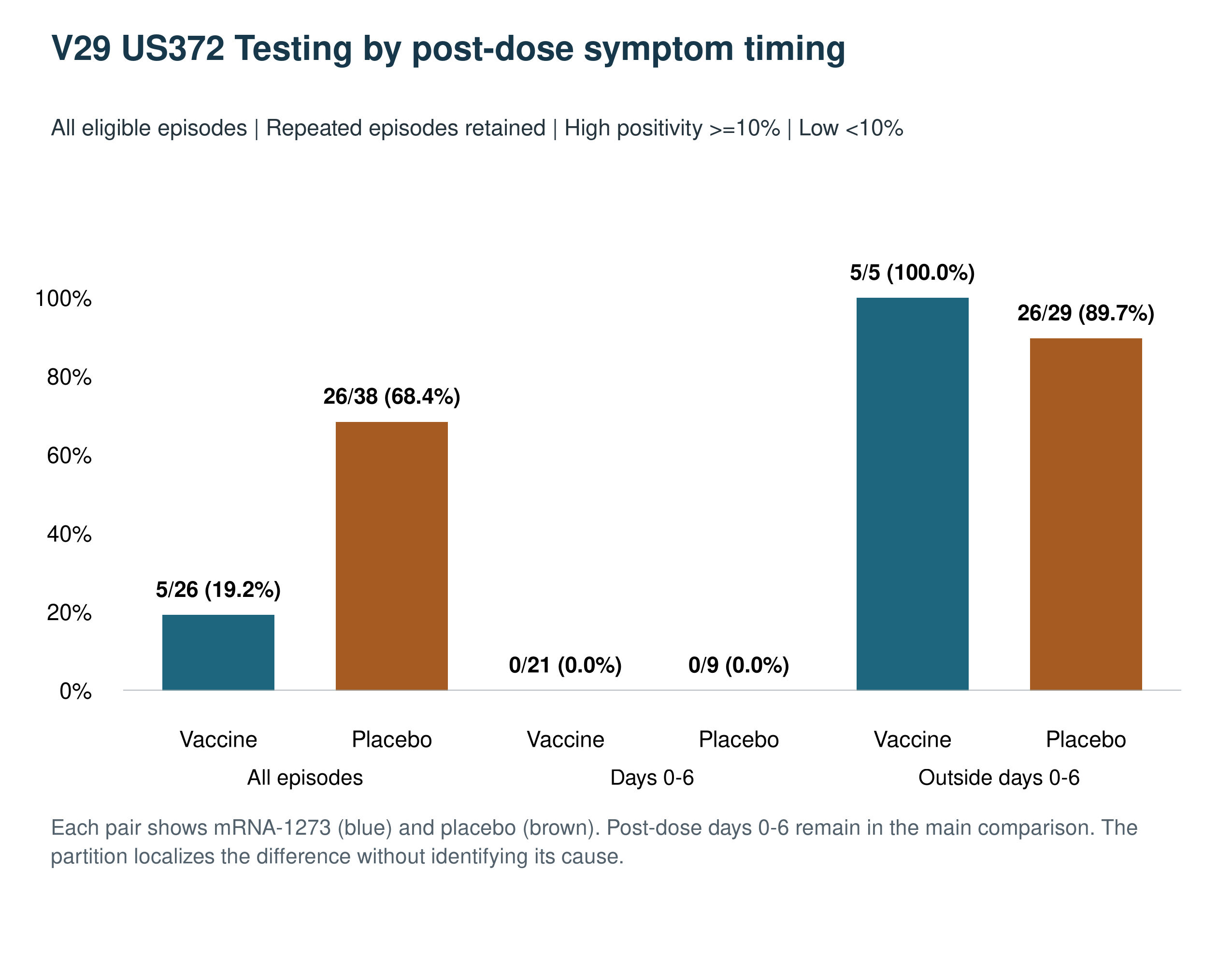
Site testing in weeks of lower and higher local positivity
A further descriptive screen compares low- and high-positivity periods within each site and arm, requiring at least ten episodes in each cell. Four sites show vaccine testing decreasing while placebo testing increases. At US302, Chatham County, Georgia, vaccine coverage falls from 9/13 (69.2%) to 9/22 (40.9%), while placebo rises from 7/16 (43.8%) to 10/18 (55.6%). The difference between these changes is −40.1 percentage points. These categories pool eligible weeks; they do not necessarily describe a single chronological transition.
At US320 (Hamilton County, TN), vaccine-arm testing was 11/19 (57.9%) in low-positivity weeks and 20/37 (54.1%) in high-positivity weeks; placebo testing was 12/27 (44.4%) and 40/65 (61.5%). At US321 (Harris County, TX), the corresponding counts were 22/40 (55.0%) and 8/16 (50.0%) for vaccine versus 39/66 (59.1%) and 28/40 (70.0%) for placebo. At US372 they were 3/14 (21.4%) and 5/26 (19.2%) versus 12/19 (63.2%) and 26/38 (68.4%). The nominal arm-by-positivity interaction p values were 0.1047 at US302, 0.2441 at US320, 0.3224 at US321 and 0.7101 at US372.
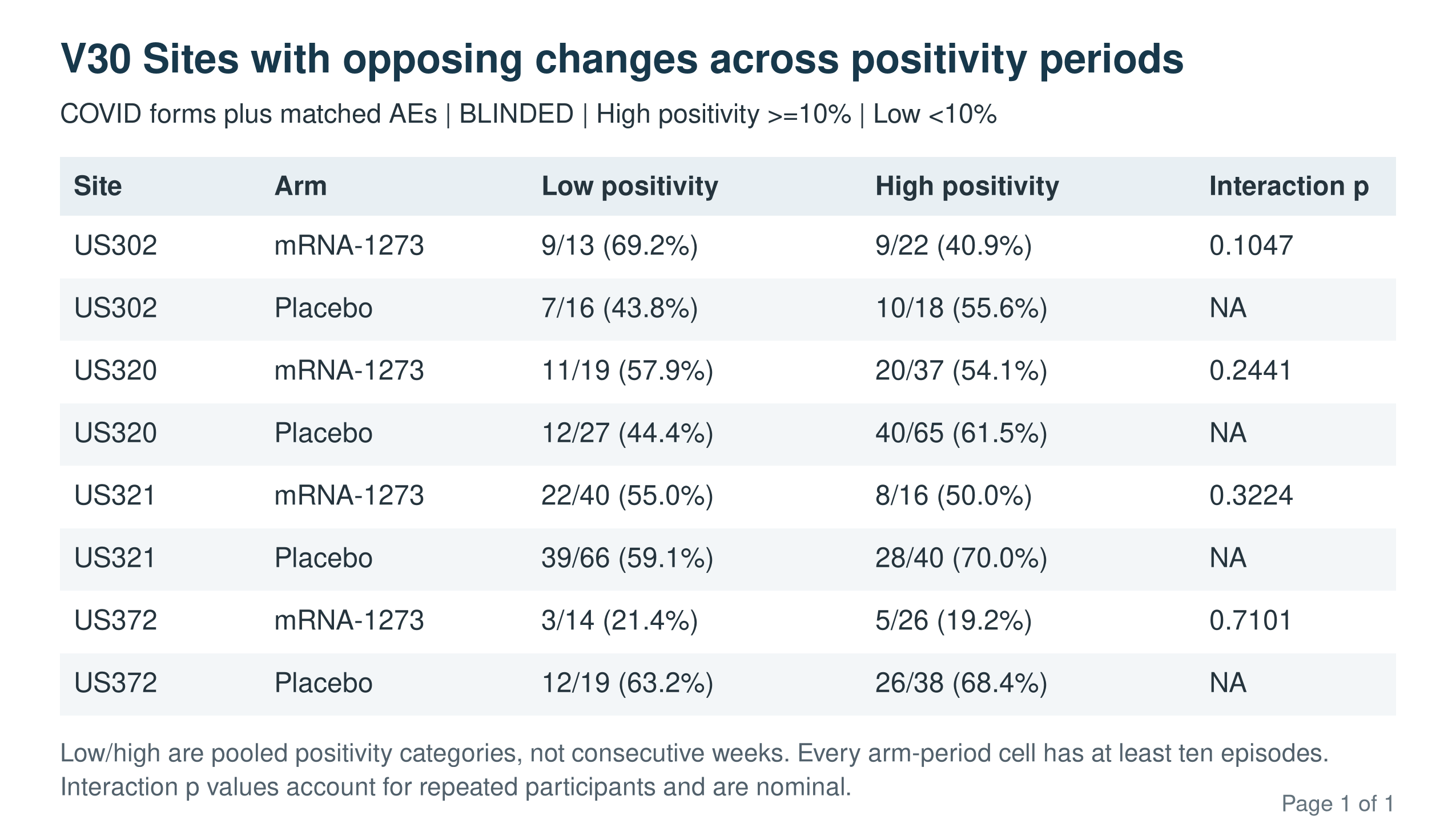
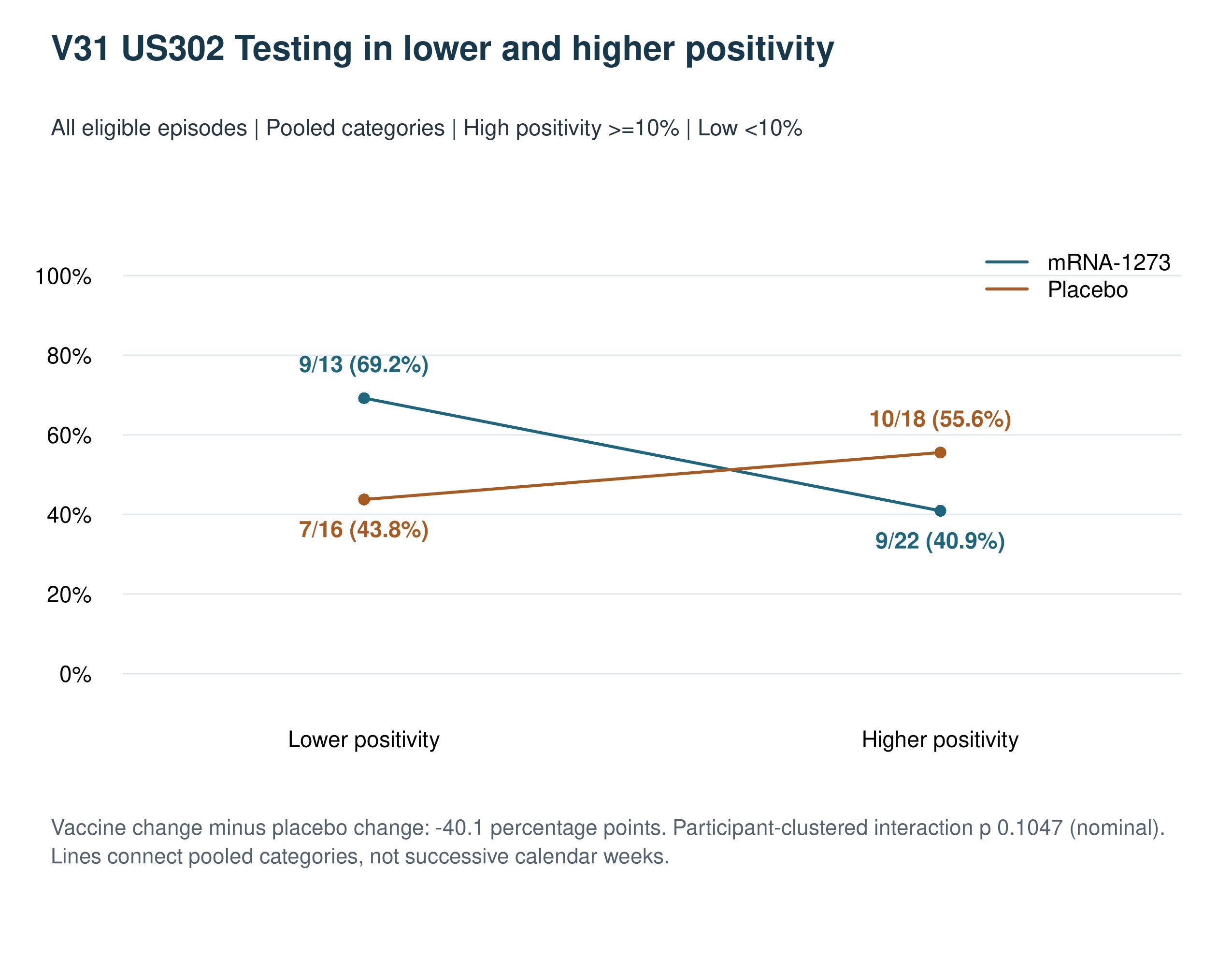
In the pooled model, the arm-by-positivity interaction odds ratio was 0.809 (site-clustered 95% CI, 0.638 to 1.025; p = 0.0788). The selected sites show opposing changes in documented testing, but the pooled analysis does not establish a general arm-specific response to rising local positivity. These sites and weeks identify concrete records for reviewing symptom severity, reporting dates, visit decisions and specimen collection.
Anti-N antibodies and infections not identified by PCR
What serology measured
The trial used the Roche Elecsys Anti-SARS-CoV-2 immunoassay to detect antibodies to the viral nucleocapsid protein. Because mRNA-1273 targets spike, anti-N antibodies were used as evidence of infection rather than as the intended vaccine response. The August 2020 protocol scheduled blood sampling for immunological assessment on Days 1 and 29 before injection, and on Days 57, 209, 394 and 759. Additional specimens were planned at illness visits and, after confirmed COVID-19, at a convalescent visit approximately 28 days later. These sampling plans should be distinguished from the availability of completed anti-N results in the released data. The published blinded-phase analysis used samples from Days 1, 29 and 57 and the participant decision visit, when allocation was disclosed; laboratory identifiers were intended to preserve blinding.37
Seroconversion supplemented PCR surveillance but did not satisfy the primary symptomatic COVID-19 endpoint, which required the specified symptoms and a positive PCR. Conversely, a negative anti-N result could not reliably exclude previous infection. Among 700 evaluable participants with PCR-confirmed illness in the published substudy, anti-N antibodies were detected at a median of 53 days after diagnosis in 21/52 vaccine recipients (40%) versus 605/648 placebo recipients (93%). The abstract’s reported 95% confidence intervals were 27%-54% and 92%-95%. Thus, 31 vaccine recipients (59.6%) and 43 placebo recipients (6.6%) were anti-N-negative at that assessment despite PCR-confirmed illness. A tenfold increase in viral copies at diagnosis was associated with higher odds of seroconversion (arm-adjusted OR, 1.90; 95% CI, 1.59-2.28). The analysis plan distinguishes the November 2020 analyses from the final blinded analysis. At the first interim and November primary analyses, the scheduled Day 29 PCR and anti-N results were excluded from the derivation of COVID-19 cases. In the final blinded analysis, a positive anti-N result at a scheduled visit could end a participant’s time at risk at the date of detected infection. The effect of differential antibody detection on the efficacy estimate has not been quantified here.38
The published-count check recalculates the arm-specific proportions, negative counts, exact binomial intervals and a two-sided Fisher test. It gives 40.4% versus 93.4%, a difference of −53.0 percentage points and p < 0.000001; the recalculated exact intervals are 27.0%-54.9% and 91.2%-95.2%. These are labelled separately from the publication’s intervals. The published selection starts with 58 versus 754 PCR-confirmed cases before the decision visit, excludes 0 versus 51 without that visit and 6 versus 55 without serology at it, leaving 52 versus 648. Recalculating these aggregates is distinct from reconstructing the participant selection in the PHMPT records. The viral-load model likewise requires participant-level quantitative data and cannot be refitted from the arm totals alone.39
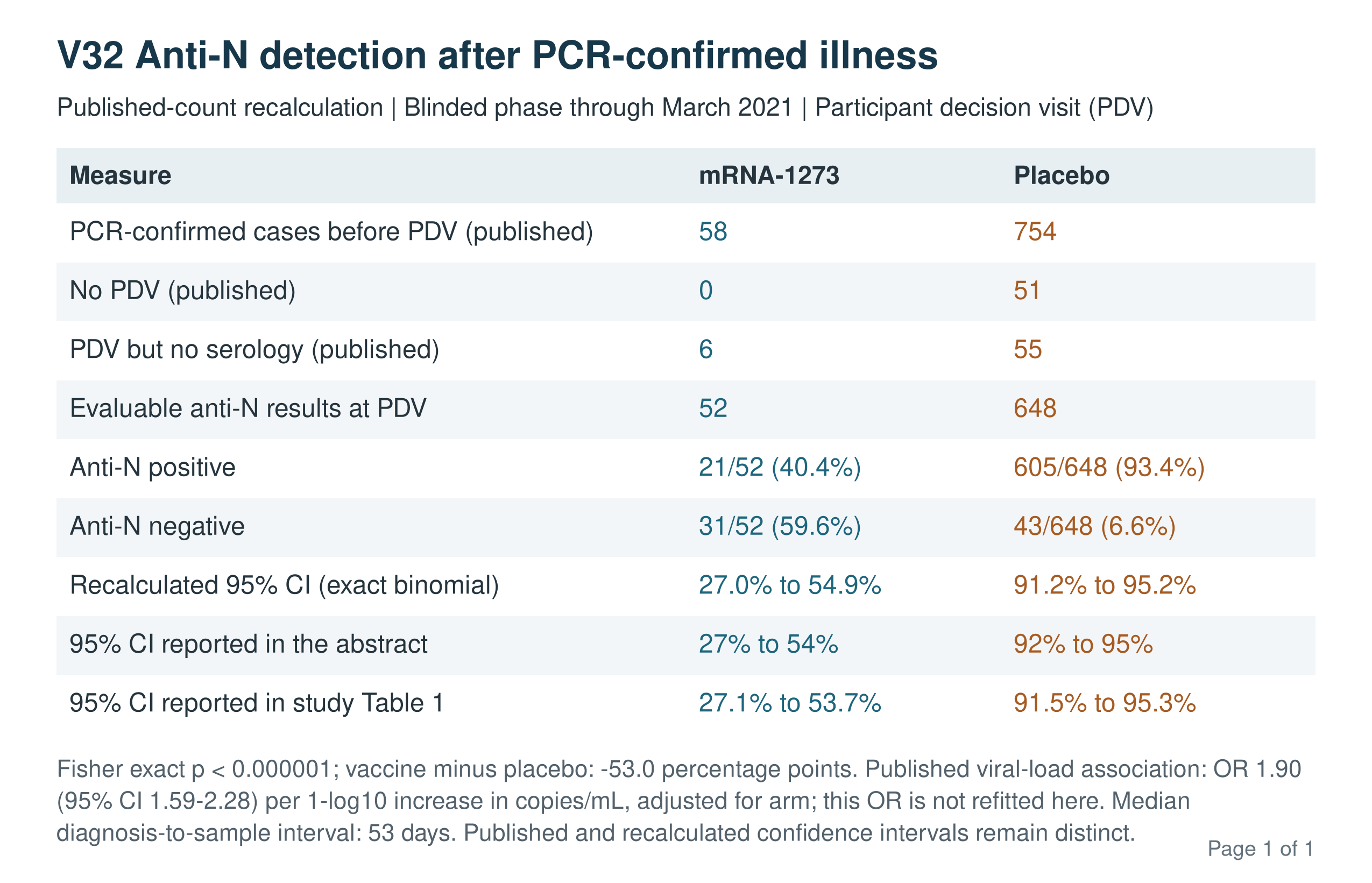
Day 57 reconstruction
We reconstructed the scheduled Day 57 antibody assessment using the original randomized groups. The target was 28 days after dose 2, or 56 days after dose 1 when there was no recorded second dose. The primary window ran from three days before to seven days after target and had to be due by the analysis cutoff. We selected one collection date per participant before looking at the result, preferring an original Day 57 visit label, then the closest date to target and the earlier date in a tie. We excluded open-label and participant-decision-visit samples. PCR history ended on the selected draw date; later positives were checked separately.40
We required negative baseline PCR and anti-N flags in the subject-level data, a documented negative laboratory result for each test from 28 days before dose 1 through dose 1 inclusive, and no unresolved baseline contradiction. We calculated follow-up from the complete BLA subject-level table. Earlier recorded limits were respected; if there was no individual closing date, the administrative cutoff of 26 March 2021 applied. This last rule applied to 143 vaccine and 140 placebo recipients: the absence of a recorded closing date does not independently verify continued blinding. In total, 14,745 vaccine and 14,743 placebo participants were eligible and due for Day 57. Interpretable results were available for 13,622 (92.38%) and 13,344 (90.51%); the other 1,123 and 1,399 remained in the coverage denominator and were not counted as antibody-negative.
At the selected draw, 24/13,622 vaccine recipients (0.18%) and 47/13,344 placebo recipients (0.35%) were anti-N positive without a recorded positive PCR. All 24 vaccine recipients and 44 of the 47 placebo recipients had only negative completed follow-up PCR results; the other 3 placebo recipients had no completed follow-up PCR. A further 4 vaccine and 8 placebo recipients had been anti-N positive earlier but were negative at Day 57, also without a positive PCR through the draw. Counting each person once, serology had identified 28 vaccine recipients (0.21%) and 55 placebo recipients (0.41%) in the measured cohorts without a recorded positive PCR.
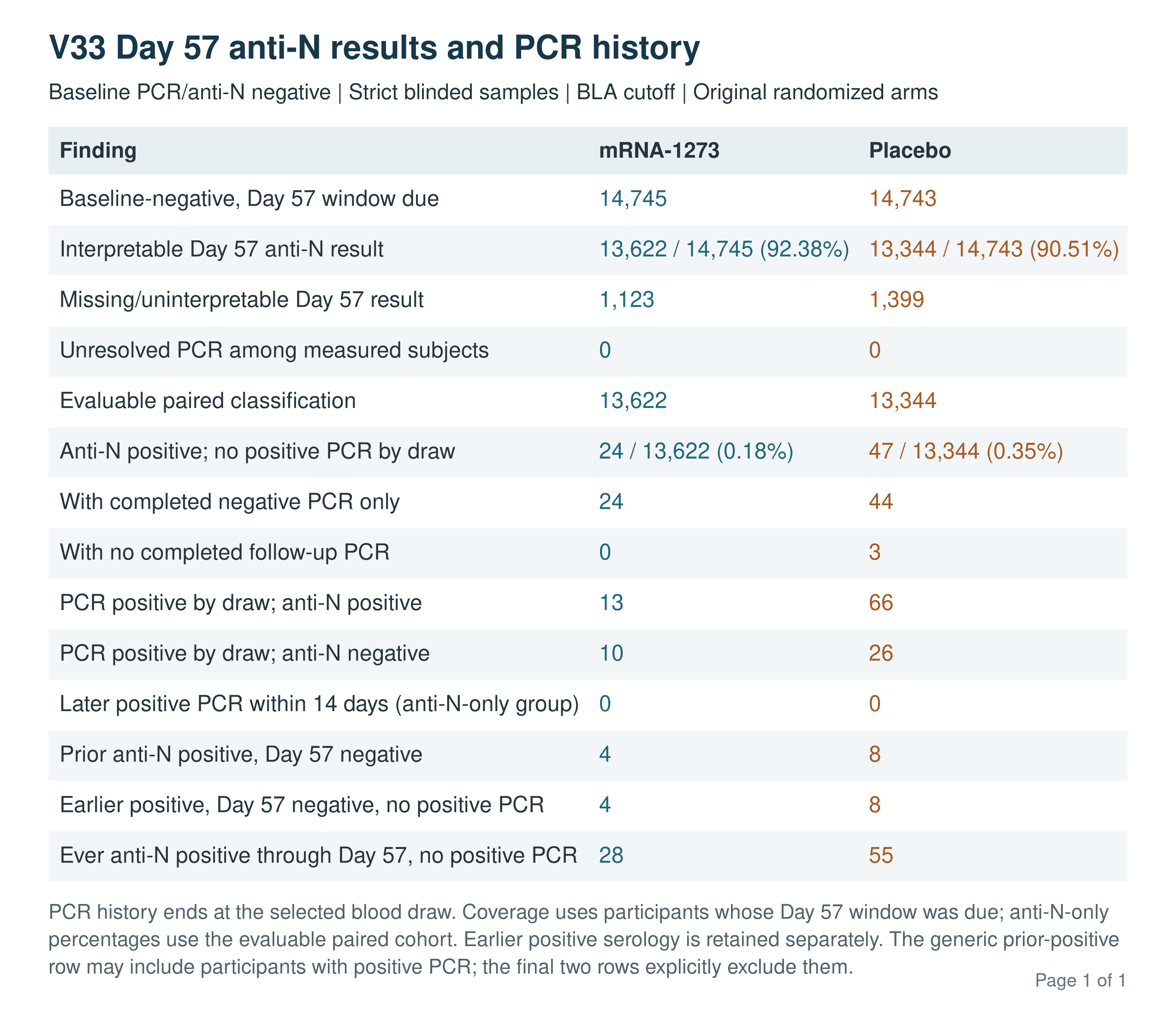
Restricting the production records to the EUA calendar cutoff of 25 November 2020 gave 19/11,981 versus 40/11,757 Day 57 anti-N positives without a recorded positive PCR by the draw. At the BLA cutoff, targeting 56 days after dose 1 for everyone gave 22/12,626 versus 44/12,348. Allowing original-labelled Day 57 samples outside the primary window gave 26/14,208 versus 51/14,004. These are visit-selection checks within the production data. The EUA-date restriction does not recreate the original EUA submission.
Limits of PCR and anti-N detection
Among participants whose first positive follow-up PCR was on or before the selected Day 57 draw, anti-N was detected in 13/23 (56.5%) versus 66/92 (71.7%). Restricting the comparison to a first positive PCR at least 14 days before the blood draw gave 12/21 (57.1%; exact 95% CI, 34.0%-78.2%) versus 61/79 (77.2%; exact 95% CI, 66.4%-85.9%). Using the same pooled weights for the 0-13, 14-27 and ≥28-day PCR-to-draw intervals gave descriptive detection proportions of 55.9% versus 72.1%. V34 gives the numerator and denominator for each interval between the positive PCR and the Day 57 blood draw.
When the first positive PCR was before dose 2 plus 14 days, or no second dose was recorded, Day 57 anti-N detection was 12/21 (57.1%) versus 59/76 (77.6%). When the first positive PCR was on or after dose 2 plus 14 days, detection was 1/2 (50.0%) versus 7/16 (43.8%). Only two vaccine recipients contributed to that last comparison. These fractions describe PCR-detected infections with an interpretable antibody sample. They do not measure the probability of detecting antibodies in infections that escaped PCR.
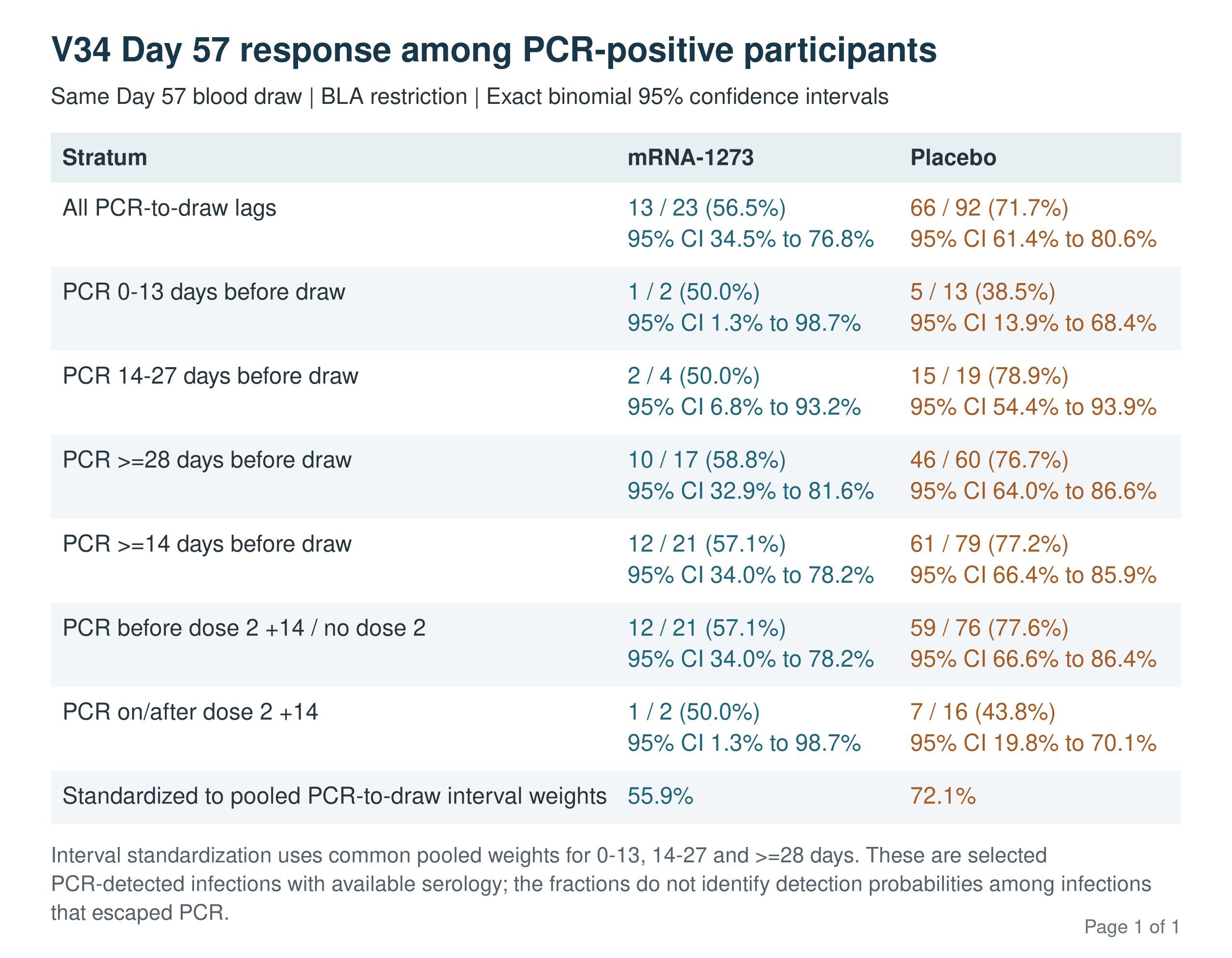
Let K be the number anti-N positive at Day 57 without a positive PCR, and q the unknown probability of a positive Day 57 result among infected participants whose infection escaped PCR. Under perfect specificity, K/q is the scenario-implied number of PCR-undetected infections through the draw in the measured cohort. If we transfer the observed fractions for a positive PCR at least 14 days before the draw, the calculation is 24 ÷ (12/21) = 42.0 for vaccine and 47 ÷ (61/79) = 60.9 for placebo. Subtracting the observed Day 57 positives leaves 18.0 versus 13.9. Subtracting the 4 and 8 people already detected by earlier serology leaves 14.0 versus 5.9 missed by both methods under this assumption. These are hypothetical expected counts, not additional identified participants or a revised efficacy estimate.
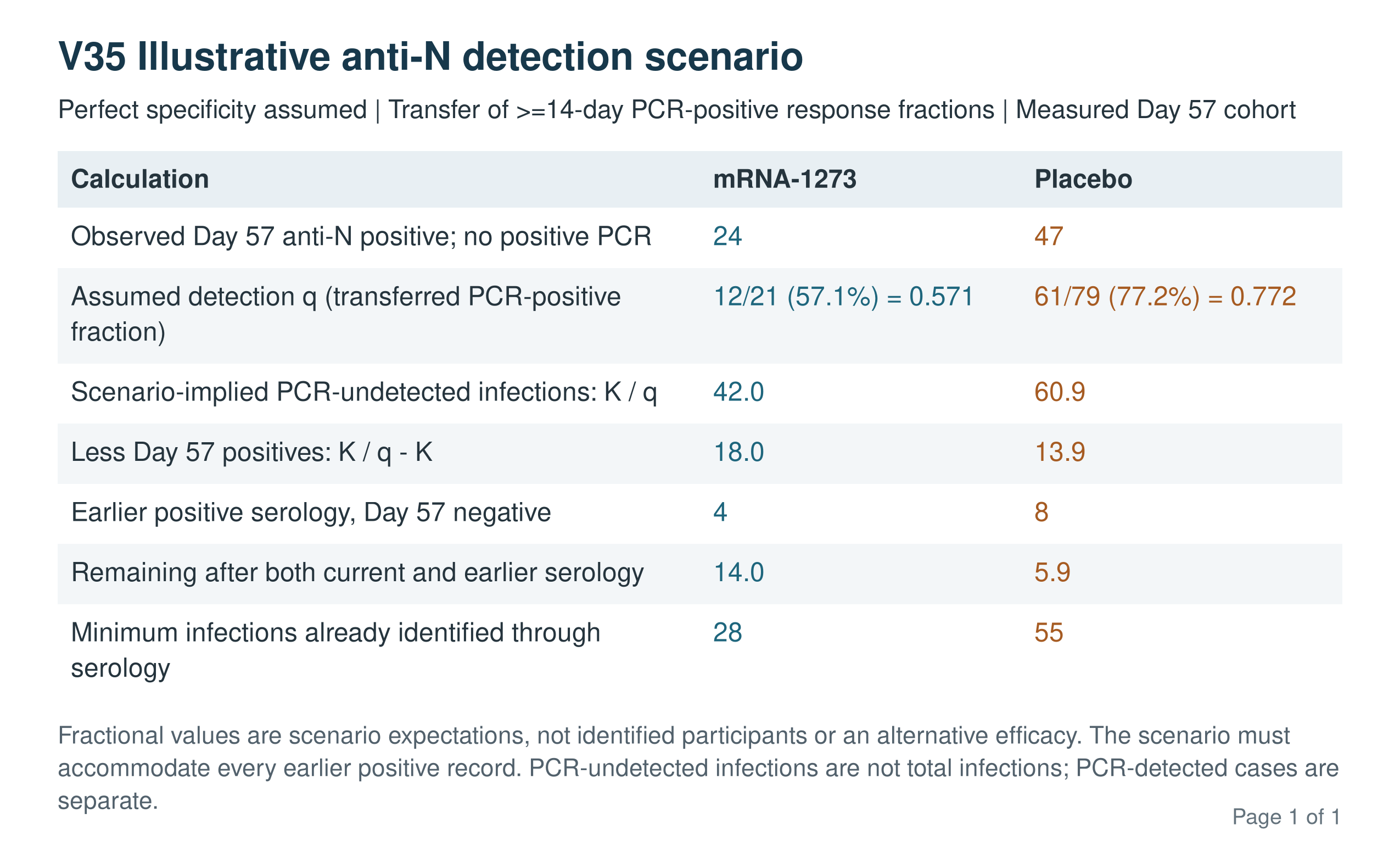
Under perfect specificity, equal numbers of PCR-undetected infections would require the vaccine-arm detection probability to be 24/47, or 51.1%, of the placebo-arm probability. For equal rates rather than counts, the relevant ratio is (24/13,622) ÷ (47/13,344), or 50.0%. These are ratios of two unknown probabilities, not estimates of their values. They concern only infections without a recorded positive PCR in the measured cohorts; no infection status is imputed for participants without interpretable serology.
Under perfect specificity, any scenario must allow for at least the 28 vaccine and 55 placebo recipients already identified by serology through the selected draw without a positive PCR. A scenario that implies fewer infections than these observed counts is incompatible with the data.
The audit finding is that anti-N results cannot provide an equally sensitive and complete count of infection in the two arms. Serology identified participants with no recorded positive PCR by the blood draw, including some whose earlier antibody-positive result was followed by a negative Day 57 result. The number of infections missed by both methods remains unknown. Complete specimen histories, quantitative PCR data, illness timing and the treatment of all serology-derived infections in the analysis datasets are needed to assess the extent of this uncertainty. The follow-up sensitivity preserves the original Day 57 draw selection and censors samples that would fall beyond an alternative boundary; it does not choose replacement samples after inspecting their results. Capping only otherwise unresolved observation ends on 17 December leaves the main counts at 24 vaccine and 47 placebo recipients with positive Day 57 anti-N and no recorded positive PCR by the draw. The corresponding PCR-positive calibration remains 12/21 versus 61/79. Restricting instead to participants with an explicit unblinding date yields 23 versus 42 and calibration fractions of 11/20 versus 53/70. The latter restriction also removes observed participants and is a selection sensitivity, not a preferred reconstruction. The new follow-up ledger identifies PCR-positive participants without a suitable later serology sample; they are not counted as antibody nonresponders.
Changes between the EUA and BLA datasets
Population reconciliation
The snapshot comparison uses EUA submission 27073_S5 and BLA production submission 125752_S3, covering ADSL, AE, ADSYMP, MB, LB and ADMB where available. Historical comparisons apply the 25 November 2020 safety and 21 November 2020 efficacy cutoffs. The original cross-submission comparison did not include paired EUA and BLA ADAE analysis datasets. A subsequent reconciliation now traces the complete released S3 AE table into S3 ADAE and reconstructs the participant counts in CSR Tables 7-12 and 7-13. All 56 arm-specific numerator cells and their safety-population denominators match. This establishes the checked S3 summaries; it does not complete the paired EUA–ADAE comparison or establish how the later S27 changes were treated in final analysis datasets and tables. For adverse events, we also compared S3 AE and SUPPAE with their S27 counterparts. The symptom and laboratory snapshot comparisons retain their EUA–S3 scope.41 S3 contains 39,215 AE rows and 37,756 ADAE rows. All 1,459 source rows absent from ADAE fall into identifiable categories under the released derivation: 1,428 carry the S3 AR removal flag, 23 have no event term, and eight have no corresponding S3 ADSL row. Every retained row carries the same seriousness classification in AE and ADAE. This accounts for the within-S3 row difference; the clinical validity of the source classifications is a separate question.
Safety follow-up was also tested using the audit’s stricter date boundaries. Among participants with a serious event of known onset within those boundaries, capping only otherwise unresolved observation ends on 17 December changes the counts from 265 to 261 in the vaccine arm and from 287 to 284 in placebo. These are censoring sensitivities, not replacements for the CSR counts of 268 and 292, which use the analysis dataset’s Part A flags. Four serious records—two in each arm—lack a usable onset date and remain separately identified. Restricting safety analyses to participants with an explicit unblinding date would also remove people who died or withdrew before formal unblinding; that subset is not an appropriate replacement safety population.
The apparent disappearance of 150 participants is a roster issue that requires careful classification. ADSL contains 30,571 identifiers at EUA and 30,423 in BLA: 30,421 are shared, 150 occur only at EUA and two only at BLA. All 150 EUA-only identifiers have a negative randomized flag and blank treatment assignment. Every identifier flagged as randomized at EUA remains present in BLA. Of the 150, 115 are found in BLA DM with blank arms; 35 remain unresolved in the compared files. The analysis-data reviewer’s guide describes the treatment of screen failures in ADSL, providing context for changes in roster scope. The finding is therefore not that 150 randomized participants vanished.
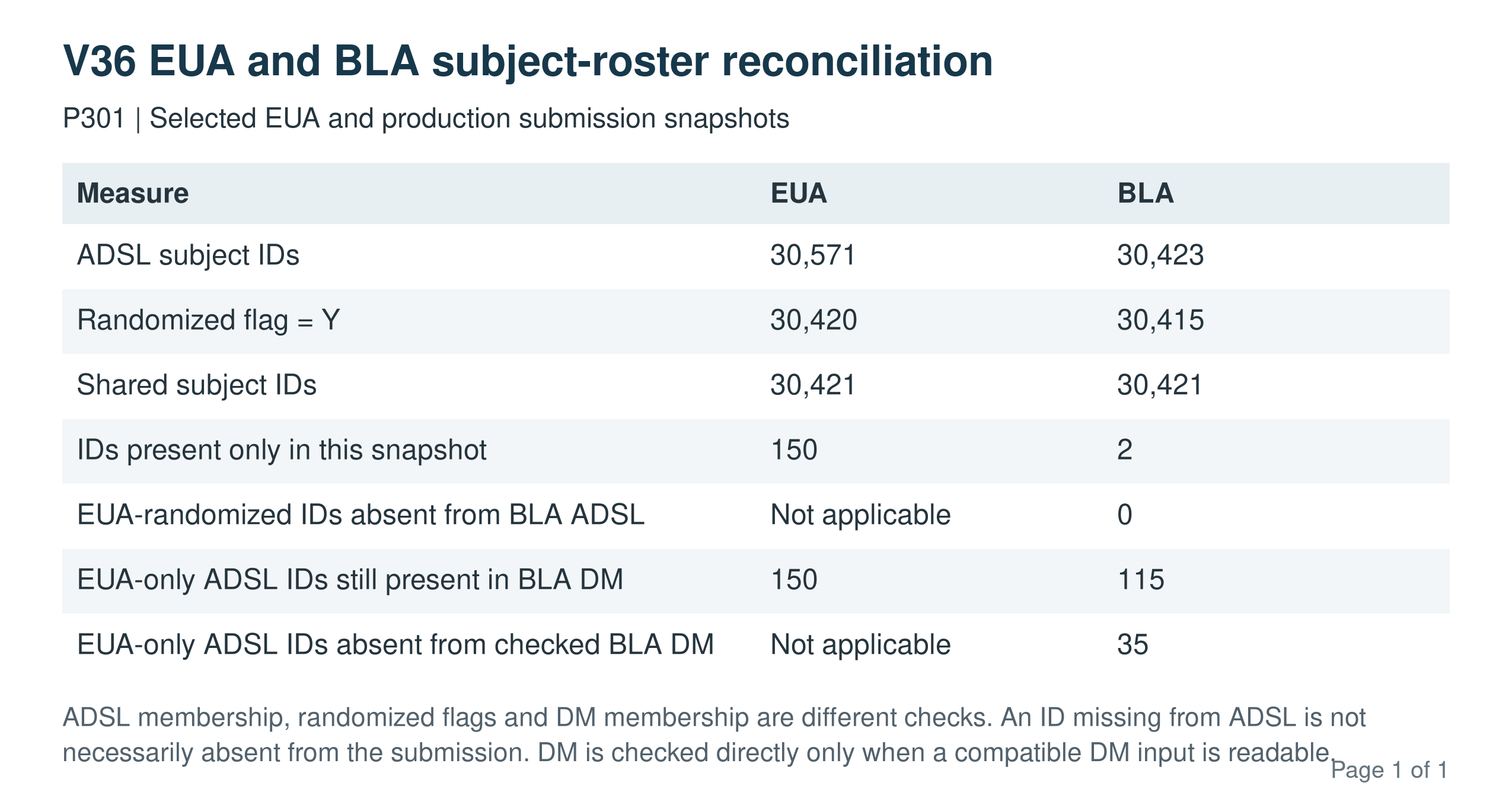
Randomized flags nevertheless change: the count falls from 30,420 to 30,415, through seven flag removals and two additions. Five removals correspond to duplicate or invalid randomizations identified in the reviewer’s guide: US3132036, US3162112, US3172220, US3352166 and US3522027, all originally assigned to placebo. A sixth removal is also traceable: US3522544 was assigned to vaccine, but no dose was recorded under that ID. A deviation decision dated 22 January 2021 says the subject had been randomized despite meeting an exclusion criterion and that the data would be used under the re-screening ID US3522680. That ID is present in the licensing safety population. The two BLA additions, US3692054 in the vaccine arm and US3272156 in placebo, have historical randomization dates and no recorded dose. Each flag change should be linked to its documented reason.
Both submissions record mRNA-1273 doses on 10 September and 13 October 2020 for US3952070. The emergency submission included this ID in the randomized, safety, full-analysis, modified intention-to-treat and per-protocol populations; the licensing submission retained the ID but changed all five flags to “no.” The reason is partly recoverable. Two deviations—an incomplete post-vaccination diary (P07.04) and a missed or out-of-window visit (P10.01)—each carry the instruction to exclude the ID from all analysis sets. PPD and Moderna recorded their agreement on 16 and 27 April 2021, respectively. The sponsor’s analysis program acted on that exclusion code and did not populate the safety or full-analysis reason fields once the randomized flag was “no.”
We checked repeat enrolment against both submissions. Two other IDs at the site matched the recorded age, sex and race; neither matched the two dose dates, and both had different recorded baseline heights and weights. No prior-screening entry linked this ID to another. Across all sites, no other ID matched all three demographic fields and both dose dates. That does not rule out repeat enrolment: none of the five duplicate or invalid randomizations identified in the reviewer’s guide had a counterpart with both dose dates in common. The outstanding records are the dated rationale for assigning the exclusion codes and a coded crosswalk showing whether the doses and safety observations were retained under another ID.
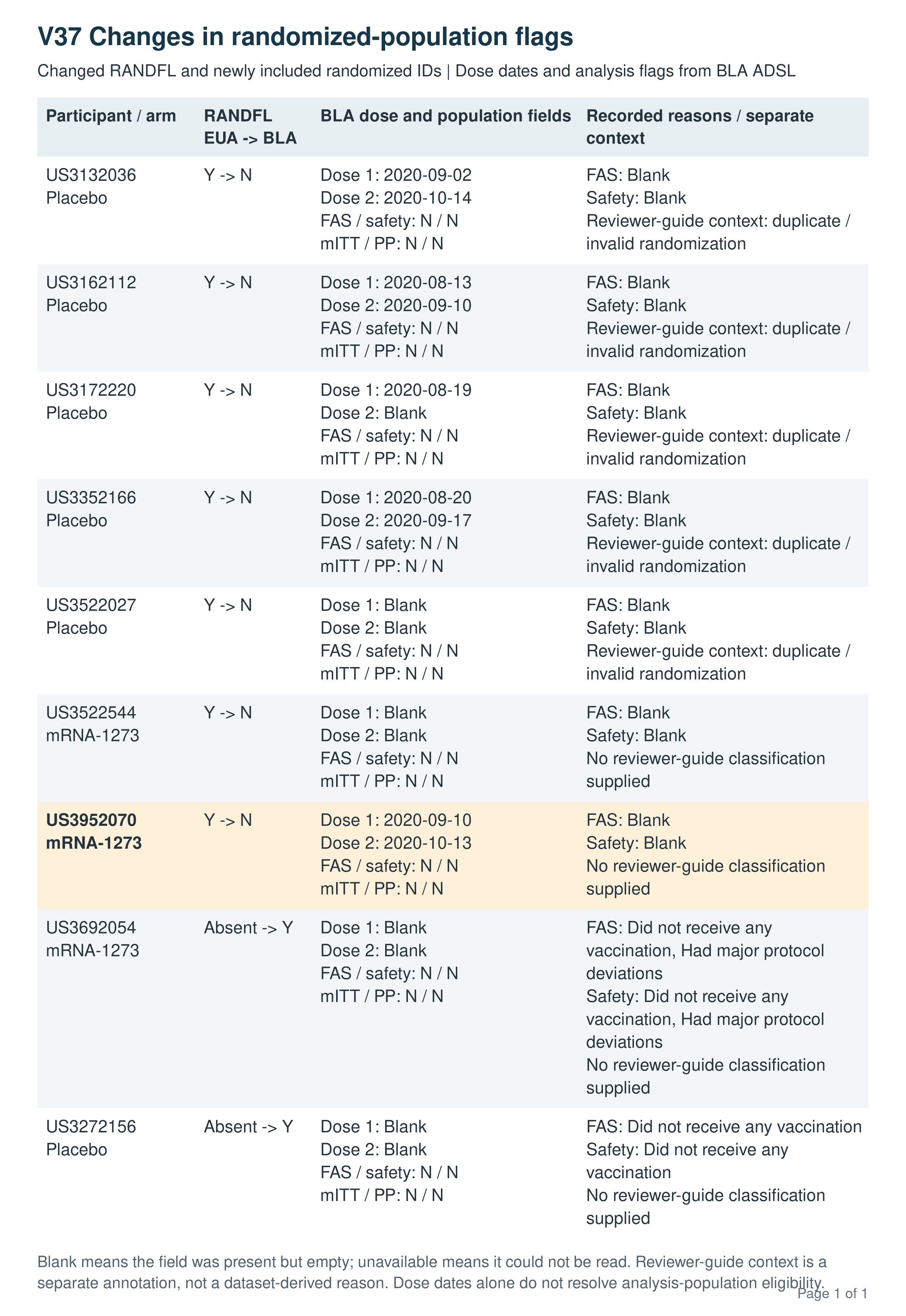
The reason fields shown are from ADSL. In the separate deviation records, US3522544 is linked to re-screening ID US3522680; US3952070 has two explicit all-set exclusion decisions, neither of which identifies a second enrolment.
Adverse-event linkage and seriousness
The AE tables expand from 16,942 to 39,215 rows. The comparison links 15,201 records and identifies content changes in 15,121, but 15,084 include an EPOCH change; a changed row is not necessarily a changed clinical event. AESPID is also not a stable medical-event identifier across snapshots. Examples include a link from fatigue or muscle symptoms in July to a broken ankle in January for US3052063, and from injection pain to an ear infection for US3722076. Automated links must therefore be checked against the event descriptions, dates and source forms before substantive changes are adjudicated. All 39,215 S3 AE records linked one-to-one to S27 records for the same 14,933 participants. An independent match using participant, sponsor event identifier, reported term and coded term reproduced every pairing without using seriousness. The event sequence number (AESEQ) changed in 23,667 pairs. Matching on participant and sequence number alone would have produced 1,148 apparent differences in the seriousness field, including differences involving missing values. Across the clinically matched pairs, the seriousness field did not change. We also checked transcription within each submission. All 1,118 eligible numbered EUA adverse-event forms matched the EUA table on the reported term and onset date. All 4,362 eligible licensing forms matched both S3 and S27 on those fields. This check used the participant and form number within each release and required a complete onset date through its cutoff. It tests whether entries already on those forms reached the corresponding table; it cannot detect a complaint that was never entered on an AE form.
Among automated linked candidates, seriousness changes from serious to non-serious in 16 records: 3 vaccine records in 3 participants and 13 placebo records in 10 participants. Changes in the reverse direction occur in 15 records: 6 vaccine records in 5 participants and 9 placebo records in 9 participants. One candidate downgrade lacks an EUA onset date. These bidirectional changes should be reviewed as changes in seriousness, separately from severity, outcome and causality. Clinical recovery does not itself remove the seriousness of an event that previously met a seriousness criterion. The 16 downgrades and 15 upgrades in V38 concern the EUA-to-S3 comparison. Every one of the 31 linked S3 records retained its seriousness classification in S27. A direct comparison from EUA to S27 also supported the same event linkage for 12 of the 16 downgrades and 7 of the 15 upgrades. For the other 12 records, the S3-to-S27 link establishes continuity of the licensing record; it does not independently verify the original EUA-to-S3 pairing. For US3812197 (placebo), a safety reviewer said a fax described the participant’s COVID illness as serious while the electronic form recorded it as non-serious. The site answered that it had raised the severity from grade 1 to grade 3 because the participant had to quarantine and undergo daily follow-up. That explained the grade, but did not identify a seriousness criterion. The electronic seriousness field changed from No to Yes and back to No; both licensing tables retained No. The original fax and the final safety review would show how the disagreement was settled.
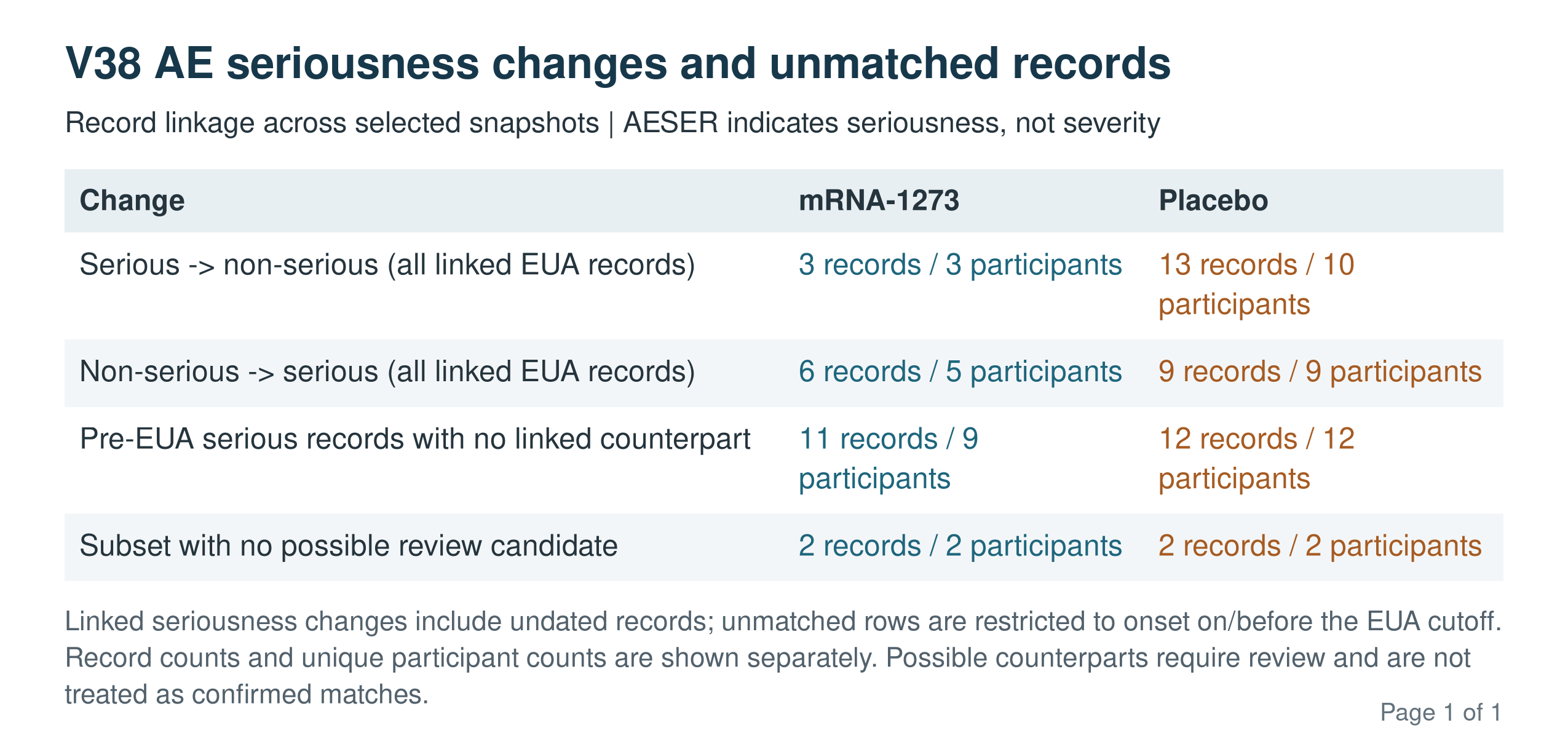
Among EUA AEs beginning on or before 25 November, 1,724 records lack a resolved BLA match: 1,057 in vaccine recipients, 665 in placebo and two with unmapped arms. Possible counterparts are identified for 1,105; none is found under the algorithm’s rules for 619. Of the 23 serious EUA records without a resolved S3 match (11 vaccine; 12 placebo), 19 had at least one possible counterpart (9 vaccine; 10 placebo). The possible S3 counterparts for these 19 EUA records can all be traced into S27. None of the 23 serious EUA records acquired a direct S27 match under the audit rules. The other four records (2 per arm) had no candidate under the matching rules. Three of those four participants had no AE rows in S3 despite remaining in BLA demographics. For the fourth participant, the licensing forms document the thyroidectomy and retain the underlying cancer as serious (¶85). We located the original EUA forms for all 23 serious records and confirmed that each was marked serious. Substantive licensing forms were available for 11 of the 21 participants, covering 12 records. None of those 12 appeared on a final licensing AE form under its original number. For US3952033 (placebo), EUA forms AE-004 and AE-005 both record serious pericarditis from 31 October to 3 November 2020. A monitor explicitly flagged AE-005 as overlapping AE-004 and requested reconciliation. The licensing CRF and both licensing tables retain AE-004 as serious with those same dates. Duplicate recording is the likely explanation for the unmatched row; the pericarditis itself is accounted for.
Three of 301 participants with a serious AE in the EUA table had no AE row of any kind in either licensing submission. All three remained in the licensing demographics. Their records show why the distinction between a missing diagnosis and a missing episode matters:
US3172069 (placebo), prostate cancer. The EUA form records the biopsy result being communicated on 4 September 2020. The site withheld the second dose pending medical records, and S5 classified the event as serious and unrelated to study product. At licensing, medical history lists prostate cancer with onset in September 2019. The procedure table retains a September 2020 prostate biopsy with “adverse event” as its indication, and the disposition listing still attributes discontinuation of dosing to “SAE #1.” The EUA narrative describes previously elevated PSA, not a documented cancer diagnosis in 2019. The pathology reports and dated medical review are needed to explain the new onset date and whether the 2020 episode warranted a separate AE. Six of the seven participants with serious prostate cancer at EUA, including metastatic disease, still had a serious prostate-cancer AE in both licensing submissions; this was the exception.
US3172205 (placebo), diverticulitis. The licensing medical history dates a prior episode to 2016. The EUA narrative explicitly distinguishes it from a recurrence for which the participant was hospitalized on 14–15 October 2020 after receiving both doses. Neither licensing AE table accounts for that recurrence.
US3432392 (mRNA-1273), benign prostatic hyperplasia. The EUA form describes an elective overnight admission for prostate surgery. The licensing history retains the condition with onset in 2019; the procedure table retains the operation on 19 October 2020 and gives medical history as its indication. Both are traceable despite the absence of a licensing AE row.
None of these three participants has an S3 ADAE row, so their events make no contribution through that dataset to the reproduced unsolicited-event summaries. That finding establishes their treatment in the checked analysis; the medical-history and procedure records still need the case-specific reconciliation described above.
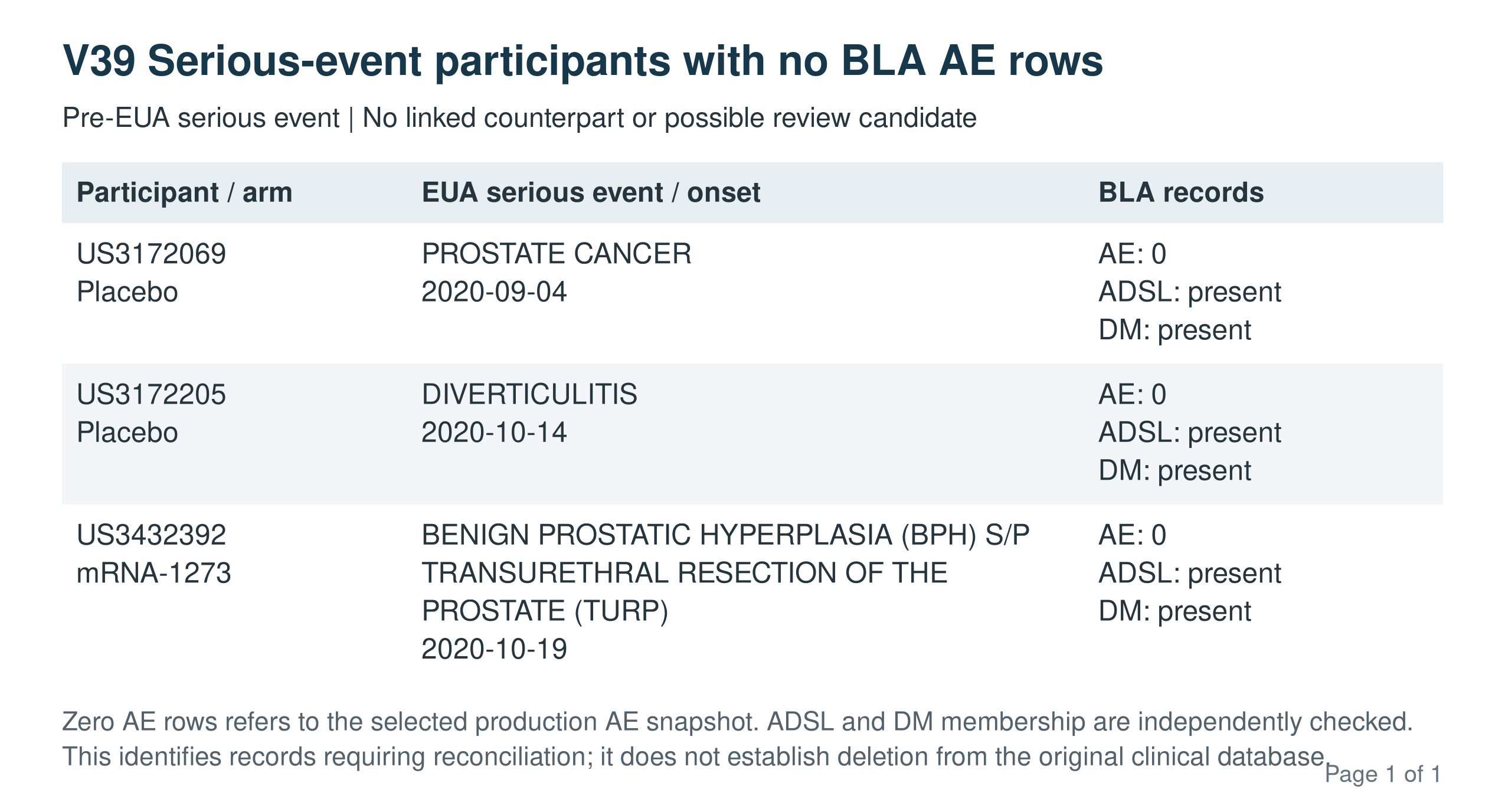
For US3252166 (vaccine), the EUA table lists thyroidectomy as serious and metastatic papillary thyroid carcinoma separately as non-serious. The EUA safety and coding queries asked the site to record the reason for surgery as the AE and the operation as a procedure. The licensing CRF describes the thyroidectomy; S3 and S27 retain the carcinoma as a serious AE. The original surgery row has no direct licensing match, but both the surgery and the diagnosis are traceable. A row-by-row comparison alone misses that distinction.
Symptom and laboratory revisions
Across linked ADSYMP candidates, 375 symptom responses change from present to absent—139 vaccine and 236 placebo—and 696 change from absent to present—356 vaccine and 340 placebo. Restricting the comparison to the same assessment date leaves 238 present-to-absent changes, 86 versus 152, and 477 absent-to-present changes, 228 versus 249. These are revised symptom records in both directions, not counts of removed or added illnesses. Same-date matching reduces the risk of linking different daily assessments but still requires validation against the forms and their edit histories.
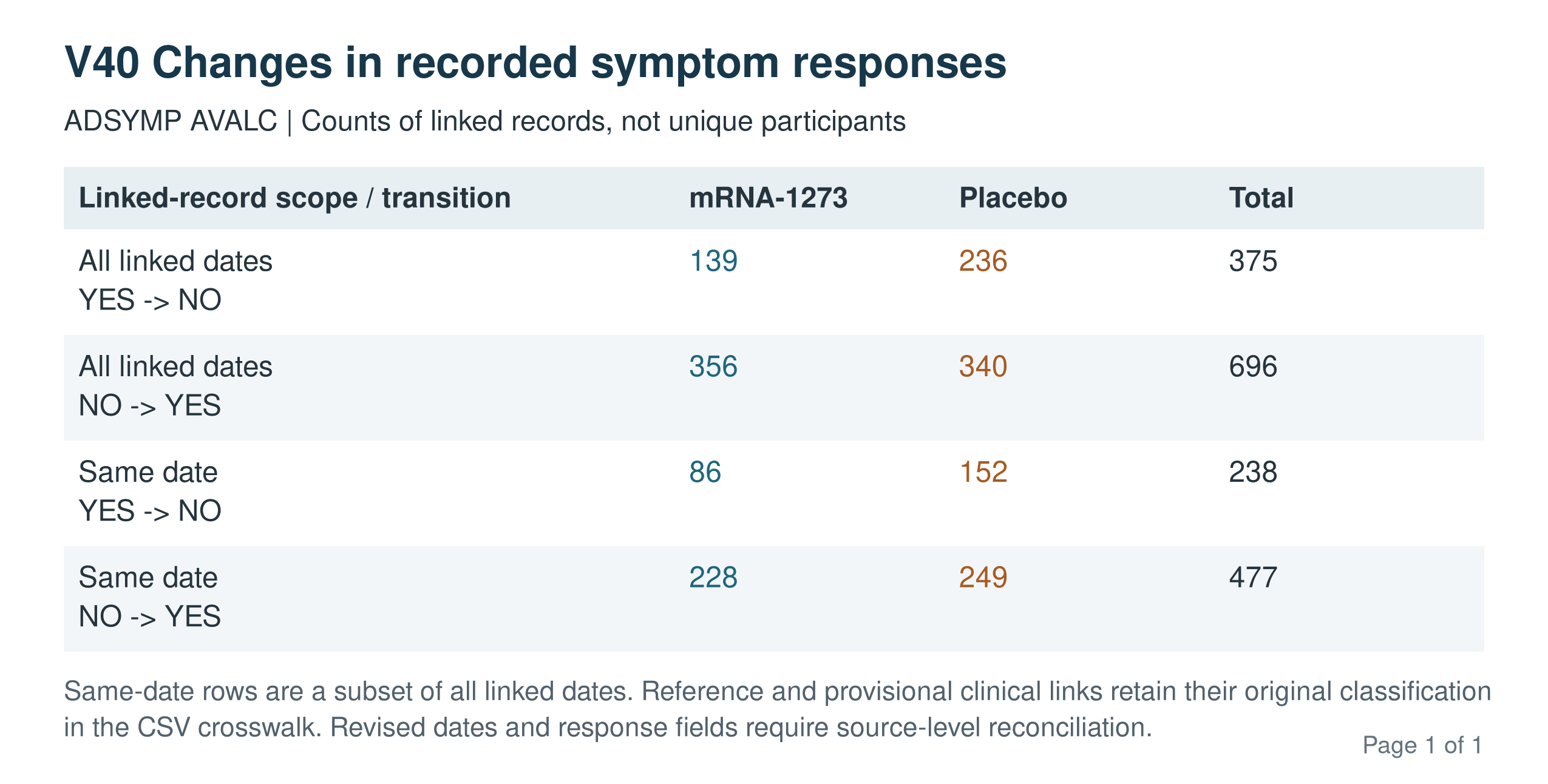
The automated EUA–S3 comparison did not identify a positive-to-negative PCR reversal among the MB or ADMB pairs it accepted. The 326 positive historical PCR rows without a resolved MB match all have possible BLA counterparts under those rules; their identities still require reconciliation. The generic positive-result flag also includes a pregnancy test in LB and four antibody-analysis rows in ADMB, which must be excluded from PCR claims.
The separate CRF check contains 640 dated form-to-laboratory comparisons, rather than 640 unique specimen dates. In 630, all usable same-date results agree with the form: 310 positive and 320 negative. The nine mixed-result comparisons represent seven participant/date combinations. Rechecking the appropriate EUA or S3 snapshot shows that each of the nine contains a laboratory record agreeing with the CRF. No opposite binary results share a nonblank laboratory reference within the same participant and submission in these records. Some results have distinct laboratory references or specimen types, while local-coded records often lack an accession reference. These are therefore unresolved specimen linkages, not nine demonstrated transcription errors. One additional comparison, US3292241 on 27 August 2020, still has no usable same-day binary laboratory result.
A cross-snapshot example deserves its own audit trail: for US3712171 on 1 October 2020, the EUA data contain a positive local-coded entry, whereas S3 contains a negative local-coded entry on that illness date; the central result is negative in both snapshots. The local records lack a laboratory reference establishing specimen identity. Both snapshots also retain a positive baseline PCR dated 25 September. The local result’s correction or replacement history remains unresolved; this baseline-positive participant is not evidence of an omitted primary-efficacy case.
FDA’s review establishes that cross-domain inconsistencies were substantive. It identified 2,428 ongoing reactogenicity records in CE without corresponding AE reporting and 3,290 records with inconsistent dates between those domains, alongside questions about coding, linkage and outcome completeness. Revised AE/SUPPAE and related datasets were submitted in amendment 27 on 1 December 2021. FDA ultimately considered the datasets adequate, although imperfect, for verification of safety and efficacy. Moderna used the “AR Remove Flag” for solicited adverse reactions to be counted in the reactogenicity analysis rather than the unsolicited adverse-event analysis. The rule excepted serious reactions and those lasting beyond Day 7. S3 flagged 860 vaccine-arm and 568 placebo-arm records; S27 flagged 907 and 583, respectively. The 62 additions (47 vaccine; 15 placebo) were all non-serious. The sponsor classified 53 as underarm gland swelling or tenderness and nine as injection-site redness.
Counting the injection date as day 0, 61 of the 62 events began on days 0-6 and one on day 7. All 62 remained in the AE table and linked to a positive solicited-reaction record. For every event, the participant also reported the same symptom after the same dose. The analysis-dataset check resolves the S3 part of this question. All 62 newly flagged reactions, including the 51 marked ongoing at Day 7 (38 vaccine; 13 placebo), are present in S3 ADAE and meet the released selection rules for the 28-day unsolicited-event summary. In 23 vaccine and 11 placebo recipients, the flagged event is their only qualifying record for that summary; the other recipients also have qualifying events. Thus these reactions were not omitted from the reconstructed S3 unsolicited-event totals. Their treatment after the S27 flag additions remains to be established from the corresponding later analysis files and table programs. FDA’s finding of 2,428 ongoing reactions without matching AE entries concerned the reverse comparison. The treatment-emergent flag (AETRTEM) changed from N to Y on 34 records. Another 59 records marked N in S3 had no corresponding flag entry in S27. For placebo participant US3442074, S27 added March 2021 as the month of both admission and discharge for the diabetic ketoacidosis event. The AE was already serious in S3 and remained serious in S27.42
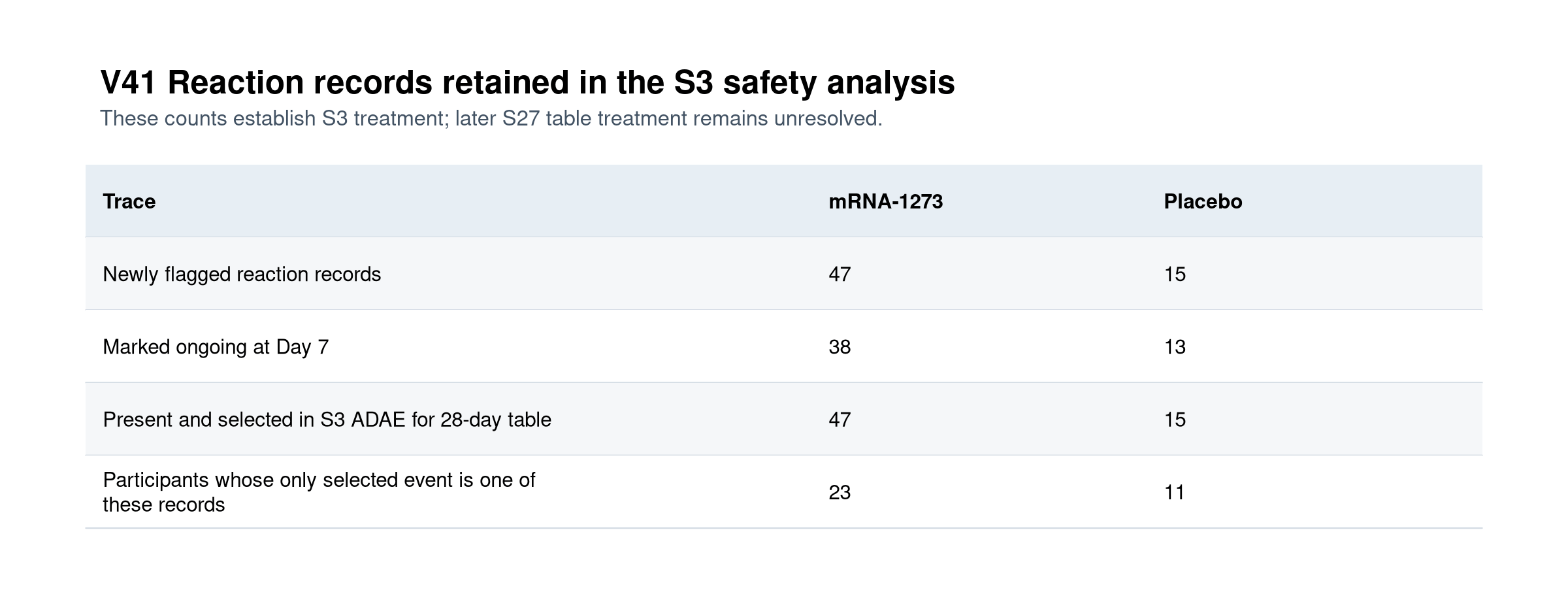
Historical efficacy cases
All 196 EUA primary-analysis cases remain qualifying BLA cases with unchanged event dates. BLA also contains 35 additional qualifying cases dated on or before 21 November 2020, comprising three vaccine and 32 placebo cases. One was already an adjudicated EUA case outside the EUA per-protocol population; 34 were not events in the selected EUA adjudicated time-to-event rows. The updated historical count is therefore 231, not a reproduction of the original 196-case analysis. Eligibility changes, adjudication and processing histories are needed to explain the additions and establish what was available for analysis at each cutoff.
Efficacy-analysis timing and public announcements
The planned efficacy analyses were to occur after 53, 106 and 151 cases. In practice, the first interim analysis included 95 cases, the second interim was dropped and the primary analysis included 196. Reconstructing the adjudicated primary-analysis populations reproduces 11 vaccine versus 185 placebo cases at EUA and 55 versus 744 at BLA. Retrospective event-date accumulation reaches 53 cases on 26 October 2020 in both snapshots; 106 cases on 5 November in EUA and 4 November in BLA; and 151 cases on 12 November in EUA and 11 November in BLA.43
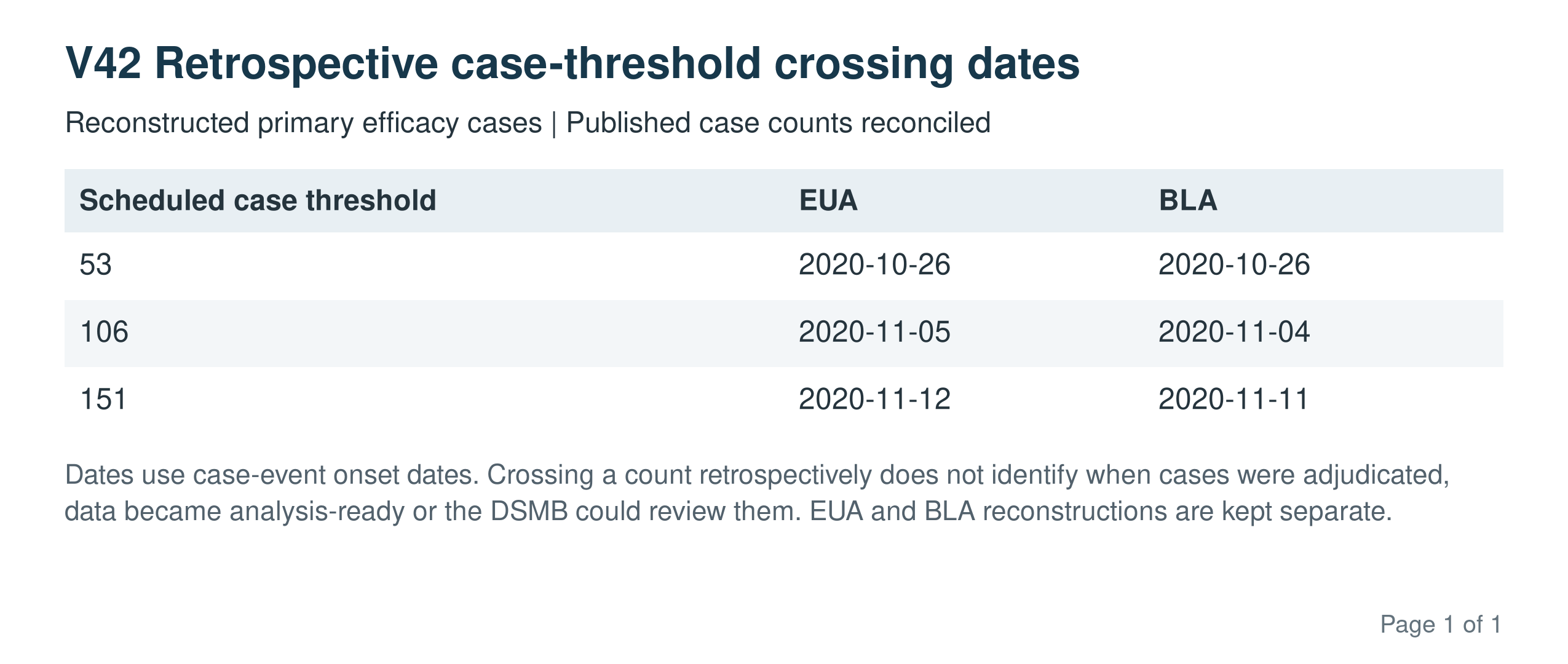
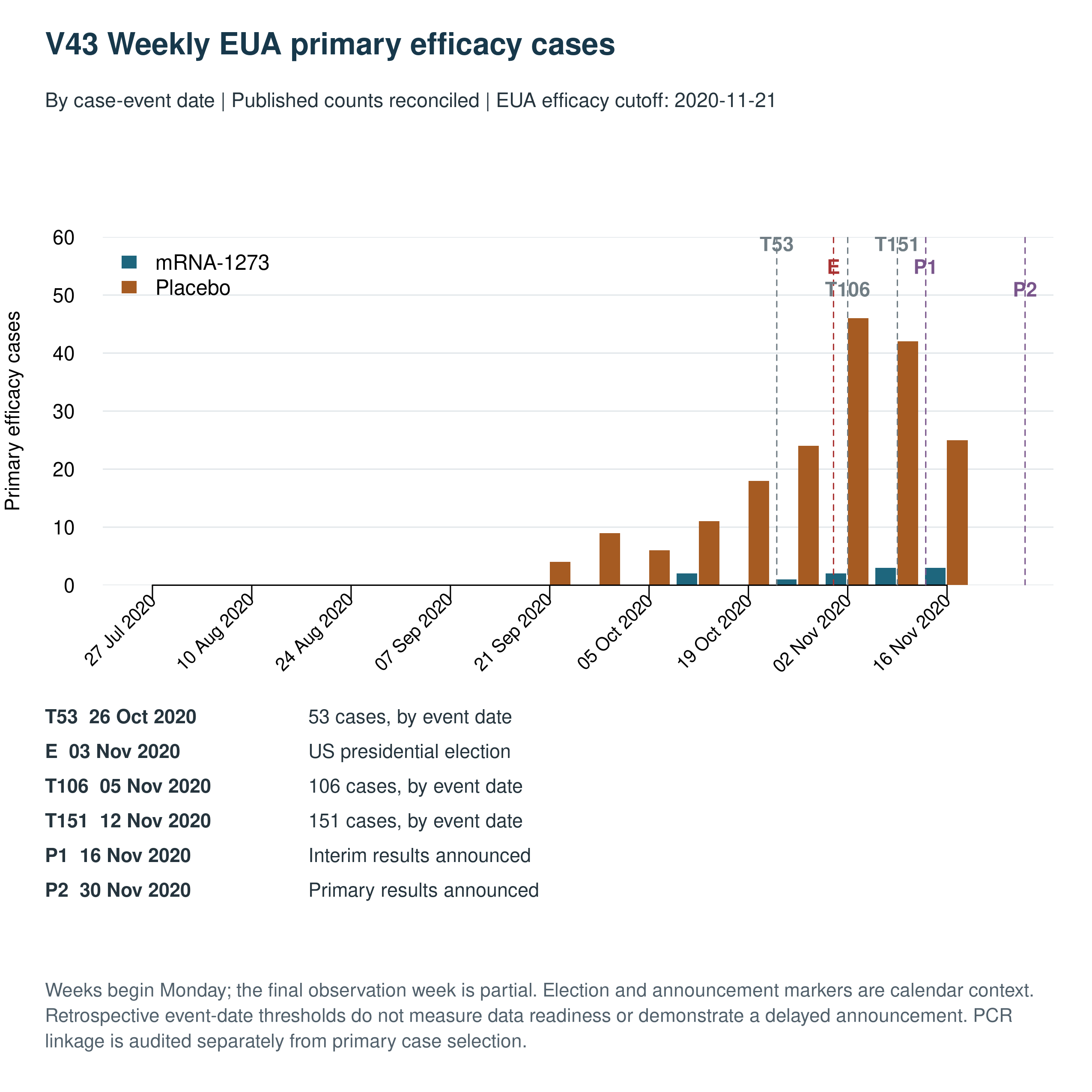
The reconstructed 53-case threshold falls eight days before the US presidential election on 3 November and 21 days before the first efficacy announcement. The interim efficacy cutoff was 7 November. On 11 November, Moderna announced that case accrual was complete, attributed the overshoot to faster case identification and stated that data were being prepared for the independent DSMB while the company remained blinded. The 16 November announcement reported 5 versus 90 cases and 94.5% efficacy. The 30 November announcement reported 11 versus 185 cases and 94.1% efficacy, alongside the EUA application.44 45 46 47
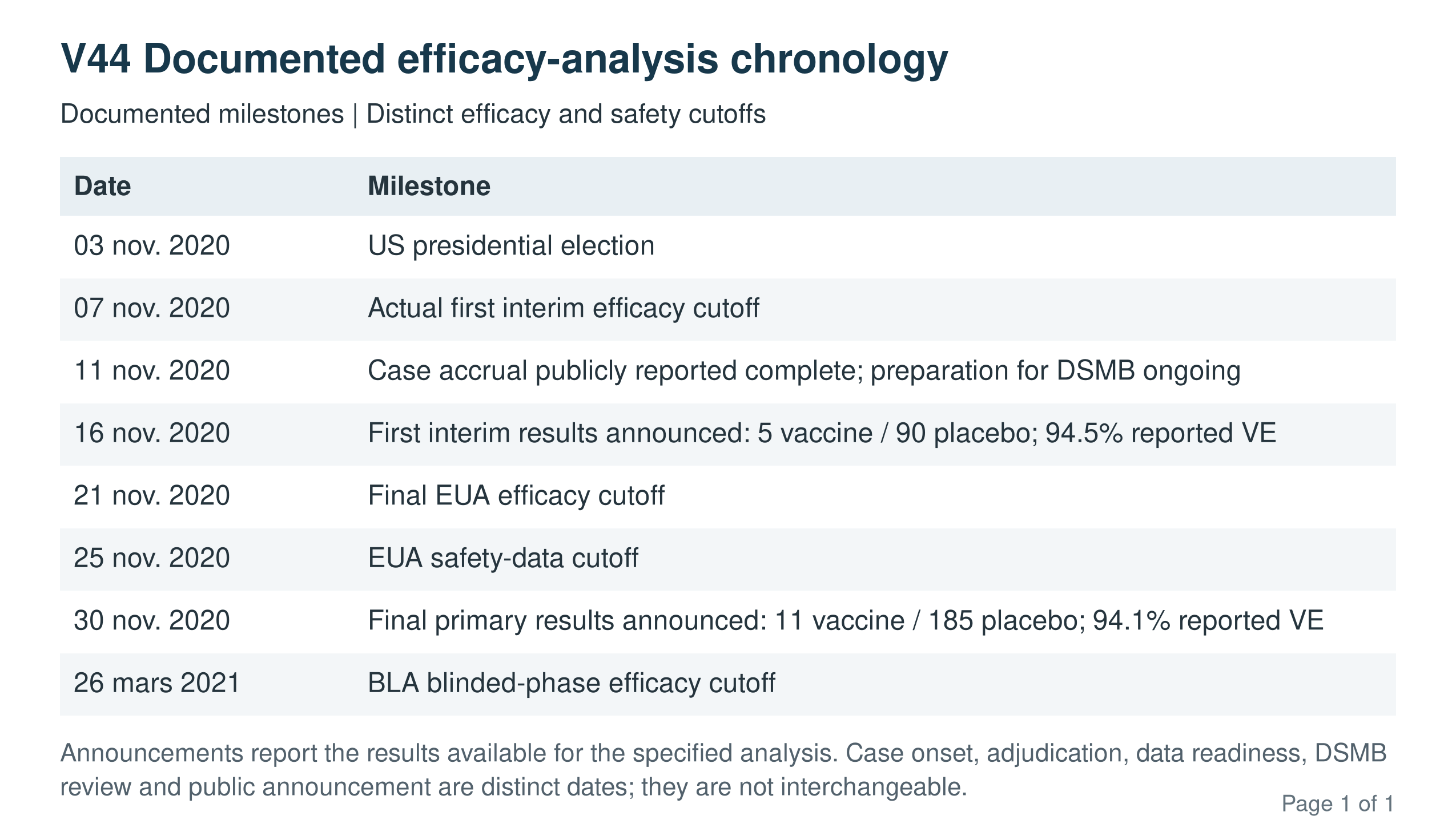
EMA expressly questioned the changes to the planned analyses. It considered the explanations based on FDA safety-data requirements and the acceleration of the pandemic insufficient to fully justify them, and could not exclude opportunistic decisions based on accruing information. It nevertheless assessed their impact on the evaluation of vaccine benefit as low. Both parts of that assessment matter: the regulator identified a methodological concern, while limiting its assessed consequence for the benefit evaluation.48
An event date is not an analysis-ready date. Symptom onset, specimen collection, result availability, case-package completion, query resolution, adjudication and DSMB review are separate milestones. The released exports do not provide the complete timestamp chain needed to determine whether 53 eligible cases were ready before 3 November or to attribute the announcement interval to an electoral decision. The audit should obtain contemporaneous accrual logs, case-processing and adjudication dates, data-transfer and freeze records, DSMB materials, and the documented decisions to change the analysis schedule.
Deaths: reporting chronology, coding and reconciliation
We reviewed the death-related subject-level records and the released case report forms for the 18 participants whose recorded deaths fell on or before 18 December 2020, and reconciled the aggregate counts against the complete BLA subject-level dataset. The review distinguishes the date of death, the date the site learned of it, entry into the clinical database, sponsor notification and FDA receipt.49 The protocol required serious adverse events to be reported to the sponsor immediately and within 24 hours of site awareness, with updated information reported within 24 hours of becoming available. A death discovered late raises a follow-up question; establishing a breach of the notification deadline requires the awareness and notification timestamps.50
The published death figures cover different populations and observation windows. The five deaths in the initial paper’s safety paragraph match the restricted fatal-AE count in its 28-day table; they are not a complete all-cause death total for the trial. The FDA’s EUA update and the subsequent blinded-phase and extended BLA totals must be read separately. The complete BLA subject-level dataset contains the same 44 deaths. Applying death and unblinding dates also reproduces the 16-versus-16 blinded count. The extended 24-versus-20 comparison includes open-label follow-up and crossover; it is not a continued blinded vaccine-versus-placebo comparison.51 52 53 54
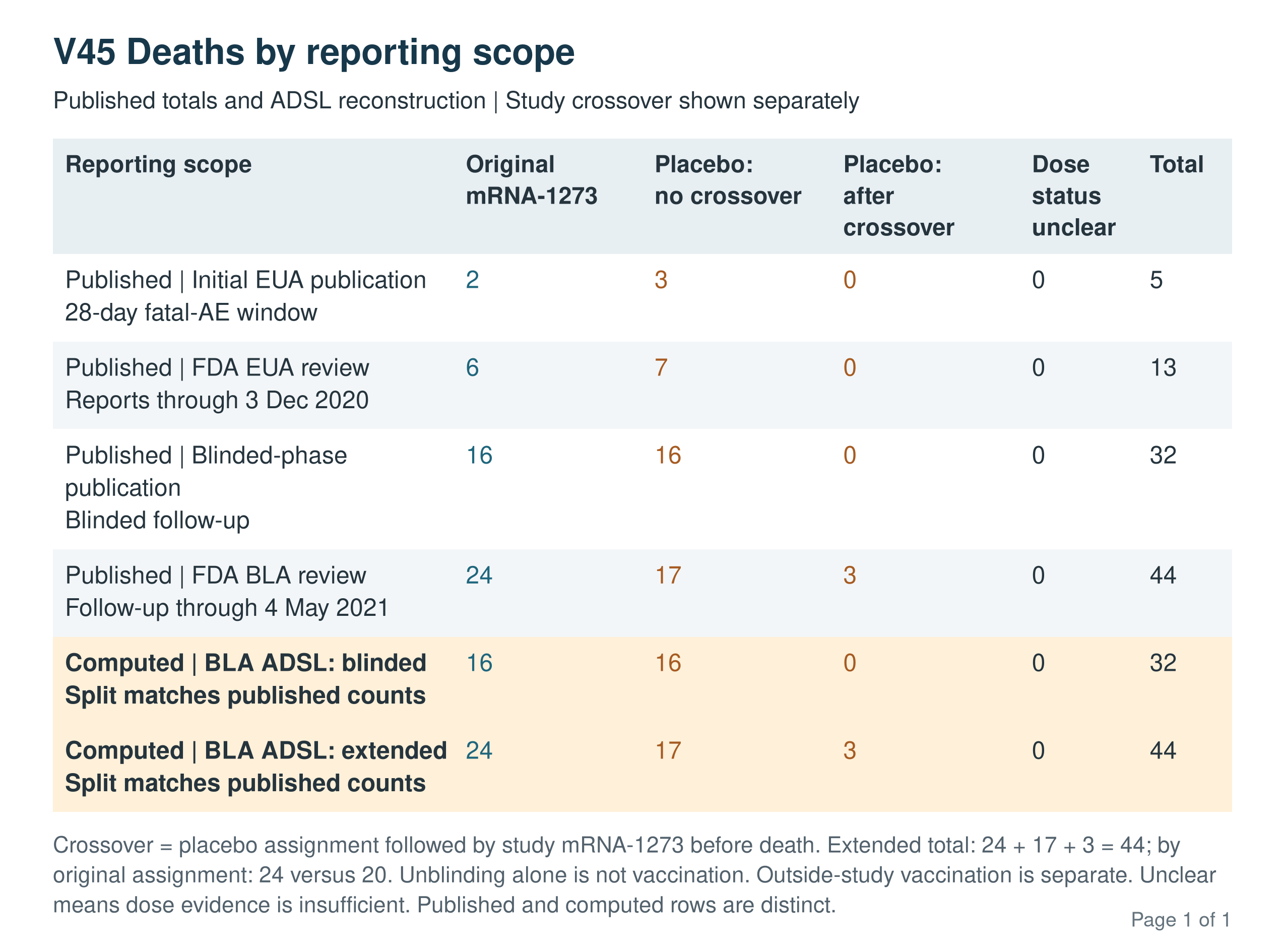
Retrospectively, the BLA records contain 15 deaths dated on or before 3 December 2020: seven vaccine and eight placebo recipients. Two entries postdate that reporting boundary. For US3812060, placebo, the site learned of the death on 4 December and entered the AE on 5 December; a death certificate obtained later established 24 November as the death date. For US3972045, vaccine, the death is dated 3 December, but the death AE was entered on 23 December after unsuccessful contact attempts and an obituary search. Removing these two later entries reconciles the retrospective 15 with the FDA’s 13.55 By the 18 December authorization, at least 14 deaths were documented at site/database level. The FDA memorandum nevertheless expressly presents its 13-death count as of 3 December. The submission and receipt logs are needed to establish which subsequent information had reached FDA by the decision date.
US3872496, vaccine: delayed ascertainment and an unsupported precise date. On 9 April 2021, after unsuccessful attempts to contact the participant, the site reached an emergency contact who reported that he had died in early December 2020. The death-date audit trail first records an unknown day in December, then 10 December, then 17 December, all on 9 April. Between the latter two entries, the site explicitly stated that the exact date was unknown.56 The final BLA subject-level record nevertheless uses 17 December. This death is retained in the BLA accounting. The unresolved issues are the roughly four-month ascertainment interval, the basis for the precise date and its treatment in follow-up calculations. The audit should establish whether the date was evidenced or imputed and how that distinction was preserved.
US3912024, vaccine: a fatal outcome temporarily recoded. Following the participant’s death on 22 November 2020, the multisystem-organ-failure event was recorded as fatal on 25 November. On 21 December, following a data-management query, its outcome was changed to “Not Recovered/Not Resolved” and its end date was cleared. A safety query on 28 December required a fatal outcome; “Fatal” and the end date were restored on 31 December. Throughout these changes, the death seriousness criterion remained recorded.57 This is a documented inconsistency in fatal-outcome coding, distinct from a downgrade in seriousness. It warrants tracing the competing instructions, the medical basis for the changes and the datasets or outputs produced during the interval.
US3812060, placebo: a corrected death date not propagated across forms. The initial report gave 30 November 2020 as the date the participant was found dead, with death possibly occurring a week earlier. On 25 March 2021, the site recorded receipt of a death certificate identifying 24 November and probable myocardial infarction. The BLA subject-level dataset uses 24 November, but the end-of-study form in the June 2021 CRF export still gives 30 November.58 The certificate provides a documented basis for the correction. The remaining discrepancy concerns synchronization of the source forms and derived datasets, and the date used in each analysis.
US3832237, placebo: delayed disposition entry and a corrected year error. The site learned on 30 November 2020 that the participant had died on 19 November, and entered the death AE on 1 December. The end-of-study disposition was not entered until 3 February 2021, when the death-date field incorrectly gave 19 November 2019. The year was corrected on 9 February after queries.59 The death was therefore recorded in the AE system well before the disposition form was completed. This case shows why a blank death field in a subject-level snapshot cannot, by itself, establish that a death was unknown or unreported.
These findings identify weaknesses in death ascertainment, date handling and consistency between safety records. Final aggregate agreement does not resolve whether information was complete and timely when earlier decisions were made. A transparent audit should link each death to the contact history, first awareness, initial and follow-up safety reports, supporting medical records or death certificate, database changes and successive regulatory submissions. It should also document the basis for uncertain dates and reconcile fatal outcomes across the AE, disposition and subject-level datasets.
Scale A and Scale B: clinical exposure and manufacturing comparability
FDA identified Scale A as the source of phase 3 clinical material and accepted Scale B material for authorization through analytical comparability. FDA guidance permits reliance on earlier clinical evidence when a manufacturing change is adequately supported by comparability. The question for audit is therefore what changed, how comparability was demonstrated, and which material participants actually received.60 61
The disclosed RNA manufacturing history identifies a scale increase from 10-litre in-vitro transcription at Scale A to 20 litres at Initial Scale B. EMA described the same sequence of RNA manufacturing unit operations for this transition. Scaling production can nevertheless change operating conditions, equipment and the control of process-related attributes. The detailed drug-product genealogy and process-comparison tables are substantially redacted, so the public record does not permit a complete independent comparison of the manufacturing parameters or their effect on product characteristics.62 63 64
Released batch analyses corroborate the Scale A classification of the identified pivotal drug-product lots. Separately, EMA-hosted RNA batch records identify Initial Scale B batches manufactured in August 2020, but a manufacturing date does not establish administration to a trial participant. EMA also refers to clinical use of Scale A and Initial Scale B material without, in that passage, resolving the extent of Scale B exposure in the pivotal blinded population. These records need to be connected through RNA lots, drug-product lots, labelled vial identifiers and actual dose records.65
For the EU Rovi finished product, EMA initially accepted the available package while withholding a final A/B comparability conclusion pending further data. It subsequently recorded the relevant manufacturing quality obligations as fulfilled. The audit should examine the full results submitted to close those obligations, including acceptance criteria, batch selection and the attributes measured, rather than relying only on the fact of regulatory closure.66
Additional lots identified in the earlier review of open-label participant-batch listings remain leads requiring verification and manufacturing classification. They do not establish the first date of Scale B administration or its extent in the blinded trial. The missing link is a complete lot-to-process mapping tied to participant-level dose records, with blinded randomized injections distinguished from open-label vaccination.67
The evidence supports describing the marketed vaccine as supported by a randomized trial and a manufacturing comparability bridge. It does not establish that the commercial process itself was directly evaluated across the pivotal randomized population. For a biologic, manufacturing history is part of the evidence defining the product; precise reporting of the bridge and access to its supporting data are therefore necessary. The distinction alone does not establish clinical inequivalence between the scales.
Unresolved gaps in site subject numbering
We reconstructed the phase 3 screening index by combining the BLA subject-level analysis table (ADSL) with the screening-related Subject Visits records (SV). The union contains 32,098 distinct identifiers across 99 sites, including the 30,415 participants in the sponsor-defined randomized population. Each identifier consists of a site code and a numerical suffix: for example, US3952070 identifies site US395 and suffix 2070. Numbering is strongly sequential: 31,854 of 31,999 adjacent observed increments are +1 (99.55%), and 98 of the 99 sites begin at 2001.
Assuming a starting suffix of 2001, and stopping at each site’s last observed identifier, we find 183 missing positions across 60 sites: 181 internal gaps, plus US3612001 and US3612002 before that site’s first observed identifier, US3612003. We do not infer numbers beyond the last observed identifier. These are missing positions in the reconstructed index; a missing number alone does not establish that a person was enrolled. We therefore checked each candidate against the complete EUA ADSL roster and the original production S3 demographics table (DM).68
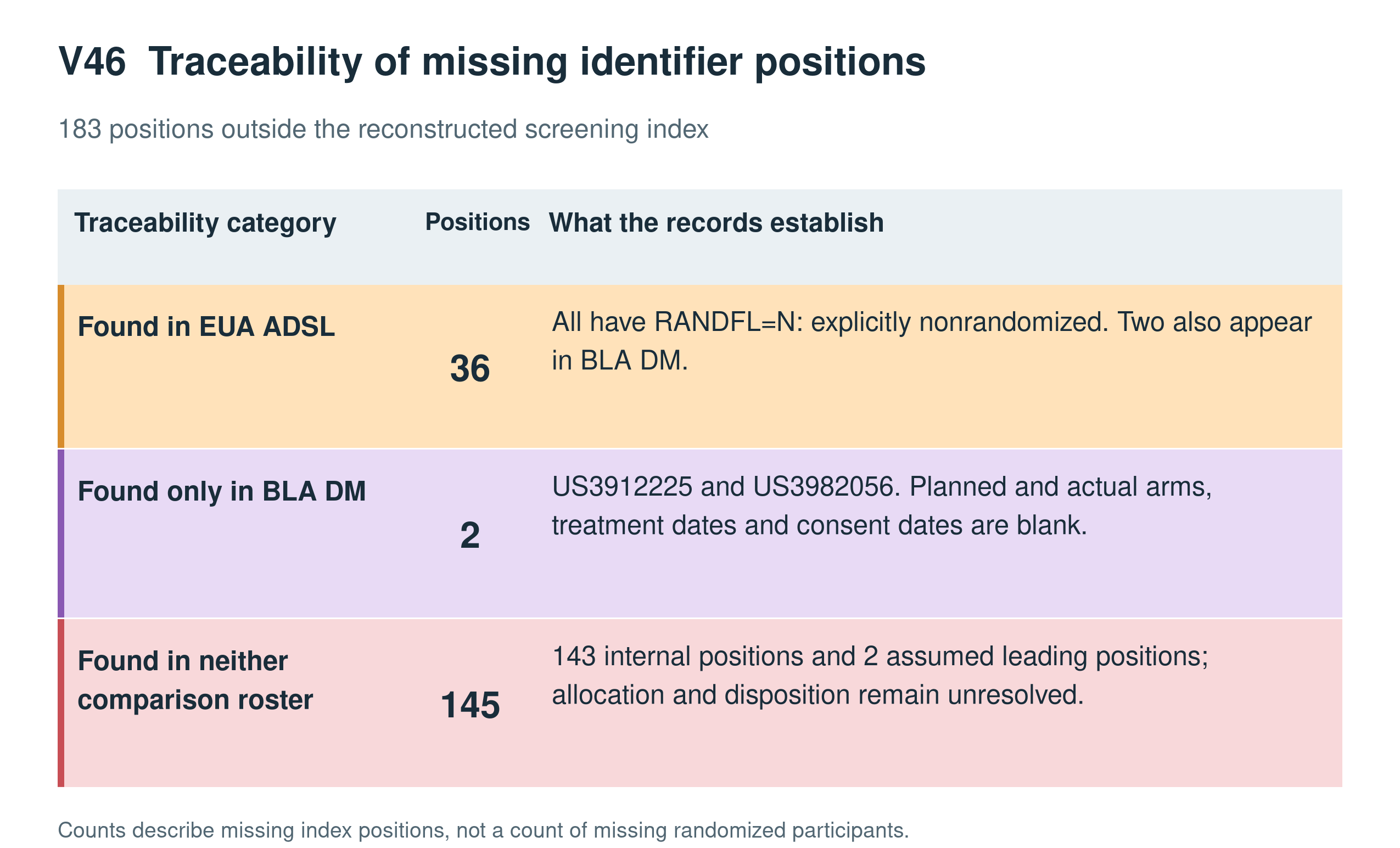
The 36 EUA-confirmed identifiers occur at 22 sites. Their negative randomized flags resolve an important part of the apparent discrepancy: these are documented nonrandomized records, not missing randomized participants. These 36 identifiers are already included among the 150 EUA-only ADSL identifiers described in ¶78. Two of the 36, US3772085 and US3902124, are also retained in BLA DM. The two additional DM-only identifiers have no recorded treatment assignment or administration dates in that table; DM alone does not establish their randomization status. The distinction is retained throughout the figures: orange for EUA-confirmed records, purple for DM-only records, and red for positions untraced in both reference rosters.
To locate the gaps in the recruitment period, we use the complete screening dates of the observed identifiers immediately before and after each uninterrupted gap. Where both dates exist, the earlier date is used; where only one exists, it is retained and flagged. Of the 183 positions, 180 have two dated neighbours and three use a single date, including the two assumed leading positions at US361. V47 shows the weekly distribution of missing identifier positions using the earlier bordering screening date. The week beginning 28 September contains 39 positions, including the single 34-number block at US370. The export retains both bordering identifiers, both dates, the rule used and the later-date alternative. The resulting proxy dates range from 27 July to 16 October 2020.
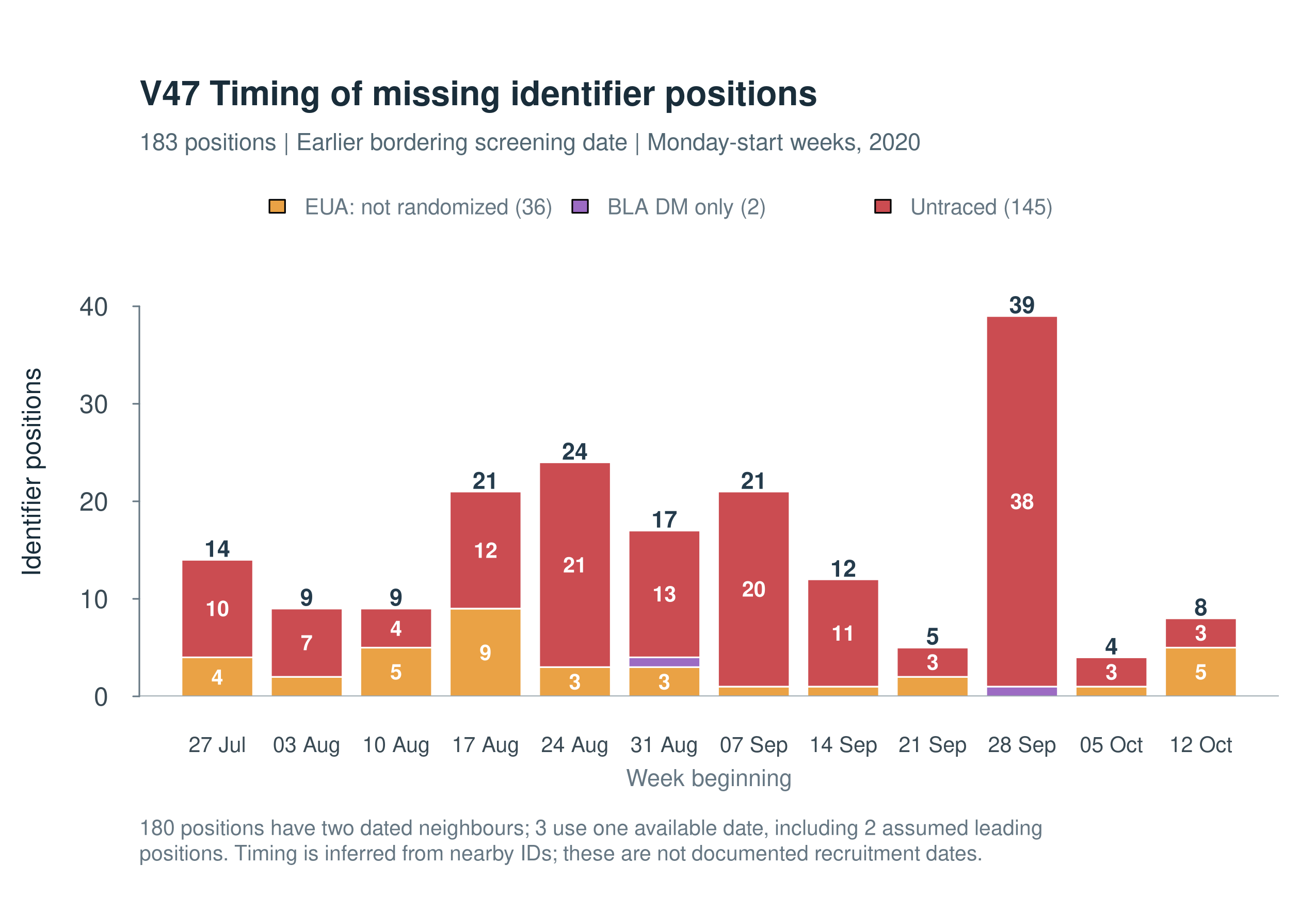
US370 is the clearest site-level example. Its observed sequence spans suffixes 2001 to 2093, comprising 57 identifiers in the screening index and 36 missing positions. Two missing identifiers, US3702020 and US3702041, are found in EUA ADSL and flagged as nonrandomized. The remaining 34 form an uninterrupted block, US3702055 through US3702088, absent from both EUA ADSL and BLA DM. US3702054 was screened on 5 October 2020, whereas US3702089 was screened on 29 September. The earlier-date rule therefore places the entire block on 29 September for the weekly chart. The reversed dates also show why numerical order cannot be treated as an exact chronology of screening.
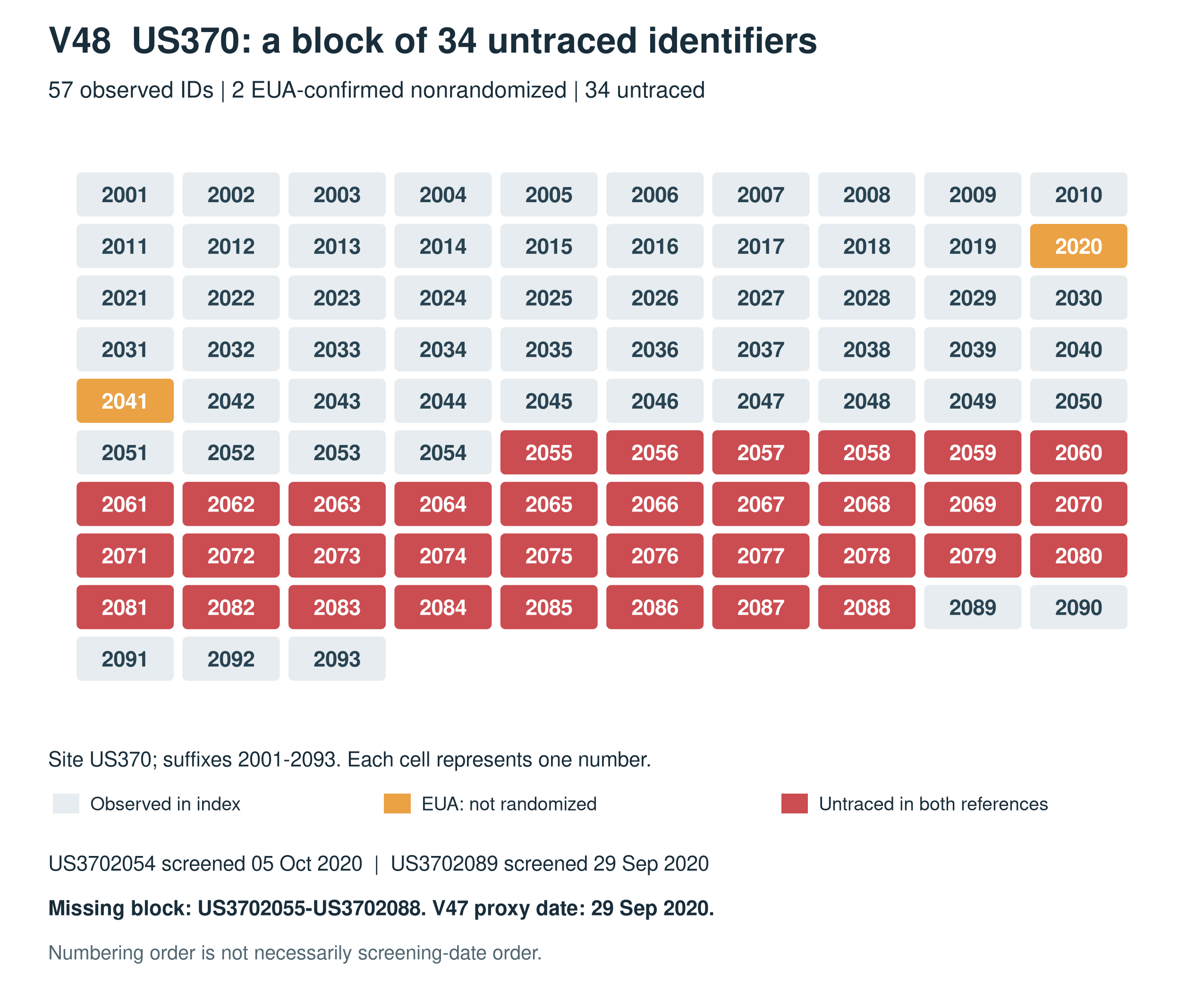
The gaps are mostly isolated, but their structure is not uniform. The 181 internal missing positions comprise 141 single-number gaps, three two-number runs and one 34-number run. Including the assumed leading pair at US361 gives 146 runs containing 183 positions: 141 runs of one, four runs of two and one run of 34. V49 counts runs of consecutive missing positions. A run of 34 contributes one run, not 34. Of the 145 untraced positions, 34 belong to the US370 block; the other 111 are distributed across 48 additional sites.
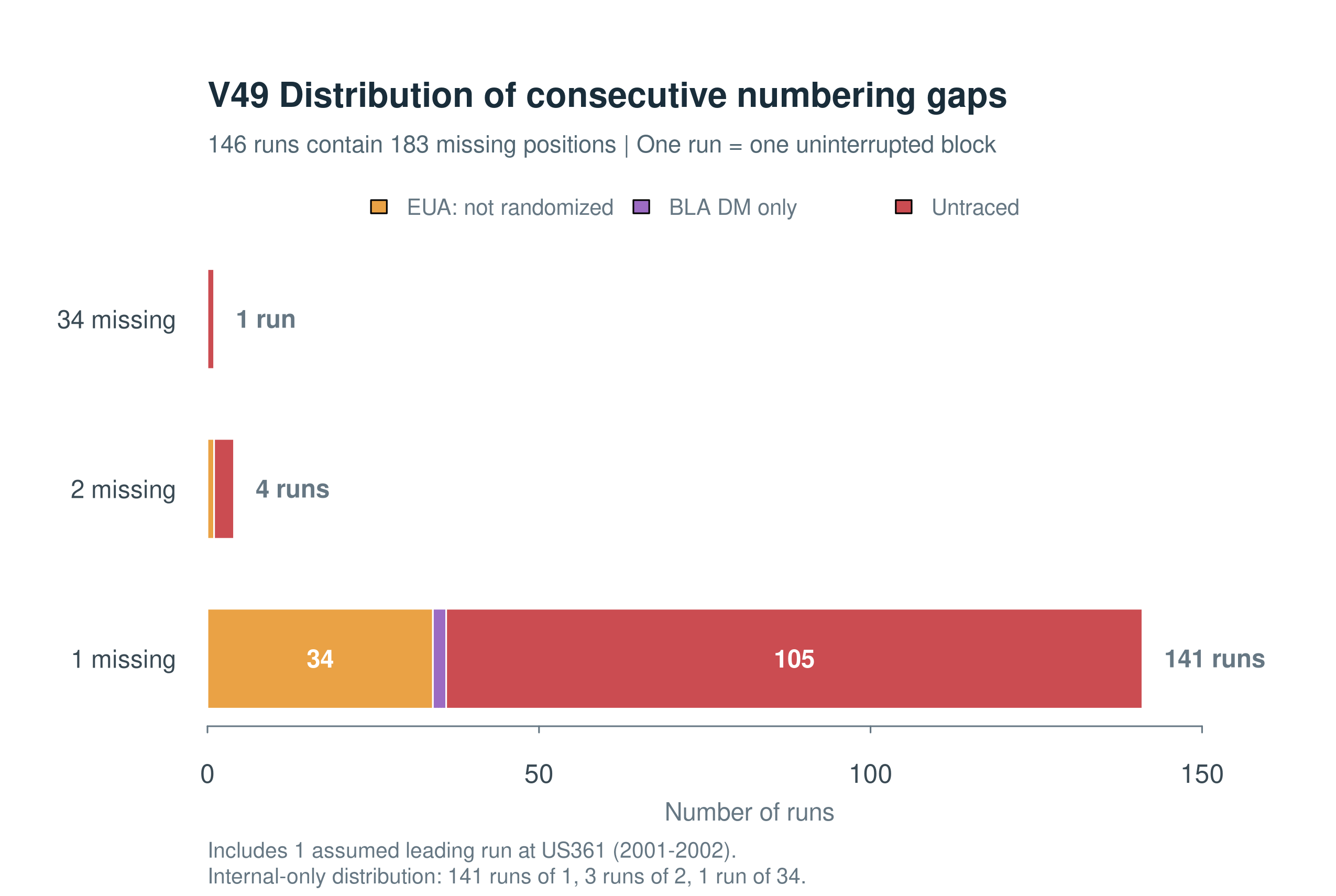
The 145 untraced positions require a documented explanation. Without the site identifier-allocation logs and original screening records, an independent reviewer cannot distinguish unused or reserved numbers from cancelled entries, repeat screenings, identifier replacements or omitted records. Nonrandomization can explain absence from an efficacy analysis, but it does not by itself explain an identifier’s disappearance from the records needed to reconstruct screening and disposition. The audit should reconcile every flagged position to its allocation status, any linked consent or screening record, any replacement identifier, and the dated reason for cancellation or exclusion. The concentration at US370 provides a specific starting point. The result is an unresolved gap in participant-accounting traceability; the records needed to determine its cause and consequences should be disclosed. We tested whether the gaps in site screening numbers were also visible in randomization. Every participant flagged as randomized in the EUA and BLA datasets had a randomization number whose prespecified treatment matched the recorded assignment. At US370, the two observed IDs on either side of 34 untraced screening numbers occupied consecutive slots in the same randomization block. Across the complete numbered BLA roster, no earlier slot was empty where a later slot in the same block was occupied. These checks narrow the unresolved issue to the allocation and disposition of the screening identifiers; they do not supply evidence of 34 missing randomized participants. Site screening logs and dated IRT transactions, including cancellations and replacements, are needed to establish what became of the numbers.69
Missing numbers in the adverse-event and medication records
Sites numbered adverse-event forms separately for each participant. If forms AE-004 and AE-006 survive, AE-005 is an internal gap. We used the original form identifier (
AESPID), not the row number assigned when the submission was assembled (AESEQ). The original licensing table (S3) had 2,390 internal gaps across 1,120 participants. For 566 positions in 287 participants, the emergency-authorization (EUA) table contained an actual row under that number. None of those numbers reappeared for the same participant in the licensing amendment (S27). Of the 566, 549 were marked non-serious, 12 serious (six in each arm), and five had no seriousness value. Those 12 are part of the 23 serious EUA records in ¶83. The other 11 would be missed by an internal-gap scan. A participant with no later AE rows, for example, has no surviving numbers on either side.70We looked for the clinical event under another number or diagnosis and, separately, for a dated explanation of what happened to the original form. Four of the 566 had a documented consolidation or reassignment, including three originally marked serious. For 281, the strongest evidence was outside the AE table, usually a matching symptom or diary entry. That shows the complaint was recorded elsewhere; it does not say how it was counted in the safety analysis. For 131 forms (62 vaccine, 69 placebo), we found no specific counterpart. No participant CRF was available to us for 119 of those 131. The other forms had varying degrees of supporting evidence, detailed in the record-by-record review.
The hospital records show what the counts alone cannot. For US3862053 (placebo), the safety reviewer identified the removal of a separate serious dehydration entry and asked that the hospitalization be recorded under COVID-19. Serious COVID-19 and the admission were retained. The EUA form, however, gives 23 October 2020 as the admission date; both licensing submissions give 26 October. For US3572167 (placebo), the EUA form records hospitalization for accelerated hypertension on 27 October. S3 records mild, non-serious congestive heart failure on the same date, but we found no serious AE or hospitalization row accounting for that admission. For US3912024 (mRNA-1273), the EUA form identifies serious atrial fibrillation with a rapid ventricular response. The licensing hospitalization and other serious AEs carry the same safety-case identifier, but none establishes what became of the arrhythmia diagnosis.71
The medication log used its own line number (
CMSPID). The EUA extract of 25 November 2020 (S5) contained 1,170 internal gaps in 961 participants. An earlier extract, dated 11 November (S80), contained a row at 107 of those positions: 104 had a reported name and three were blank. Of the 104 named entries, 44 had no matching reported name or coded product anywhere in the same participant’s later S5 or S3 medication records. The available participant CRFs covered only 105 of the 1,170 positions. One illustrates a documented correction: for US3892032 the site wrote that line 17 replaced a duplicate prednisone entry on line 14. The later EUA medication table does contain prednisone on line 17.A different result emerged for US3602051 (placebo), who underwent aortic valve surgery on 29 October 2020. The earlier medication table records intravenous porcine heparin on line 27 that day. No corresponding heparin entry appears in either the later EUA or licensing medication table. Yet in a 19 November response to a safety query, the site cited the operative report and described reversal of heparin with protamine and continuing bleeding of unknown origin. The bleeding remained a serious AE in S5, S3 and S27. A reviewer relying on the later medication tables alone would miss a documented exposure relevant to that event. The hospital medication administration record and the history of line 27 are needed to explain its absence.72
The same check identifies narrower questions elsewhere. Among S3 general medical-history and concomitant-procedure forms, 267 of 2,592 internal history gaps (
MHSPID) and six of 87 procedure gaps (PRSPID) had a numbered entry at EUA. These entries can be reviewed individually. The PCR row number (MBSEQ) works differently: all 31,197 apparent internal gaps seen after restricting the S3 microbiology table to PCR rows were occupied in the full table by “All Microbiology Specimen” records. They provide no evidence of missing PCR tests. A missing swab has to be investigated through the illness visit, swab order, collection and laboratory result.73
Records needed for a transparent audit
The findings converge on a common requirement: connect the original clinical observations and manufactured lots to the decisions that determined the analysis. Aggregate reconciliation is insufficient where the unresolved issue is whether an illness was investigated, a death was promptly ascertained and accurately recorded, an event was reclassified or a dosed trial ID was excluded without enough detail to reconstruct why. For US3952070, provide the April deviation-review records, the rule applied to exclude this ID from the safety population, and the coded screening and randomization history needed to establish whether its doses and safety observations were counted elsewhere. A complete audit should provide the following records and explanations, with stable identifiers and dated changes.
Symptom assessment and testing: obtain each site’s protocol activation dates, the first qualifying participant-to-site contact, original symptom descriptions, severity and duration, checklist creation history, swab orders and collection times, reasons for delay or omission, and participant-specific unblinding dates. The masked packet contains 570 respiratory-trigger episodes without a diagnostic specimen from the trigger through day seven and 570 tested controls. Two independent reviewers should assess the protocol indications using the original descriptions, contact history and applicable site protocol, with treatment assignment and test results concealed. The supplied workflow records source availability, disagreements and a signed consensus before unmasking. No independent clinical adjudication has yet taken place; preparation of the packet is not completion of that review. For the missed illness visits documented at US393 and US363, provide the contemporaneous contact notes, swab orders or reasons no swab was ordered, and the identifier of any deviation filed. These named cases can be reconciled separately from the masked review. For the 21 vaccine and 39 placebo recipients in FDA’s suspected-case review, provide the participant-level listings, specimen dates and reasons a qualifying PCR result was unavailable, so their records can be linked to the respiratory episodes reviewed here.
Deviation handling and analysis populations: release the crosswalk from each late notice to its safety case or COVID diagnosis, the site-awareness and sponsor-receipt timestamps, and the applicable protocol version. For missed follow-up, supply the dates each visit, specimen and monitoring contact was due and whether it took place. Reconcile missing dates of unblinding or entry to Part B, deviation-review decisions and the reasons for changed population flags.
Identifier allocation and screening completeness: site-level identifier-allocation logs; screening and consent logs; explanations for reserved, cancelled or unused numbers; links between repeat screenings or replacement identifiers; and dated disposition and deletion/change histories. Reconcile all 183 flagged positions, distinguishing the 38 documented identifiers from the 145 positions untraced in the checked reference rosters, with particular attention to US3702055-US3702088.
Blinded dose history: For the 50 discrepant second-dose fields, provide the versioned form instructions and rules that controlled access to the open-label visit pages. Site US331 documented this workaround in three cases. For the other entries, reconcile the site’s source records, randomization-system output, dispensing and administration logs, and dated queries or corrections. For US3172360’s separate first-dose conflict, provide the record underlying the monitor’s query and its final disposition. Identify the exposure source used for dose-specific safety analyses.
Safety-data corrections: Provide the final disposition of the 23 serious EUA rows and the audit trail for the 566 numbered EUA forms absent inside the licensing sequences. For each changed form, identify the reason, date, reviewer, replacement record if any, and treatment in the final safety tables. Priorities are the diagnostic records supporting US3172069’s revised cancer onset; the hospital and safety-case records for US3172205, US3572167 and US3912024; and the admission dates for US3862053. For US3432392, document when the surgery was planned. For medication changes, provide inactive and replaced log lines, beginning with US3602051’s line 27 and the hospital medication administration record. For US3812197, provide the safety fax and final seriousness assessment. The S3 contribution of the 31 licensing-side seriousness records and the 62 newly flagged reactions is now traced. Provide the dated clinical decisions supporting the changed classifications, the final S27 analysis datasets and programs, and the record-to-table links establishing whether the December changes altered later safety summaries.
Infection ascertainment: complete PCR and serology histories, specimen-selection and missingness records, quantitative viral results where available, and traceability of serology-derived infections into the efficacy and infection analyses. Negative later tests must not silently replace earlier positive evidence. For the final blinded efficacy analysis, identify by arm each participant whose follow-up ended because of a positive anti-N result at a scheduled visit, the censoring date and any subsequent qualifying illness or PCR result.
Efficacy-case readiness and analysis decisions: contemporaneous accrual and adjudication logs, query closure, database transfers and freezes, DSMB review records, and the reasons for departing from the planned 53-, 106- and 151-case analyses.
Death ascertainment and reporting: missed-contact and escalation records; dates of first site awareness, sponsor notification and FDA receipt; initial and follow-up SAE reports; death certificates and other supporting records; the evidence or imputation rules behind death dates; query histories for fatal outcomes; and reconciliation across AE, disposition and subject-level datasets. Each submission should identify both its event cutoff and its reporting cutoff, so that later completeness does not obscure what was known at the time.
Manufacturing comparability and clinical exposure: unredacted batch genealogy and process classification, participant-level dose-lot links, comparability protocols and results, and the evidence used to close the manufacturing quality obligations.
These requests follow directly from identifiable records, measurable differences and documented regulatory questions. The death review adds a specific requirement: reconstruct the information available at each decision point, including late discoveries and corrections that are no longer visible in the final totals. For adverse events, the records explain some missing form numbers: the licensing submission retains both the pericarditis diagnosis and the thyroid surgery. Elsewhere, the records disagree on a detail that matters for safety review: when prostate cancer was first diagnosed, whether a later diverticulitis admission was counted, and why heparin documented during a serious bleeding event is absent from the later medication tables. These are questions that the dated case decisions and hospital records can answer. For dosing, one site documented entering the assigned placebo to open later visit pages despite no second blinded injection. The remaining discrepancies warrant reconciliation with the form rules and administration records; none of the 50 participants was included in the licensing per-protocol population. For symptomatic illness, the matched comparisons describe a limited subset with comparable recorded characteristics; they do not resolve the broader difference in investigation coverage. Removing detected positives likewise cannot establish equal ascertainment. The forms establish missed investigations in both arms. The remaining task is to determine how often this occurred, whether the decisions followed the protocol, and what consequences followed for case detection. The S3 safety-table reproduction provides a firm basis for the next reconciliation: establish the clinical justification and later analysis treatment of each disputed record. Making the source histories and decision trails available would allow independent reviewers to distinguish legitimate data maturation from correctable errors and assess whether any materially affected the reported safety or efficacy results.

Phase 1 participant listing. PHMPT file 125752_S3_M5_5352_dmid-200003-16-1-6.pdf.
Phase 2 Day 57 ADSL. PHMPT file FDA-CBER-2022-1614-3821429-3821443_125752_S3_M5_mrna-1273-p201-d57_A_D_adsl.xpt.
Baden et al. Efficacy and Safety of the mRNA-1273 SARS-CoV-2 Vaccine. New England Journal of Medicine; online 30 December 2020. Source
El Sahly et al. Efficacy of the mRNA-1273 SARS-CoV-2 Vaccine at Completion of Blinded Phase. New England Journal of Medicine; online 22 September 2021. Source
El Sahly et al. Efficacy of the mRNA-1273 SARS-CoV-2 Vaccine at Completion of Blinded Phase. New England Journal of Medicine; online 22 September 2021. Source
Public Health and Medical Professionals for Transparency et al. v. FDA, No. 4:22-cv-00915-P, Northern District of Texas.
Children’s Health Defense v. FDA, No. 23-220, memorandum opinion of 12 January 2024, printed p. 3, quoting the PHMPT 2 production order of 12 June 2023, ECF 38. This is the judicial source reproducing the schedule, not ECF 38 itself. Source
github.com/OpenVAET. analyse_dose_timeline.R. Source For the blinded exposure check, see the P301 licensing subject-level (ADSL) and exposure (EX) tables, the unblinding “Actual Dose 1/2” fields and the vaccination-visit Exposure forms. Examples: US3122047 (S3), PDF pp. 302, 811, 1476 (Bates 0065047, 0065556, 0066221); US3172360 (S3), PDF pp. 303, 669, 1506 (Bates 0564333, 0564699, 0565536). The accompanying audit lists all 50 second-dose discrepancies in dose2_flags.csv and the reviewed fields in arm_checkbox.csv. For the decision-visit comparison, the unblinding and Visit Date forms and their audit histories were checked for all 171 readable participants without a recorded second blinded injection, against P301 S3 EX and ADSL (including PPROTFL, PPEREAS, FASFL and SAFFL). Dates of product entry are GMT audit timestamps, distinguished from the unblinding date, clinic visit date, actual first open-label administration and final form signature. See the following S3 form histories: US3312201, p. 1,391 (Bates 0881483); US3312212, p. 1,619 (Bates 0883628); US3312548, p. 2,047 (Bates 0916303) (site’s explanation); US3192730, p. 1,372 (Bates 0422540) (correction after a monitor’s randomization-system check). The aggregate comparison uses one record per participant. Source files: arm_checkbox.csv and dose2_flags.csv. The PDF extractor reads the dark marked boxes, not the product names printed beside every option. The comparison script checks these against blinded drug administration and the licensing subject table. The 171-participant visit comparison contains field-entry and visit dates; the workflow script reconstructs those fields from the source records.
Moderna. Protocol mRNA-1273-P301, Amendment 4, 30 September 2020, §§8.1.1-8.1.3, pp. 61-66. For the investigation rules in force at enrollment and their subsequent change, see Moderna, P301 protocol and amendments, Amendment 1, §8.1.2; and Amendment 3, §8.1.2 and Appendix 5, documenting the changes introduced in Amendment 2 on 31 July 2020.
Production P301 ADaM and SDTM define.xml files: ADSYMP parameter definitions and derivations; FAEF and SUPPFAEF definitions.
P301 case report form for US3772037, COVID-19 Assessment — Symptom Log, printed pp. 342-344, Bates FDA-CBER-2022-1614-6198272-6198274.
Background-data outputs: printable charts, HTML report and CSV assets linking the indicators to sites and weeks, with source information and download dates. Missing observations remain explicitly missing.
github.com/OpenVAET. analyse_site_testing_imbalance.R. Source Additional participant and episode checks: analyse_symptom_critique.R (linked-positive PCR sensitivity) and analyse_protocol_triggered_illness.R (protocol triggers, checklist documentation, specimen collection and within-site comparisons). The first-week sensitivity is reproduced by analyse_symptom_critique.R and independently checked by analyse_blinded_testing_gap.R. The counts and intervals plotted in V02 are in audit_assets/V02_table_data.csv. Source checks against the released P301 case report forms, AE, deviation and PCR records: US3932147 (S6), PDF p. 1659 (Bates 6554378); archive md-eua-090126.zip; US3932018 (S10), PDF p. 2413 (Bates 3894674); archive md-production-060225.zip; US3632127 (S10), PDF p. 2798 (Bates 3630371). For late entry of a contact date, see US3572076 (S10), PDF p. 1632 (Bates 2478285). The 642 eligible fields had a parseable audit entry date, matching first and final contact dates on or after 27 July 2020, and a non-negative entry lag. See contact_lags.csv, case_PCR_records.csv, illness_DV.csv and dv_links.csv in the accompanying audit. Review examples and source pages: reviewed_cases.csv; contact-entry history: contact_lags.csv; selected test and deviation records: case_PCR_records.csv, illness_DV.csv and dv_links.csv. The candidate-page list is a search result, not a count of confirmed missed visits. Follow-up checks: analyse_testing_robustness.R and prepare_masked_respiratory_review.R, supplied in the accompanying audit bundle. Outputs include complete and positivity-restricted episode comparisons; the matched/unmatched episode ledger and site/clinical profiles; alternative follow-up boundaries; and separate reviewer and custodian files. New episode intervals use 2,000 site-cluster bootstrap draws; the unchanged participant intervals in V02 use the original 4,000 draws. The masked review remains pending.
Follmann et al. Antinucleocapsid Antibodies After SARS-CoV-2 Infection in the Blinded Phase of the Randomized, Placebo-Controlled mRNA-1273 COVID-19 Vaccine Efficacy Clinical Trial. Annals of Internal Medicine, 2022. Source
github.com/OpenVAET. analyse_day57_anti_n_sensitivity.R. Primary and sensitivity definitions, participant-level reconciliation and exports. Source analyse_specimen_followup.R adds a fixed-draw follow-up sensitivity, the record-level PCR/serology review queues and the serology follow-up ledger. It preserves the baseline-negative cohort and primary Day 57 sample choice from the reconciled run. It does not estimate corrected infection totals or an alternative efficacy.
github.com/OpenVAET. analyse_eua_bla_changes.R. Source For the adverse-event amendment, see also analyse_s27_adverse_events.R and its case-level results. The comparison uses the P301 adverse-event tables from submissions 27073_S5, 125752_S3 and 125752_S27, together with the supplementary AE tables from S3 and S27. For the solicited-reaction rule, see the P301 clinical study data reviewer’s guide, pp. 13-15, the P301 analysis data reviewer’s guide, p. 20, the S27 submission cover, pp. 1-2 and FDA’s December follow-up on S27 and Moderna’s response, items 1-4. The S27 symptom lookup (solic.xlsx) and linked AE, CE and FACE records are checked in analyse_ar_remove_flag.R. Case report forms: probable duplicate pericarditis, US3952033 (S6), PDF pp. 479, 482, 2537 (Bates 6571002, 6571005, 6573060); archive md-eua-090126.zip and US3952033 (S10), PDF p. 295 (Bates 3789887); thyroidectomy and underlying diagnosis, US3252166 (S6), PDF p. 1561 (Bates 5715650); archive md-eua-050126.zip and US3252166 (S3), PDF pp. 329, 330, 332, 1868 (Bates 0718824, 0718825, 0718827, 0720363); prostate cancer, US3172069 (S6), PDF p. 314 (Bates 5577472); archive md-eua-040126.zip; fax versus electronic seriousness, US3812197 (S10), PDF pp. 4092, 4093 (Bates 3688883, 3688884). PDF pages are counted from the first page of the file; Bates numbers have the prefix FDA-CBER-2022-1614-. Individual file names and archive locations are listed in reviewed_cases.csv. The checks of the 23 original rows, within-submission AE transcription and same-date PCR results are in previous_23_cases_CRF_crosswalk.csv, AE_term_onset_checks.csv and pcr_comparison.csv. For the three participants without licensing AE rows, compare S5 AE; S3 and S27 AE; S3 medical history (MH), procedures (PR), disposition (DS) and analysis adverse events (ADAE). US3172069: S6 CRF pp. 314–316, 1342 and 1362 (Bates 5577472–5577474, 5578500, 5578520); S3 MH sequence 21, start 2019-09; S3 PR sequence 1; S3 DS sequence 3; BLA disposition listing 16.2.1.1, PDF p. 189 (Bates 3219184). US3172205: S6 CRF pp. 340–342 (Bates 5587024–5587026). US3432392: S6 CRF pp. 334–335 (Bates 5940926–5940927). The prostate-cancer comparison counts participants with the serious flag and either preferred term “Prostate cancer” or “Prostate cancer metastatic.” For within-submission checks see AE_term_onset_checks.csv and pcr_comparison.csv. For event-level reviews see previous_23_cases_CRF_crosswalk.csv, form_dispositions_566.csv and serious_12.csv. The 12 serious forms are part of the 566 and overlap the earlier 23; they are not additional serious events. Later cross-domain findings for the three participants with no licensing AE rows are in the case follow-up. Within-S3 reconciliation: analyse_safety_summary_reconciliation.R; S3 AE, ADAE and ADSL, with S27 AE and the 62-record reaction crosswalk. Released ADAE derivation program; 28-day summary program; and CSR Tables 7-12 and 7-13, printed/PDF pp. 290–291, Bates 3372200–3372201. The released table-definition PDF is a shell; the numerical comparison uses the completed CSR tables. The 56 matched cells are arm-specific participant counts across two windows and fourteen rows per window, not an independent validation of every clinical decision. Source-file fingerprints and record-level contributions accompany the script. Specimen checks: analyse_specimen_followup.R, CRF_PCR_submission_specific_reconciliation.csv, flagged_dates_individual_test_records.csv and US3712171_cross_snapshot_test_rows.csv. Original microbiology sources: EUA FDA-CBER-2022-1614-4800394 - 4804724_27073_S5_M5_mrna-1273-p301_S_mb.xpt and S3 FDA-CBER-2022-1614-2551655-2558961_125752_S3_M5_mrna-1273-p301_S_mb.xpt. Each CRF comparison retains its submission, document and page locator. A blank laboratory reference is not treated as proof that records concern the same specimen.
FDA. BLA committee memorandum, 11 January 2022, pp. 2-3 and 5-8; Bates 3817022-3817028. Includes amendment 27 revisions and the final assessment. Source
Moderna. First interim results announcement, 16 November 2020. Same underlying source as reference 12. Source
Moderna. Primary-analysis and EUA-filing announcement, 30 November 2020. Same underlying source as reference 13. Source
Federal Election Commission. Official 2020 Presidential General Election Results; election date 3 November 2020.
EMA. Initial public assessment report, EMA/15689/2021, printed pp. 107-108: planned-analysis changes, sponsor explanations and regulatory assessment. Source
Moderna, protocol mRNA-1273-P301, Amendment 4, 30 September 2020, §§8.3.6-8.3.10, especially pp. 78 and 80; Bates FDA-CBER-2022-1614-4805961 and 4805963. SAE collection, follow-up and reporting to the sponsor within 24 hours of awareness; follow-up information within 24 hours of availability. This protocol requirement is distinct from the sponsor’s regulatory reporting obligations.
Baden et al., Efficacy and Safety of the mRNA-1273 SARS-CoV-2 Vaccine, online 30 December 2020, safety results; Supplementary Appendix, Table S8, p. 33, fatal-AE row under the 28-day post-injection window. The five-death safety count should not be presented as the all-cause total known at publication. The efficacy section separately reports a fatal COVID-19 case.
FDA, Moderna COVID-19 Vaccine EUA Review Memorandum, completed 18 December 2020, “Deaths”, printed p. 44 / PDF page 44: 13 deaths reported as of 3 December, six vaccine and seven placebo. This is the final 61-page memorandum, distinct from the advisory-committee briefing document.
El Sahly et al., Efficacy of the mRNA-1273 SARS-CoV-2 Vaccine at Completion of Blinded Phase, online 22 September 2021, safety results and Tables S19/S26: 32 blinded-phase deaths, 16 in each arm. Independently reconciled against complete BLA ADSL using the recorded death and unblinding dates, with the 26 March 2021 analysis boundary.
FDA, SPIKEVAX BLA Clinical Review Memorandum, 28 January 2022, printed pp. 36 and 60 for the extended death-surveillance boundary; §6.1.12.3 and Table 37, printed pp. 79-81, for 24 original vaccine recipients, 17 placebo recipients and three crossover recipients. Deaths and pregnancies were monitored through the 4 May 2021 database lock. The 44-death total agrees with complete released BLA ADSL. The table includes a 61-year-old male vaccine recipient, two doses, relative day 70, whose unknown-cause death matches US3872496.
PHMPT-released CRFs: 125752_S10_M5_CRF_mrna-1273-p301-us3812060.pdf, PDF pp. 210 and 1614, Bates 3664730 and 3666134, for awareness on 4 December and initial AE entry on 5 December; and 125752_S10_M5_CRF_mrna-1273-p301-us3972045.pdf, PDF pp. 141 and 1138, Bates 3989604 and 3990601, for the 3 December death, obituary-search narrative and 23 December AE entry. The latter entry timestamp does not independently establish the exact first-awareness date. Retrospective death dates are drawn from BLA ADSL; the 14-death lower bound by authorization is based on documented site/database entries, not verified FDA receipt.
PHMPT-released CRF 125752_S3_M5_CRF_mrna-1273-p301-us3872496.pdf, PDF p. 151, Bates 3884107, for the 9 April 2021 emergency-contact narrative; PDF p. 1332, Bates 3885288, for the death-date audit trail. Entries on 9 April progress from an unknown December day to 10 December and 17 December, with the intervening response that the exact date was not known. The precise interval from death to awareness cannot be calculated from an uncertain death date.
PHMPT-released CRF 125752_S10_M5_CRF_mrna-1273-p301-us3912024.pdf: PDF p. 1749, Bates 3493375, event-end-date history; PDF p. 1754, Bates 3493380, unchanged death seriousness criterion; PDF pp. 1770-1771, Bates 3493396-3493397, outcome history and the data-management and safety queries. “Fatal” was entered on 25 November, changed on 21 December and restored on 31 December 2020.
PHMPT-released CRF 125752_S10_M5_CRF_mrna-1273-p301-us3812060.pdf, PDF p. 210, Bates 3664730, narrative recording receipt of the death certificate on 25 March 2021; PDF p. 244, Bates 3664764, end-of-study form; PDF p. 1993, Bates 3666513, its death-date audit history. Compare the 30 November date retained in that form with 24 November in the certificate narrative and BLA ADSL.
PHMPT-released CRF 125752_S10_M5_CRF_mrna-1273-p301-us3832237.pdf, PDF p. 1045, Bates 3443980, awareness narrative; PDF p. 1010, Bates 3443945, initial death-AE entry; PDF pp. 1213 and 1219, Bates 3444148 and 3444154, disposition and death-date histories. The end-of-study record was first entered on 3 February 2021, with a 2019 death year corrected to 2020 on 9 February.
FDA. Moderna COVID-19 Vaccine EUA Review Memorandum, December 2020, §5.4, printed p. 53: Scale A clinical material, Scale B authorization material and comparability. Source
FDA. Demonstration of Comparability of Human Biological Products, Including Therapeutic Biotechnology-derived Products, April 1996, §§II, III and V. General comparability guidance. Source
EMA. Initial public assessment report, EMA/15689/2021, first published 20 January 2021, printed pp. 19-20, 26-28 and 152. RNA scale-up, clinical-use wording and initial drug-product comparability assessment. Source
EMA-hosted sponsor CTD. 3.2.S.4.4 Batch Analyses, CX-024414, Table 1, p. 2; data through 29 October 2021. RNA lots, IVT volumes, facilities and manufacturing dates. Source
PHMPT-released BLA document. 2.3.P Quality Overall Summary, VV-QUAL-007199 v1.0, F002163_125752_S3_M2_23_qos-drug-product.pdf. Tables 5-8, pp. 12-18; process-development narrative p. 19, Bates 4065536; Table 11, pp. 22-23, Bates 4065539-4065540. Substantial genealogy and process-comparison redactions.
PHMPT-released BLA document. 3.2.P.5.4 Batch Analyses, VV-QUAL-003700 v2.0, F002156_125752_S14_M3_32p54_batch-analyses.pdf. Table 15, p. 30, Bates 4146654; Table 16, p. 31. Page 3 distinguishes clinical/registration lots and labelled/unlabelled identifiers.
EMA. Renewal assessment, EMA/850007/2022, procedure EMEA/H/C/005791/R/0074, pp. 6-7, 11-12 and 20. Fulfilment of manufacturing quality obligations. Source
Earlier project review, 18 October 2026: CSR Appendix 16.1.6 participant-batch listings. Additional open-label lot leads requiring verification; not an established Scale B classification or first-exposure date.
github.com/OpenVAET. analyse_subject_numbering.R, using the screening index produced by analyse_moderna_demographics.R. The index combines FDA-CBER-2022-1614-3824347-3825106_125752_S3_M5_mrna-1273-p301_A_D_adsl.jmp and FDA-CBER-2022-1614-4188701-4201848_125752_S3_M5_mrna-1273-p301_S_sv.jmp. Candidate identifiers are checked against the complete EUA ADSL roster, FDA-CBER-2022-1614-6328950-6329713_27073_S5_M5_mrna-1273-p301_A_adsl.jmp, and original production S3 DM, FDA-CBER-2022-1614-3825109-3825910_125752_S3_M5_mrna-1273-p301_S_dm.xpt. The outputs retain per-position membership, randomized flags where available, neighbouring IDs and dates, date-selection rules, site counts, run distributions and source checksums. “Untraced” refers to these checked reference rosters, not an exhaustive search of all released documents. Source
PHMPT, P301 S5, S3 and S27 adverse-event tables and SDTM definitions. S3 identifies AESPID as the source form number and AESEQ as derived. The full-table comparison uses participant plus AESPID without an onset-date or arm restriction. The earlier 23-record review is restricted to serious records with onset through 25 November 2020. See source_form_gaps.csv, EUA_AE_form_numbers_absent_in_S3.csv and EUA_missing_later_by_location.csv in the record-number audit. PHMPT source archives.
P301 S5, S3 and S27 AE; S3 hospital encounters (HO); S3/S27 supplementary AE data; participant CRFs. The 566-form audit gives the original term, onset, candidate destination and supporting evidence in form_dispositions_566.csv and serious_12.csv. US3862053: S6 CRF p. 519 (Bates 6498707); S10 CRF p. 3862 (Bates 3751019). US3572167: S6 CRF pp. 351–352, 1580 (Bates 6087870–6087871, 6089099), archive md-eua-070126.zip. US3912024: S6 CRF pp. 411–412 (Bates 6533612–6533613); S3 HO sequence 2 and the S3/S27 AE records carrying the same safety-case ID.
P301 S80 and S5 clinical study data reviewer’s guides, PDF pp. 7 and 6 (Bates 5654334 and 5658233), establish the 11 and 25 November 2020 extraction dates. Compare S80 and S5 CM by participant and CMSPID, then search S5 CM and S3 CM/ADCM by reported name or complete coded product. The released S3 medication tables do not supply CMSPID. See all_1170_positions.csv and case_source_pages.csv. US3892032: S10 CRF pp. 4141–4142 (Bates 3457536–3457537). US3602051: S80 CM line 27; S6 CRF p. 1754 (Bates 6102889); S10 CRF p. 2110 (Bates 2860269). The two PDFs reproduce the same site response.
P301 S5 and S3 MH (numbered general medical-history records), PR (numbered concomitant procedures) and MB (microbiology). See EUA_MH_numbers_absent_in_S3.csv, EUA_PR_numbers_absent_in_S3.csv and S3_PCR_intervening_record_types.csv. All intervening S3 microbiology rows in the stated PCR check have MBTESTCD=MBALL. The check tests the numbering of submitted rows; it cannot establish whether a swab was collected.
Congratulations
A more accessible summary is needed for readers, emphasizing the consequences of the issues identified.
Moderna Batch scale with Lot numbers up to 60 litres with production dates
https://geoffpain.substack.com/p/moderna-spikevax-endotoxin-latest